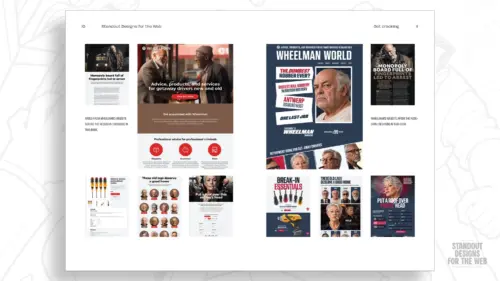
Prominent web designer, author, and Stuff & Nonsense founder Andy Clarke has officially released a new e-book, Standout Designs for the Web, aimed at encouraging digital creators to push past familiar templates, predictable layouts, and conventional styling in pursuit of more personality-driven websites. Drawing from a rich career spanning three decades in the industry, Clarke’s latest publication serves as a timely critique of modern web aesthetics, offering a thoughtful roadmap for injecting genuine character back into digital spaces.
The e-book explores how fundamental design elements—such as storytelling, color theory, typography, imagery, and layout structures—can work in tandem to craft websites that users not only recognize, but truly remember. To understand the philosophy and motivations behind the project, industry observers have taken a closer look at the core ideas driving Clarke’s latest work, exploring why he believes the contemporary web has grown overly uniform and how designers can reclaim their creative edge.
What Made Andy Clarke Want to Write This Book?
Reflecting on his extensive experience spanning more than thirty years in the web design industry, Clarke notes that he cannot remember a time when practitioners had access to such an advanced array of tools, techniques, and technologies. Yet, despite this unprecedented technological leap forward, a striking visual homogenization has taken hold across the internet, leaving countless websites looking remarkably similar to one another.
Clarke is careful to clarify that he is not advocating for novelty design for its own sake, nor does he suggest that every website requires a radical, eccentric overhaul. Instead, his core observation is that somewhere along the line, the digital design community has grown a bit too comfortable relying on familiar patterns and predictable layouts. With Standout Designs for the Web, his objective is to encourage modern designers to rediscover the vibrant creativity and distinct personality that initially drew him into the web design field decades ago.
What’s Wrong With Websites Looking Similar? Is Familiarity a Good Thing?
A central theme in discussions surrounding modern user experience design is the value of familiarity. After all, users rely on established patterns to understand how websites function, and creating unnecessary friction just to appear unique is rarely a sound strategy. Clarke readily acknowledges the importance of these conventions, noting that there is no valid reason to make a digital product difficult to use simply for the sake of being different.
The underlying issue, according to Clarke, arises when this reliance on familiarity causes every design within a specific industry to look identical. Whether a user visits a hotel website, browses an insurance provider, or shops on an e-commerce platform, they should be able to perceive a distinct reflection of the actual company and brand behind the digital facade.
Clarke describes this pervasive lack of differentiation as "commodity design." In his view, commodity design is perfectly acceptable when a project calls for nothing more than passable execution, but it does little to make a brand genuinely recognizable or its website memorable. Rather than arguing against the use of established conventions altogether, Clarke challenges designers to make much more deliberate, thoughtful decisions regarding when and how those conventions should be applied.
What Does Storytelling Actually Mean for Web Design?
Discussions of storytelling in digital spaces often conjure images of lengthy corporate histories or pages overloaded with heavy marketing copy. However, Clarke approaches the concept from a much more foundational and visual perspective. In his view, every legitimate company possesses a story worth telling. That narrative might stem from its origins, the unique individuals driving the organization, its distinct brand personality, or an unexpected aspect of its everyday operations.
These narrative details possess the capacity to influence virtually every creative choice a designer makes, ranging from copywriting choices to the selection of color palettes, typography, custom illustrations, and page layouts. Clarke spends a significant amount of time engaging directly with clients in search of the specific traits that set them apart from competitors. Often, a minor detail mentioned almost in passing during an initial conversation serves as the primary inspiration for an entire design concept. The true art lies in recognizing which specific details warrant development and successfully translating those intangible traits into visual mediums.
Why Did Clarke Invent a Fake Company for Getaway Drivers?
To effectively demonstrate his abstract ideas within the book, Clarke took a creative and unconventional approach by inventing a fictional enterprise. "Wheelman" is a conceptual company tailored specifically for getaway drivers, providing the author with a playful vehicle for his explanations while liberating him from the practical constraints and compromises typical of real-world client projects.
Complete with colorful characters, criminal connections, and highly questionable business activities, Wheelman gave Clarke ample room to experiment with extreme forms of brand personality. However, a serious methodology underpins this playful exercise. Clarke utilizes the fictional company to illustrate how a strong, distinct organizational character can successfully influence ordinary business pages, e-commerce platforms, editorial content, and even mundane transactional forms. By demonstrating that even a donation form designed for retired criminals can be made engaging and unique, Clarke aims to prove that designers working on everyday corporate websites have no valid excuse to shy away from injecting personality into their work.
Challenging the Twelve-Column Grid and Modern Layout Dependencies
Another major focal point of the e-book is a direct challenge to the ubiquitous twelve-column grid system, which Clarke argues has become the default setting for modern web design. While twelve-column grids are undeniably familiar and useful, Clarke points out that they represent only one of many possible methods for organizing content. When designers automatically initiate every new project with a standard twelve-column framework, they risk narrowing their creative possibilities before they have even taken the time to analyze what the specific content truly demands.
Within the pages of Standout Designs for the Web, Clarke delves into alternative layout structures, including column grids, compound grids, modular grids, proportional ratios, and the careful interplay between symmetry and asymmetry. Through these explorations, he demonstrates various ways to establish compelling rhythm and movement across a digital page. Clarke is not suggesting that designers should completely abandon column grids altogether; rather, he wants practitioners to develop a deeper understanding of layout theory so they can choose the exact type of grid required—or thoughtfully combine several—to elevate the visual interest of their work.
Cultivating Greater Curiosity in Future Web Design Projects
When asked about the primary takeaway he hopes readers will internalize after finishing his e-book, Clarke points toward the cultivation of professional curiosity. Before launching design software like Figma or Sketch, selecting a typeface, or settling on a structural layout, he encourages designers to invest more time in uncovering the specific traits that make a client’s business genuinely interesting.
Following that initial discovery phase, Clarke urges designers to critically evaluate their own early creative decisions. Professionals should continually ask themselves whether a chosen layout genuinely serves the content or if it is merely a familiar default, whether the selected typography truly captures the brand’s personality, and whether custom illustrations might communicate a concept more effectively than generic stock photography or AI-generated imagery.
While Clarke does not expect every single website on the internet to be extraordinary, nor does he believe that every design must aggressively break conventions, he ultimately wants practitioners to feel more confident making deliberate, bold choices that imbue their digital work with lasting character.
Standout Designs for the Web is currently available for purchase through the CSS-Tricks store.