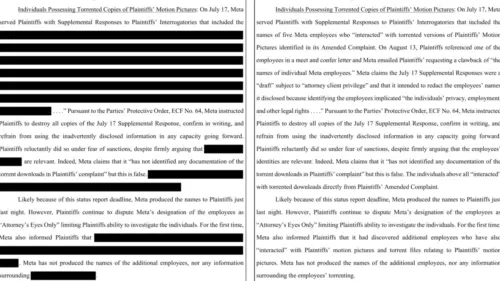
The bizarre legal battle between prominent private torrent trackers and a self-proclaimed filmmaker who filed a series of copyright lawsuits took another unusual turn this week. The individual litigating under the name "Matthew
Schneider" failed to appear for a crucial federal court hearing designed to confirm his true identity, leaving the judge, defense attorneys, and the court itself waiting in an empty virtual courtroom.
The ongoing legal drama centers on a series of lawsuits filed against several high-profile private torrent trackers, including PassThePopcorn and BroadcasTheNet. Although the plaintiff voluntarily dropped his copyright claims against the platforms, the lingering fallout involves severe sanctions sought by remaining anonymous defendants, known in court filings as Doe defendants. These defendants have aggressively pushed back, arguing that the entire legal action is built on questionable foundations and demanding accountability from a plaintiff whose very existence and background have become matters of intense judicial scrutiny.
Last month, an Illinois federal court issued a direct order requiring the individual styling himself as Matthew Schneider to definitively prove his identity. The directive came amid mounting skepticism over who was actually behind the filings. The self-proclaimed filmmaker was explicitly instructed to email verifying documentation—including his passport, driver’s license, and official U.S. Copyright Office paperwork—directly to the courtroom deputy by October 9.
Instead of complying with the court’s explicit instructions, the plaintiff missed the deadline. Rather than submitting the required documents through the established channels, he subsequently offered an alternative arrangement: he would display a single apostilled United Kingdom identification document exclusively to the judge, keeping it out of the hands of the opposing counsel and the broader public record.
This maneuver set the stage for a high-stakes status hearing before U.S. District Judge Andrea R. Wood. The judge intended to question the plaintiff directly about his sudden change of approach and his failure to submit the mandatory verification materials on time. However, Judge Wood never got the opportunity to pose those questions, as the plaintiff simply never logged into the proceedings.
No Show
The status hearing was scheduled for 11:00 AM Chicago time to be conducted via video conferencing technology. As courtroom proceedings commenced, the courtroom deputy called for the plaintiff twice, but there was no response, neither on video nor by telephone. Court staff also attempted to reach him via email, but that communication similarly went unanswered.
After waiting for approximately twenty minutes to account for any potential technological glitches or minor scheduling mishaps, Judge Wood decided to move forward with the hearing anyway.

"We waited long enough to account for any reasonable delay," Judge Wood remarked during the session, expressing the court’s growing frustration with the plaintiff’s pattern of procedural evasion.
This absence stood in stark contrast to a previous video hearing held the month prior, during which the plaintiff did dial in, though restricted to audio only. At that time, he cited technical difficulties on his end as the reason for his lack of video feed. Anticipating similar issues, Judge Wood had specifically instructed him to test his video connection with the court well in advance of this week’s scheduled status conference. That advance testing never took place, culminating in his complete failure to log on or call in for the hearing altogether.
Despite the blatant disregard for the court’s schedule, Judge Wood refrained from immediately issuing the harshest possible penalties. Instead, she exercised judicial restraint by granting the plaintiff a final window of one week to submit a formal, written explanation detailing why he failed to appear for the mandatory status conference.
The consequences for failing to respond adequately to this new directive are severe. If the plaintiff neglects to provide a satisfactory explanation within the allotted timeframe, he will forfeit his ability to seek any further discovery in the case. Furthermore, his own previously proposed discovery requests directed at the defense will be summarily discarded, effectively cutting off his offensive legal maneuvers.
‘Absurd’
During the hearing, defense attorney Erin Russell, representing Doe #1, voiced intense frustration regarding the prolonged procedural delays. Russell argued that the pending discovery requests and third-party subpoenas need to move forward as rapidly as possible. She emphasized a critical logistical concern: certain vital digital evidence, most notably internet protocol (IP) address logs, is preserved by network operators and service providers for only a strictly limited duration before being permanently deleted.
"It’s absurd that we are conducting discovery to figure out who the plaintiff in this lawsuit really is," Russell told the court, summarizing the exasperation shared by the anonymous tracker operators caught up in the litigation.
The third-party subpoenas proposed by the defense last month represent a calculated effort to unmask the individual behind the "Matthew Schneider" persona. Among the targeted entities is the PACER Service Center, from which the defense hopes to subpoena the specific IP addresses utilized by the plaintiff to access the federal court’s electronic filing and docketing website. Additionally, Russell highlighted a mail-drop address located in Sanborn, New York, associated with the plaintiff, which could potentially hold critical forwarding records revealing his actual physical whereabouts and mailing history.
While the plaintiff faces immense pressure to validate his identity, the operators of the private trackers maintain their anonymity for the time being. Judge Wood directed the tracker operators to file their true identities with the court under seal—a standard procedural safeguard routinely granted to litigants operating under pseudonyms. The judge indicated that she would subsequently evaluate the nuanced legal question of whether defendants who remain anonymous under seal possess the legal standing to seek sanctions against a plaintiff.
While offering no guarantees as to how she will ultimately rule on the sanctions motion, Judge Wood pointedly noted that the plaintiff’s repeated failure to show up and participate in his own lawsuit makes it increasingly difficult to justify granting him access to the defendants’ real names and personal identifying information, particularly when he refuses to appear to defend against the active sanctions motions.
To address the privacy concerns surrounding the ongoing unmasking process, the defense team will draft a comprehensive protective order. This order will strictly govern whatever sensitive information comes to light regarding the plaintiff’s true identity and residential address through the authorized discovery process—a protective measure that both legal sides had previously agreed upon in principle back in October.
Discovery Fight
The contentious hearing was originally designed to resolve a flurry of discovery requests and formal objections filed by both sides throughout October. The plaintiff’s own set of discovery questions had arrived four days past the deadline and essentially attempted to turn the tables on the defending tracker operators. Among other things, the plaintiff demanded that the defense attorneys formally admit that they had directly contacted the judge’s chambers in an effort to delay unfavorable rulings, and that they had never actually viewed his independently produced film, titled Do Us Part, prior to filing their aggressive sanctions motion against him.
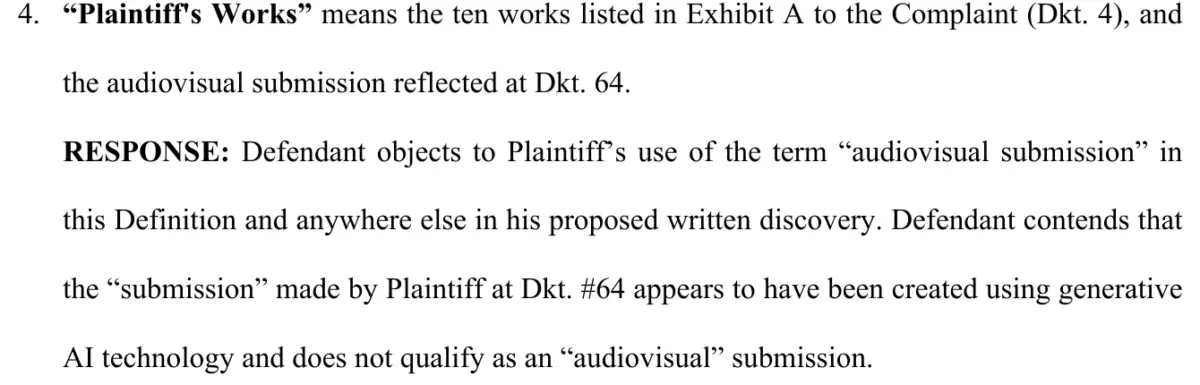
The defense swiftly objected to all of these inquiries. In its formal written objections, Doe #1 raised a startling evidentiary challenge, asserting that the film submitted by the plaintiff as foundational evidence in September "appears to have been created using generative AI technology and does not qualify as an ‘audiovisual’ submission."
Adding to the barrage of challenges, Doe #10 pointed out in a separate filing that the plaintiff had consistently failed to provide any substantive evidence or legal registration materials for the ten separate works over which he initiated the multi-tracker copyright lawsuit.
"Plaintiff has not produced a registration certificate, application, or deposit copy for any of them," the legal filing explicitly noted, throwing the legitimacy of the underlying copyright claims into even deeper doubt.
Judge Wood announced that she will address the competing discovery requests, objections, and AI-related evidentiary disputes in a forthcoming written order.
As the matter stands, the overarching mystery surrounding the true identity of the person who initiated the lawsuits against the private trackers remains entirely unresolved. The court has scheduled the next status hearing for December 17. Unlike the virtual proceedings that have marked recent developments, Judge Wood mandated that this upcoming hearing must take place in person in Chicago. The judge further noted that the travel expenses and financial costs incurred by the defense in order to attend the in-person hearing in Chicago may ultimately be factored into the costs the defense attempts to recover from the plaintiff.