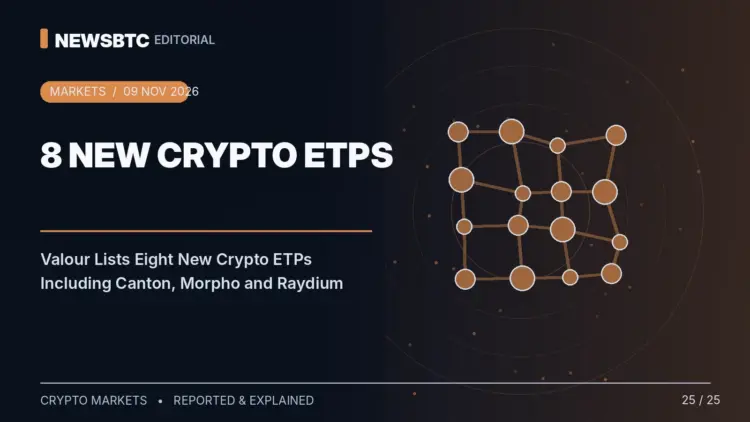
Valour, a prominent subsidiary of crypto investment firm DeFi Technologies, has significantly broadened its product lineup on the Swedish Spotlight Stock Market. In an announcement released on November 5, the issuer confirmed the rollout of eight new digital asset exchange-traded products (ETPs), marking a strategic shift beyond standard, highly established cryptocurrencies into a diverse mixture of decentralized finance protocols, blockchain infrastructure networks, and speculative community-driven tokens.
The strategic expansion introduces a wide array of specialized digital assets into a familiar securities-market wrapper, granting eligible investors conventional brokerage access to segments of the crypto economy that historically required specialized wallets and complex onchain interactions. However, the sheer variety of the newly listed instruments underscores a critical nuance for market participants: understanding the distinct mechanics, risks, and underlying mechanics of each individual product is more important than ever.
The Eight Underlying Assets
The newly minted SEK-denominated products reference a vastly eclectic group of underlying digital assets: Venice Token (VVV), Canton Coin (CC), Raydium (RAY), Morpho (MORPHO), Maple (SYRUP), Pump.fun (PUMP), Dogwifhat (WIF), and Bonk (BONK).
These assets represent drastically different corners of the digital asset landscape. Some of the included tokens connect directly to decentralized lending markets, automated market-making trading platforms, or sophisticated institutional blockchain networks. Others derive their demand almost entirely from online community engagement, viral internet culture, and pure token speculation.
Industry analysts emphasize that presenting these eight distinct offerings as part of a single, cohesive crypto investment strategy would be misleading. A buyer who purchases one of these listed products receives direct financial exposure exclusively to that specific token and the contractual terms outlined in the ETP prospectus, rather than a diversified, balanced basket spanning all eight assets. Each product stands alone, carrying its own unique risk-and-reward profile.
Why the Securities Wrapper Matters
For many traditional investors, the primary appeal of an exchange-traded product lies in its accessibility. By wrapping digital assets inside a conventional securities structure, issuers allow eligible market participants to gain exposure through standard brokerage accounts. This eliminates the operational hurdles of maintaining self-custody wallets, safeguarding private keys, and executing complex token transfers across various blockchain networks. Furthermore, it streamlines record-keeping and tax reporting within traditional financial jurisdictions.
Yet, financial experts caution that a securities wrapper does not fundamentally alter the underlying nature of the asset, nor does it automatically provide the same legal protections or regulatory frameworks associated with conventional equity mutual funds or exchange-traded funds holding traditional stocks.
Investors evaluating these products are advised to examine several structural details: whether the ETP is physically backed by the underlying tokens, how institutional custody is managed, what management fees are levied by the issuer, and how efficiently the creation and redemption mechanisms operate during periods of high market volatility. While the securities wrapper successfully removes certain operational burdens, the core market risk tied to the price volatility of the underlying cryptocurrency remains fully intact.
A Wide Spectrum of Token Risks
The sheer diversity of the eight underlying assets highlights a wide spectrum of token risks. Projects like Canton and Morpho are closely associated with institutional-grade blockchain architectures and advanced decentralized finance (DeFi) infrastructure. Raydium operates as a prominent trading hub within the Solana ecosystem, while Maple facilitates onchain credit markets for corporate borrowers.
In sharp contrast, meme-linked tokens such as Dogwifhat and Bonk have historically depended heavily on fleeting market sentiment, viral social media trends, and speculative community momentum. Meanwhile, exposure to platforms like Pump.fun brings an entirely separate set of commercial, operational, and regulatory considerations to the table.
While none of these classifications definitively dictate future performance, these fundamental differences are crucial for proper portfolio construction and rigorous due diligence. Crucially, the mere presence of a regulated trading venue listing an ETP does not constitute an official regulatory endorsement or guarantee of the underlying token’s intrinsic economic value.
Trading in Swedish Kronor Adds Another Consideration
Because these new products are quoted and settled in Swedish kronor (SEK), investors whose reference currency is different must factor currency exchange-rate fluctuations into their overall return calculations alongside the spot price movements of the underlying tokens.
Additionally, trading hours and market liquidity on traditional stock exchanges differ significantly from the around-the-clock, 24/7 nature of global cryptocurrency markets. This temporal mismatch can occasionally create wider bid-ask spreads or noticeable price gaps when significant token movements occur while the traditional securities venue is closed for the evening or weekend.
Market participants are advised to carefully examine the issuer’s market-making arrangements and monitor the tracking difference between quoted market prices and indicative net asset values. Assuming that an exchange listing automatically guarantees a tight execution price during turbulent market conditions can lead to unexpected execution costs.
A Useful Signal, with Limits
Valour’s latest expansion illustrates the ongoing efforts by financial product issuers to test institutional and retail demand for increasingly specialized crypto exposures packaged through familiar financial channels. Whether these eight new products develop into meaningful, long-term investment options will ultimately depend on sustained trading volumes, competitive management fees, robust custody disclosures, and genuine investor interest extending well beyond the initial launch week.
For broader market observers, the significance of the development lies less in the addition of eight fresh ticker symbols and more in the continuous push to bridge niche digital assets with traditional brokerage accounts—alongside the necessary safeguards required as retail and institutional investors follow them there.
The launch builds upon ongoing shifts in global digital asset markets, where established products like spot Bitcoin ETFs continue to see dynamic institutional flows and shifting market sentiment across international jurisdictions. As traditional financial markets increasingly intersect with decentralized ecosystems, the expansion of regulated wrappers highlights both the growing demand for accessibility and the enduring responsibility of investors to conduct thorough due diligence.