
A federal magistrate judge has ordered Meta to disclose the names of employees and decision-makers involved in using BitTorrent to download pirated books and scholarly articles from shadow libraries for its Llama artificial intelligence models. The ruling marks a significant escalation in ongoing legal battles centered on copyright infringement and digital piracy.
Magistrate Judge Thomas Hixson issued the order following a dispute between Meta and publisher Entrepreneur Media, one of several entities pursuing legal action against the tech giant. While a U.S. court previously ruled that training AI models on copyrighted books constitutes fair use under certain conditions, claims surrounding Meta’s use of BitTorrent to acquire and potentially distribute the material remain an active and contentious part of the litigation.
The latest discovery order mandates that Meta identify individuals who participated in discussions regarding the use of torrent networks, authorized the acquisitions, or managed technical seeding settings during the data collection processes spanning from 2022 to 2024.
The Background of Meta’s Data Collection and Legal Battles
The legal scrutiny stems from class-action lawsuits and independent complaints filed by authors, creators, and publishers—including high-profile authors like Richard Kadrey and Sarah Silverman, alongside Entrepreneur Media, the publisher of Entrepreneur magazine. These lawsuits accuse Meta of not only acquiring datasets containing unauthorized copies of books and research papers from shadow libraries like Library Genesis (LibGen) and Anna’s Archive, but also actively contributing to piracy through the mechanics of peer-to-peer file sharing.

BitTorrent protocols inherently involve both downloading (leeching) and uploading (seeding) data simultaneously, meaning that clients connected to a torrent swarm typically share fragments of files with other users across the network.
While the court previously handed Meta a partial victory by determining that the ingestion and training phases of its AI models fell under fair use protections, the BitTorrent distribution claims survived. Rightsholders argue that even if training an AI on copyrighted text is legally permissible, the act of seeding unauthorized copies to third parties via torrent networks constitutes contributory copyright infringement.
To probe these allegations, plaintiffs have sought to uncover the exact sequence of events, technical configurations, and internal decision-making processes that preceded Meta’s downloads. Last month, Magistrate Judge Hixson ordered Meta to hand over the command histories of the servers it used to torrent the pirated materials, logs that are expected to reveal how the torrent clients were set up and whether upload settings were actively modified. However, publishers maintained that understanding the technical logs was only part of the puzzle; they also needed to know who within the corporate hierarchy authorized the activity.
‘Technical Decisions’ vs. Corporate Accountability
In subsequent legal filings, Entrepreneur Media asked Meta to identify every individual who "made, authorized, or approved" the decisions to acquire shadow library datasets using BitTorrent.
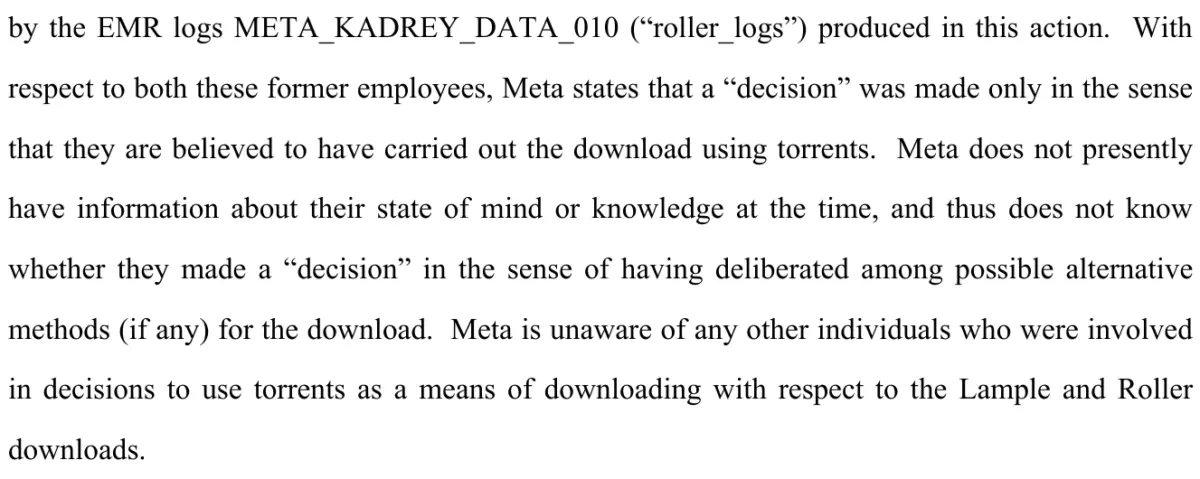
Meta’s responses pointed to several employees involved in data handling, but the company maintained it could not identify anyone who "formally" made or approved decisions to acquire or use books for its first two iterations of the Llama models. According to Meta, those acquisition paths were frequently the result of organic team consensus rather than top-down executive directives. When questioned specifically about the torrenting activity, Meta characterized the choices made by engineers as routine technical decisions.

Furthermore, Meta noted that the acquisition of data from Anna’s Archive underwent an internal legal review in early 2024 involving its in-house legal team. However, the company stopped short of naming high-level executives or managers who explicitly greenlit the deployment of BitTorrent protocols.
This defense drew sharp criticism from the plaintiffs. Entrepreneur Media countered that under Meta’s construction of events, no actual person at the company decided to utilize torrents, yet corporate servers repeatedly accessed shadow libraries using BitTorrent between 2022 and 2024.
Internal Warnings and ‘Legally Not Okay’ Logbooks
The question of corporate awareness and intent is further complicated by internal records discovered during the discovery phase. Testimonies and internal logbooks revealed that the legal and ethical implications of using BitTorrent were discussed internally by engineering teams, with explicit steps occasionally proposed to limit peer-to-peer uploading.
One internal Meta logbook, reviewed by an employee prior to initiating a download from Anna’s Archive, documented a deliberate conversation regarding file-sharing mechanisms. As quoted in Entrepreneur Media’s court filings, the logbook entry reads: "Decided to go with direct file uploads without using torrents for the following reasons: Using torrents would entail seeding the file such as sharing content outside. This would be legally not okay."
Despite such internal acknowledgments, Meta does not dispute that it ultimately utilized BitTorrent to download LibGen’s Scimag collection and data from Anna’s Archive. The company maintains that it is unaware of any individual who specifically approved an unauthorized distribution or upload of the data, emphasizing that measures were implemented to mitigate seeding.
The exact volume of data redistributed by Meta remains a subject of debate. An expert report submitted by Meta last year estimated that uploads from its Amazon Web Services (AWS) servers accounted for roughly 30 percent of the total volume downloaded during torrent operations conducted between April and July 2024.
The Court’s Ruling on Discovery and Group Responsibility
Faced with a stalemate over interrogatories, Magistrate Judge Hixson intervened and ruled in favor of Entrepreneur Media. The judge dismissed Meta’s assertion that it lacked further information regarding the torrenting decisions, noting that the plaintiffs’ inquiries were not restricted to formal, written executive approvals.
Judge Hixson emphasized that because Meta characterized its decision-making as collaborative team consensus, the company is legally required to identify every individual who participated in those groups. The ruling explicitly mandates that Meta must name the participants in the internal discussions preceding the 2023 LibGen torrent download, the individuals who approved the transition to BitTorrent, and those who authorized the April 2024 download from Anna’s Archive.
Additionally, the judicial order compels Meta to disclose the identities of anyone who decided "whether or how to seed, or to mitigate seeding," during the acquisition of the pirated collections.
For publishers like Entrepreneur Media, these disclosures are critical for establishing willfulness, which can significantly impact statutory damages, alongside supporting their ongoing claims of contributory copyright infringement and unauthorized distribution.

While the immediate dispute centers on corporate transparency and the identification of personnel, the broader legal battles continue to test the boundaries of copyright law in the age of generative artificial intelligence. The fundamental questions of whether Meta’s torrenting practices constituted actionable copyright infringement or distribution, and whether those actions are shielded by fair use doctrines, remain to be adjudicated by the court.


Leave a Reply