
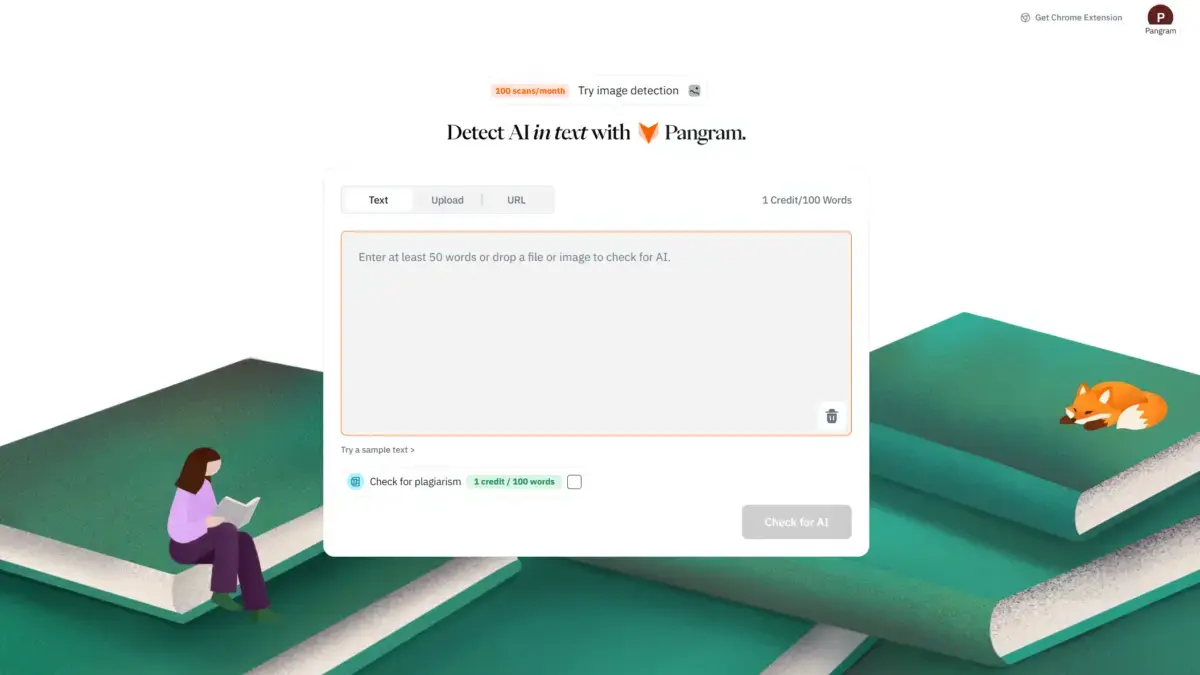
Founded in 2023, Pangram has rapidly ascended the ranks to become one of the most popular and formidable AI detection tools on the market today. Amid an increasingly crowded digital landscape where distinguishing between human and machine-generated writing grows more difficult by the day, Pangram makes some bold assertions regarding its capabilities. Its latest iteration, Pangram 4, claims to successfully catch fully AI-generated text, writing that seamlessly blends human and AI input, and even passages that have received light, careful human edits to mask their synthetic origins.
Furthermore, the company reports an exceptionally low false-positive rate in its internal testing—roughly 1 in 24,000 with its newest model. Alongside its core AI detection engine, Pangram also packs a comprehensive suite of features, including built-in plagiarism checking, document uploads, and support for 24 distinct languages. While such a robust pitch sounds promising, the practical reality of AI detection is notoriously messy and fraught with edge cases. To determine how well the service performs under real-world conditions, reviewers put Pangram through a rigorous gauntlet of tests involving purely AI-generated text, unadulterated human writing, blended passages, heavily edited texts, and common adversarial tricks designed to throw off automated classifiers.
What Features Does Pangram Offer?
Pangram operates differently from many legacy AI detectors that rely heavily on perplexity—a metric measuring how predictable a piece of writing appears to an underlying language model. Instead, Pangram utilizes a specialized classifier trained specifically to recognize the distinct patterns associated with human versus AI authorship. It then estimates whether a given passage was crafted entirely by a person, generated by an artificial intelligence model, or produced via a collaborative process involving AI generation paired with human editing.

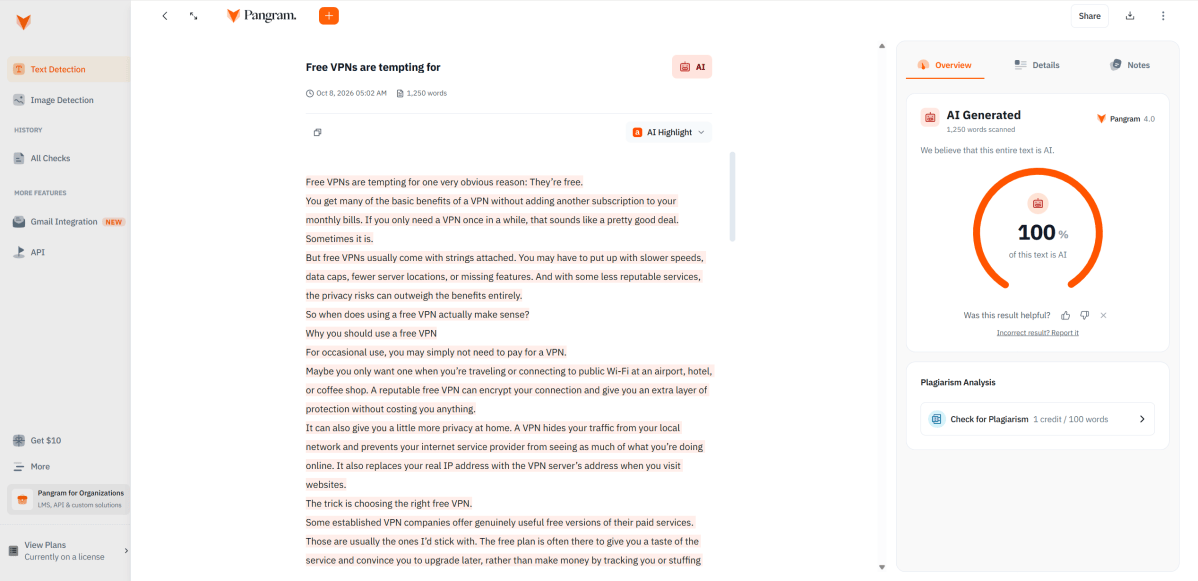
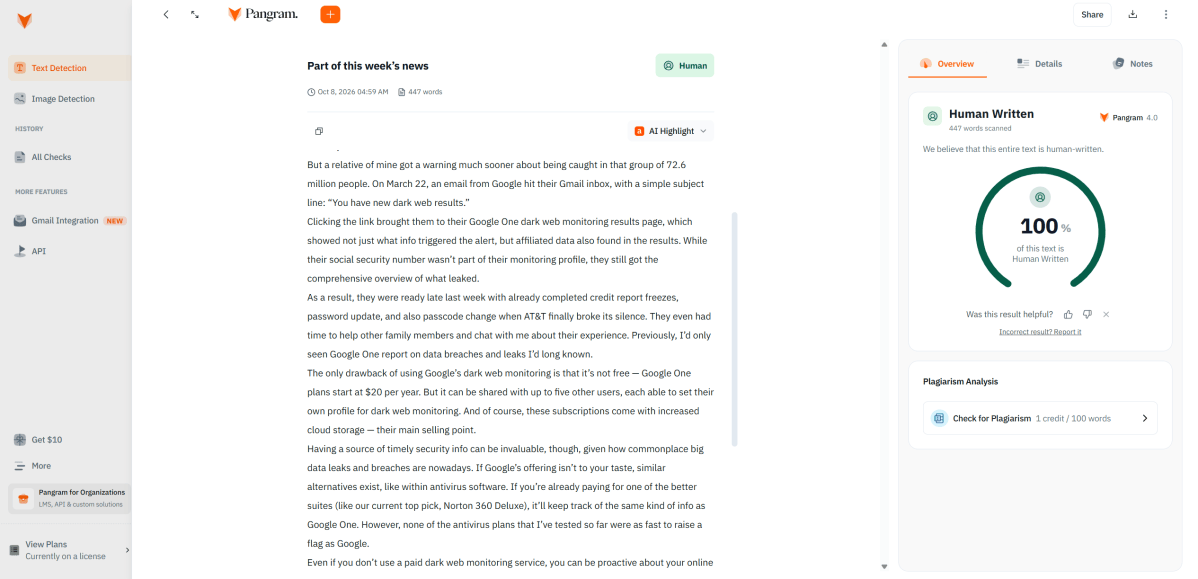
Like many services in this sector, Pangram provides an overarching AI detection score ranging from 0, representing entirely human writing, to 100, indicating fully AI-generated content. For longer documents, the system automatically segments the text, highlighting specific passages based on their individual classifications. This granular level of detail serves as a primary selling point. Unlike competing detectors that assign a single, broad label to an entire document, Pangram dives deep into the text, flagging precise sentences and paragraphs it believes originate from an artificial intelligence model.
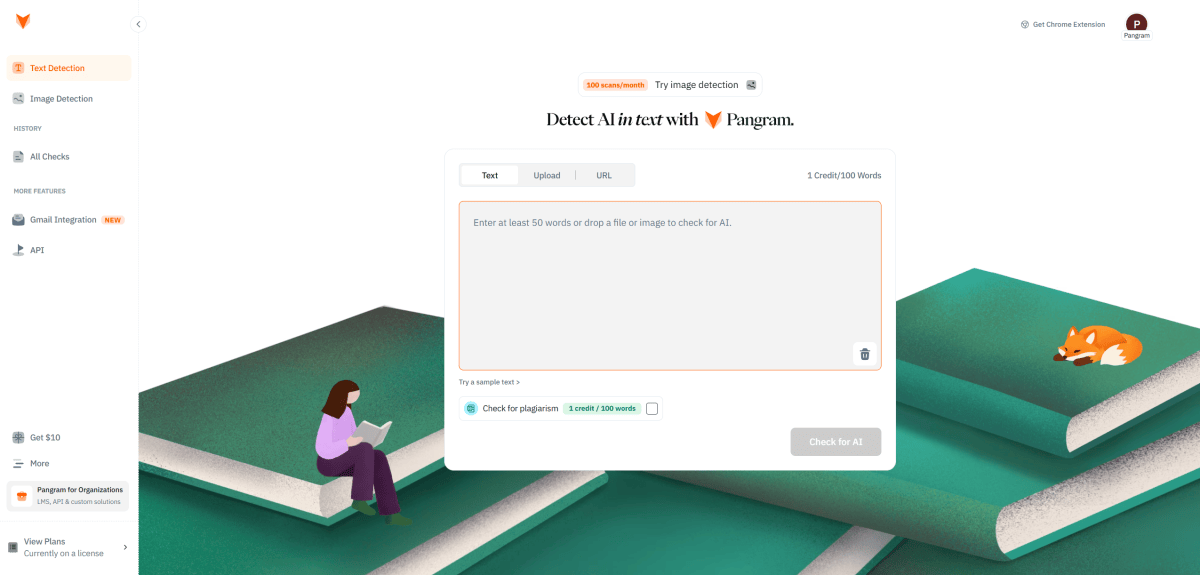
Following an analysis, the dashboard color-codes the text to make the results easily digestible. Rather than presenting definitive conclusions, Pangram frames its statistical results as helpful guidance, encouraging users to read deeper rather than relying blindly on a single score. The web interface itself is exceptionally clean and streamlined. A prominent text box sits squarely in the center for quick copy-pasting, while a sidebar provides access to dedicated tabs for Text Detection, Image Detection, Scan History, Gmail Integration, and the platform’s API.
Users can paste text directly, upload documents in PDF, DOCX, and RTF formats, or process scanned documents using optical character recognition (OCR). The system supports batch uploads of up to 100 files simultaneously and maintains a comprehensive history of past scans so users can retrieve reports at a later date. Additionally, the platform allows users to input a webpage URL to scan its contents directly.

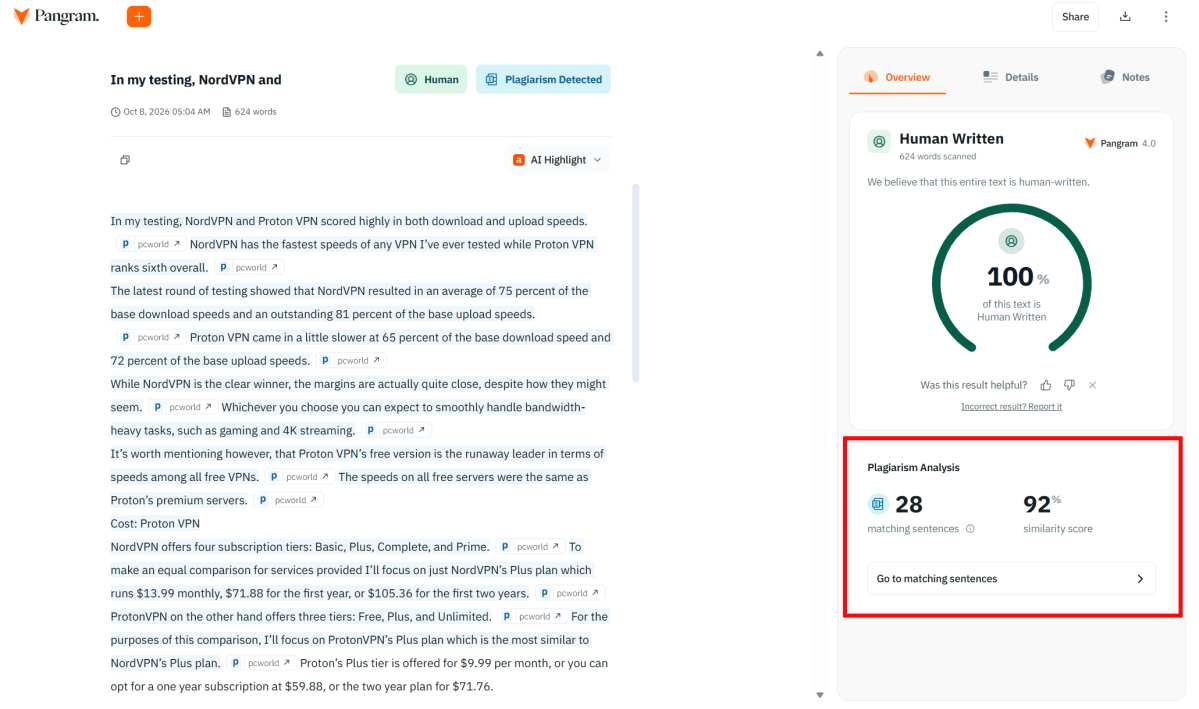
Beyond the web dashboard, Pangram offers browser extensions for both Chrome and Firefox, allowing users to highlight and scan text directly on any webpage. The service also integrates smoothly with Google Docs and popular educational management platforms such as Canvas, Moodle, Blackboard, and Google Classroom. For paid subscribers, the platform includes a robust plagiarism checker that operates in tandem with the AI detector, flagging matching passages separately and providing direct links to original source material. An API is also available for automated, continuous bulk processing, returning both overall document classifications and detailed segment-level data.
How Much Does Pangram Cost?
Pangram operates on a freemium model, offering a functional free tier alongside several structured paid subscription plans. The Free plan permits up to 2,000 words per day and includes essential features such as file uploads, OCR processing, browser extensions, Google Docs integration, and limited AI image detection. However, the built-in plagiarism checking tool is excluded from the complimentary tier.
For individual power users, the Individual plan costs $20 per month, or drops to $15 per month when billed annually at $180 for the year. This tier expands the allowance to 300,000 words per month, grants 100 image scans, unlocks full plagiarism detection, and adds advanced scanning capabilities. A seven-day free trial is available for prospective subscribers wishing to test the platform.
Larger organizations and professionals can opt for the Professional plan, priced at $65 per month, or $45 per month when billed annually at $540 for the year. This plan significantly increases monthly limits to 1.5 million words and 500 image scans, while also bundling $200 in monthly API usage credits. Broken down on a per-word basis using the annual Individual plan pricing, the cost equates to approximately $5 per 100,000 words.
How Well Does Pangram Detect AI-Generated Text?
To rigorously evaluate Pangram’s efficacy, testers subjected the platform to a diverse set of 50 distinct text samples divided evenly across five categories: 100 percent human-written prose, 100 percent AI-generated text, human-written text with light AI edits, AI-generated text with light human modifications, and mixed passages combining roughly equal parts human and machine writing.
Overall, Pangram delivered impressive performance, shining brightest when dealing with clear-cut, unedited content. It accurately classified every single 100 percent human-written and 100 percent AI-generated sample, regardless of which major conversational AI model was used to produce the text—including ChatGPT, Claude, Gemini, and Grok.
Complications arose, however, once human editing entered the equation. The detector displayed a tendency to view mixed or edited texts through an all-or-nothing lens. While it successfully flagged most of the AI-heavy texts with a cautionary warning indicating the passage appeared to have been paraphrased or rewritten, it often failed to isolate the exact nuances of human intervention. This suggests that while Pangram excels at catching untouched artificial output, it encounters predictable hurdles when faced with heavily revised and reshaped prose.
When tested specifically against pure AI text, Pangram achieved a flawless score. Ten entirely AI-generated samples sourced from ChatGPT, Claude, Gemini, and Grok were all flagged as 100 percent artificial on the first pass. Consistency tests involving multiple scans of the exact same ChatGPT sample returned identical, perfect AI scores every single time, demonstrating that the system reliably recognizes the foundational signatures of major language models without relying on the stylistic quirks of a single chatbot.
When evaluating human-written text, Pangram performed equally well. Across 10 entirely human-authored samples, the platform returned a 0 percent false-positive rate, consistently identifying every passage as completely human-written across repeated scans. While external factors such as writing style, document length, specialized topics, and language nuances can theoretically influence outcomes, the platform demonstrated strong reliability in avoiding false accusations of synthetic authorship.
The platform encountered more significant challenges when analyzing edited text. In evaluations of AI-generated samples that were subsequently subjected to substantial human revision—resulting in roughly a 75 percent AI and 25 percent human composition—Pangram successfully identified only three out of five samples. Similarly, tests involving primarily human-written text infused with light AI contributions resulted in several samples being misclassified entirely as human-written. Mixed texts, where whole paragraphs were swapped out, fared somewhat better, with the system accurately pinpointing the locations of the inserted artificial segments despite minor inaccuracies in overall percentage estimation.
How Does Pangram Handle Privacy and Data?
Data privacy remains a paramount concern for users of AI detection tools, and Pangram maintains transparent policies designed to reassure cautious users. Scans executed within the web dashboard are saved to the user’s scan history and remain stored until manually deleted or until the user closes their account. Deleting a specific scan purges the corresponding text from Pangram’s active servers, retaining only a minimal record of the transaction for billing and operational analytics. Account closures trigger a complete data deletion within 30 days.
Crucially, Pangram explicitly states that it does not utilize user-submitted text to train its underlying detection models, relying instead on licensed datasets and internally generated corpora. The company asserts that it neither sells user data nor shares it for third-party advertising purposes. Infrastructure and payment processing are handled through established enterprise providers, namely Amazon Web Services for cloud hosting and Stripe for payment execution, both of which are bound by strict data usage restrictions.
Pangram maintains compliance with global privacy frameworks, including the General Data Protection Regulation (GDPR). European users should note, however, that standard accounts store data on servers located within the United States rather than the European Economic Area. The platform’s commitment to a strict no-training policy and user-controlled scan deletion represents a strong privacy posture within the AI detection industry, though handling sensitive documents with discretion remains advisable.
Is Pangram Worth It?
Pangram establishes itself as a top-tier contender in the AI detection market, driven by exceptional accuracy on unedited human and synthetic texts, a clean and responsive interface, and useful auxiliary features like integrated plagiarism checking and robust document management. While the platform struggles with heavily edited or mixed authorship—a limitation that continues to affect virtually all automated detectors—its overall polish and reliability make it a valuable screening tool.
Priced competitively at $20 per month for individual users, and supported by a capable free tier for casual testing, Pangram provides detailed, actionable insights rather than absolute verdicts. As digital content creation continues to evolve, tools like Pangram function best when paired with human oversight and critical editorial judgment.



Leave a Reply