
A federal magistrate judge has dealt a significant blow to Meta in an ongoing legal battle over intellectual property, ordering the tech giant to identify every employee involved in decisions to use BitTorrent to acquire pirated book datasets for artificial intelligence training.
The ruling, handed down by Magistrate Judge Thomas Hixson, addresses a persistent point of contention in copyright lawsuits brought against the company. While a court previously ruled that Meta’s use of copyrighted books to train its Llama AI models constituted fair use—providing the company with a major legal victory—the claims surrounding the company’s reliance on BitTorrent to gather data remain very much alive.
The latest development stems from a discovery dispute involving Entrepreneur Media, the publisher of Entrepreneur magazine, which filed a separate lawsuit accusing Meta of contributing to copyright infringement by uploading and seeding works to third parties via peer-to-peer networks.
Uncovering the Paper Trail and Server Logs
The conflict over who authorized the downloading and seeding of shadow library databases has occupied the court for months. Last month, Magistrate Judge Hixson ordered Meta to hand over the command histories of the servers it used to torrent pirated books from sources like Library Genesis (LibGen) and Anna’s Archive.

Those server logs are expected to shed light on how Meta’s torrent clients were configured, including whether adjustments were made to upload settings. However, obtaining technical logs is only part of the equation for plaintiffs like Entrepreneur Media, who have aggressively sought to pin down accountability by discovering which human actors greenlit the operations.
To that end, the publisher previously asked Meta to identify everyone who "made, authorized, or approved" decisions to obtain shadow library datasets using BitTorrent. In response, Meta pointed to several individuals allegedly involved in general data-related choices. Yet, the company maintained it could not single out anyone who "formally" made or approved decisions to acquire or use books for its first two iterations of the Llama large language models. Instead, Meta argued that those choices typically materialized through team consensus.
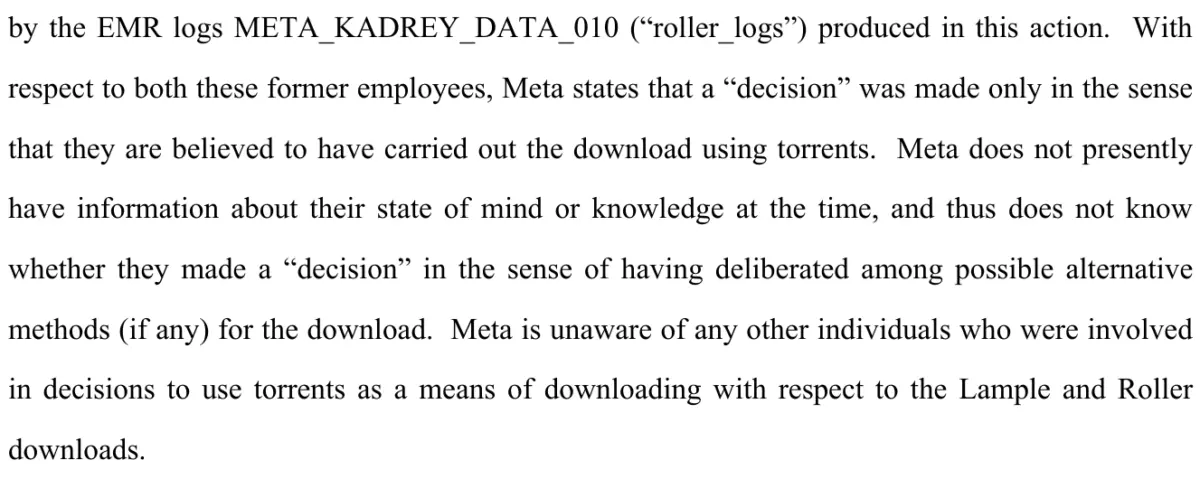
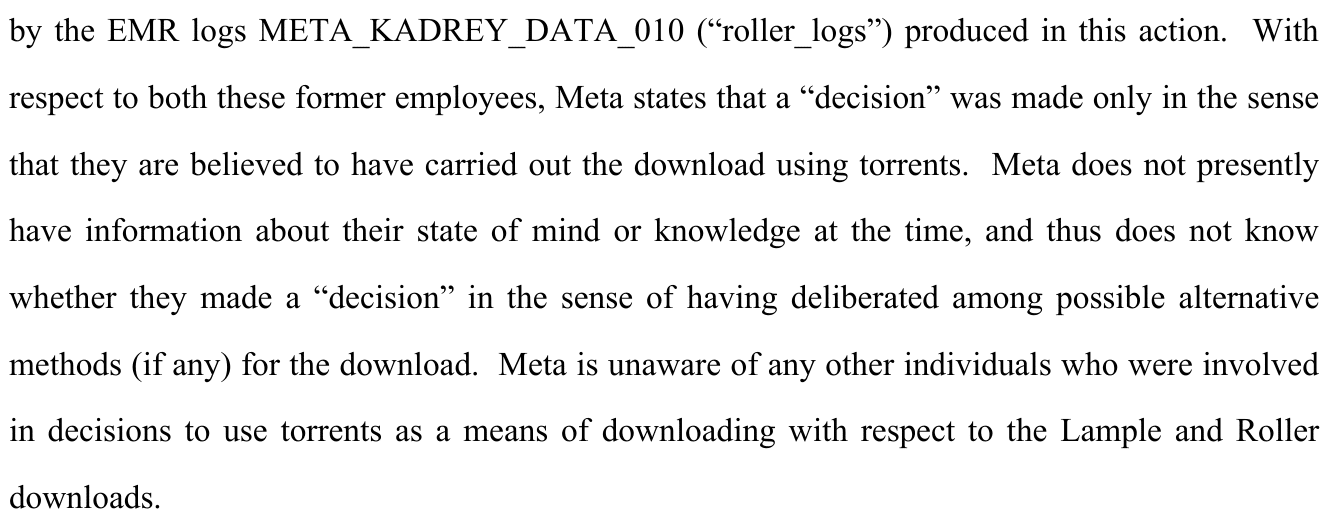
When questioned about the actual torrenting mechanics, Meta deferred to the rank-and-file engineers who executed the downloads, describing their actions as purely technical decisions. The company also noted that its acquisition of data from Anna’s Archive underwent an internal legal review in early 2024 involving in-house counsel, carefully avoiding the naming of high-ranking executives who might have sanctioned the protocol.
"On that construction no one at Meta decided to torrent anything, yet Meta torrented shadow libraries repeatedly from 2022 to 2024," Entrepreneur Media countered in court filings, highlighting the friction between the company’s organizational defense and its actual digital footprint.

‘Legally Not Okay’
The question of institutional awareness and approval becomes even more critical when examining internal records concerning seeding—the process of uploading pieces of files to other users on a BitTorrent network.
During discovery, testimony from an engineer who handled LibGen data revealed that the legal implications of seeding had been explicitly raised and discussed internally, prompting some technical measures aimed at limiting outgoing data sharing. An internal Meta logbook reviewed by an employee prior to executing a download from Anna’s Archive painted a revealing picture of internal reservations.
"Decided to go with direct file uploads without using torrents for the following reasons: Using torrents would entail seeding the file such as sharing content outside. This would be legally not okay," the logbook read, as quoted in Entrepreneur Media’s legal briefs.
Meta does not dispute that it utilized BitTorrent to download the Scimag collection from LibGen as well as massive datasets from Anna’s Archive. However, the company maintains it is unaware of any individual who explicitly authorized uploading or distributing the material, reiterating that protective measures were put in place to curtail seeding.
The exact volume of copyrighted material Meta shared with external peers remains a lingering question. Last year, an expert retained by Meta estimated that uploads originating from its Amazon Web Services (AWS) servers accounted for roughly 30 percent of the data volume downloaded during torrent operations conducted between April and July 2024.
The Court Weighs In on Group Responsibility
Magistrate Judge Hixson’s recent ruling effectively dismantles Meta’s defense regarding collaborative decision-making. Rejecting the notion that a lack of formal authorization shields the company from naming names, the judge emphasized that discovery requests are not limited to formal boardroom decisions.
The court noted that Meta’s prior answers largely addressed how the acquired data was utilized rather than how it was obtained or downloaded in the first place. Furthermore, Judge Hixson pointed out that because the interrogatories explicitly inquired about all decision-makers, the corporate reality of collaborative or team-based consensus means every individual involved must be formally identified.
Under the terms of the new order, Meta is required to name the individuals who participated in discussions preceding the 2023 LibGen torrent download. The company must also identify those who approved the transition to BitTorrent, as well as the individuals who greenlit the April 2024 download from Anna’s Archive.

Crucially, the directive extends to anyone who deliberated or decided "whether or how to seed, or to mitigate seeding," during the acquisition of the LibGen and Anna’s Archive collections.
For plaintiffs like Entrepreneur Media, these identifications carry significant weight. The publisher contends that uncovering who participated in these discussions directly bears on establishing willfulness, which is vital for substantiating contributory copyright infringement and illegal distribution claims.
While the discovery battle has largely centered on compiling a comprehensive roster of corporate actors, the broader legal questions remain open. Courts have yet to definitively determine whether Meta’s specific implementation of BitTorrent qualified as fair use or if the tech conglomerate can be held legally liable for distributing pirated books to external third parties.



Leave a Reply