
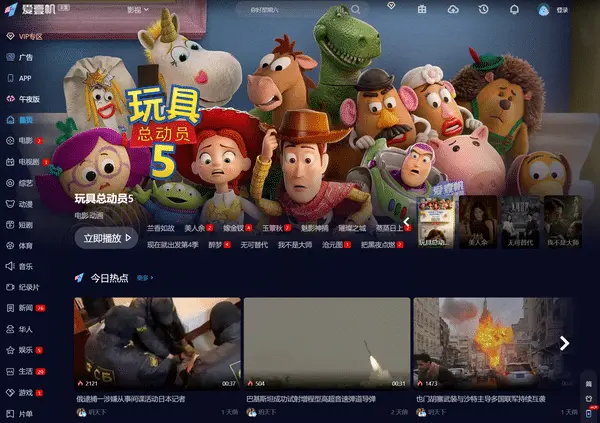
Chinese streaming giant iQIYI has secured a significant legal victory in a United States federal court against Aiyifan, a prominent pirate streaming platform catering to Chinese-speaking audiences residing outside of China. However, the outcome fell drastically short of the massive financial and operational penalties the company originally demanded, highlighting the complex jurisdictional and logistical hurdles international copyright holders face when targeting overseas digital piracy operations.
The ruling in the U.S. District Court for the Southern District of Florida marks the latest chapter in a broader, multi-continental legal offensive launched by major Chinese entertainment companies against unauthorized streaming portals. Last month, rival Chinese streaming titan Tencent successfully cleared the first procedural hurdle in its own U.S. legal battle against another major pirate platform, Olevod. In that case, a Florida judge ruled that the litigation could proceed domestically, paving the way for similar foreign copyright enforcement efforts in American courts.
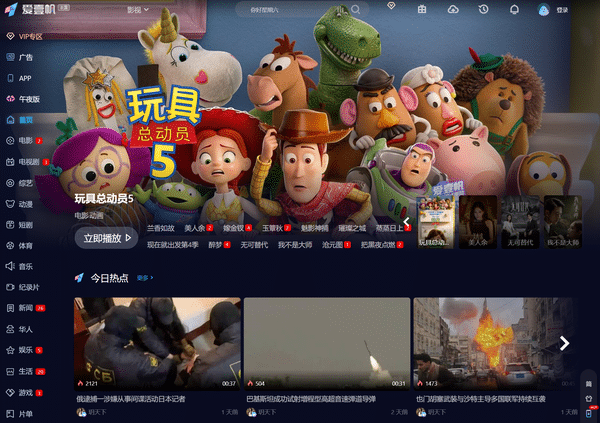
iQIYI initiated its civil lawsuit last year, utilizing the same legal team and judicial forum that Tencent would later employ. The target of the complaint, Aiyifan—which operates across multiple domains and aliases including YFSP and IYF, utilizing web addresses such as aiyifan.tv, yfsp.tv, and iyf.tv—remains a massive draw for online audiences. According to digital intelligence data from Similarweb, the platform’s primary portal, yfsp.tv, commanded approximately 14 million visits during the month prior to the ruling.
Despite the platform’s extensive reach and popularity among the overseas Chinese diaspora, the defendants chose not to participate in the American legal proceedings. Aiyifan never made an appearance in the Florida court, and its anonymous operators were never formally named as individual defendants in the U.S. complaint. Consequently, the court entered a default against the platform in July of last year, clearing the path for a default judgment.

While the civil case progressed through the American judicial system, the site’s operators were facing far more immediate and severe consequences on home soil in China.
Operator Jailed in China
While the civil litigation in Florida unfolded in a remote courtroom, the human architects behind the pirate network were experiencing the full weight of criminal law in the People’s Republic of China. In August, legal representatives for iQIYI formally updated the Florida court regarding a pivotal criminal proceeding that had concluded in Shanghai.
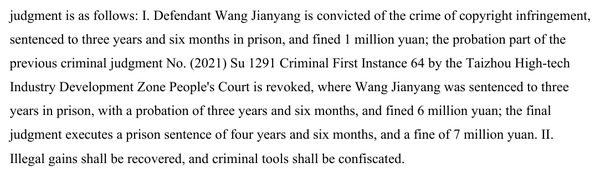
According to documentation submitted to the U.S. court, the Shanghai Third Intermediate People’s Court upheld the criminal conviction of Wang Jianyang, whom iQIYI identified as a primary principal behind the Aiyifan operation. The underlying judicial ruling details how Wang directed a corporate entity based in Chongqing that supplied essential technical infrastructure, website management, and software application support for the sprawling piracy network. Wang had been actively involved in maintaining and promoting the unauthorized platform since 2022.
Law enforcement authorities in China detained Wang in March 2024, a timeline that predated iQIYI’s initiation of its civil lawsuit in Florida by more than a year. The arrest compounded existing legal jeopardy for Wang, who was already burdened by a prior criminal conviction. Back in 2021, a judicial authority in Jiangsu province had handed down a three-year suspended prison sentence alongside a substantial fine of 6 million Chinese yuan for establishing and operating an entirely separate pirate streaming website.

The launch of Aiyifan occurred while Wang was still serving his probationary period. Consequently, in March of this year, a district court in Shanghai revoked the previous suspension, activated the original prison term, and appended an additional sentence of three and a half years, coupled with an extra 1 million yuan fine. Combined, Wang now faces a total prison sentence of four and a half years and financial penalties amounting to 7 million yuan.
Wang subsequently appealed the verdict, contending that the evidentiary support presented by prosecutors was insufficient and arguing that his professional involvement was strictly limited to providing neutral technical support services. The appellate court firmly rejected these arguments, concluding that his contributions were integral to the functioning and success of the illegal enterprise. That judicial ruling is now final, cementing his imprisonment.
Florida: $1.96 Million Instead of $196 Million
In the U.S. federal court, iQIYI initially pursued an aggressive strategy designed to shutter the pirate network permanently and cripple its financial foundations. Because Aiyifan utterly failed to respond to the initial complaint, the plaintiff sought an astronomical damages award totaling $196.55 million.
The calculation behind this gargantuan figure relied heavily on statutory maximum penalties under U.S. copyright law. iQIYI requested the statutory maximum of $150,000 for each of 776 formally registered works distributed on the platform, while thousands of additional unregistered works accounted for an extra $78.55 million in proposed statutory damages.
In January, U.S. District Judge Melissa Damian formally ruled that Aiyifan was indeed liable for copyright infringement. However, the court flatly rejected the proposed damages award, noting that it lacked proper evidentiary support and justification. In response to the judicial rebuff, iQIYI submitted a revised demand seeking a reduced sum of $54.4 million. Even this adjusted figure proved excessive under the scrutiny of the court.
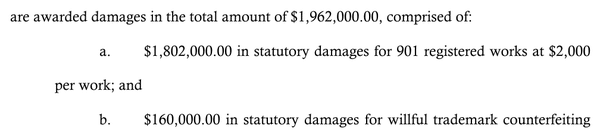
In a final order issued last week, Judge Damian formulated a drastically smaller financial penalty. The court awarded $1,000 per registered work, which was subsequently doubled to account for the willful nature of the infringement, resulting in a baseline figure of $1.8 million. This calculation encompassed a total of 901 registered works, as iQIYI had successfully processed additional copyright registrations while the litigation was actively pending.
Additional trademark infringement claims contributed another $160,000 to the final total. Conversely, the court declined to award any statutory damages whatsoever for the roughly 5,000 unregistered works cited in the complaint. This brought the ultimate financial judgment to $1.96 million—representing a mere one percent of iQIYI’s original monetary demand.
Judge Won’t Transfer Domains
The downward revision of monetary damages was not the only significant setback for the Chinese streaming enterprise. iQIYI had also petitioned the court for sweeping injunctive relief designed to incapacitate the piracy network’s digital infrastructure. Specifically, the streaming platform requested that the court order the outright transfer of Aiyifan’s primary domain names, compelling registrars to redirect incoming traffic directly to iQIYI’s own legitimate web portal.
Furthermore, the initial legal filings demanded that a broad coalition of third-party service providers—including internet service providers, web hosting companies, content delivery networks, payment processing platforms, and the messaging giant WeChat—be legally barred from providing any form of operational or technical support to Aiyifan.
Although iQIYI’s amended motion for a default judgment eventually pared back the expansive demands directed at various third-party service providers, it continued to press heavily for the complete seizure and takeover of the targeted domain names to render the sites permanently offline.
Judge Damian ultimately concluded that such an expansive remedy was unwarranted under the circumstances. The pivotal factor in the court’s refusal centered on an admission by iQIYI itself: the streaming company conceded that it could not definitively determine what exact proportion of the massive video library hosted on the pirate domains constituted copyright infringement, nor could it ascertain whether other materials featured on the sites were properly licensed from third parties.
Because Aiyifan streams a substantial quantity of audiovisual content that is not exclusively owned by iQIYI, the wholesale confiscation and transfer of the underlying domain names would represent an overly broad intervention, the judge ruled. The written order explicitly acknowledged that while some judges within the same judicial district have historically adopted a more liberal approach toward granting broad injunctive relief, Judge Damian chose to adhere strictly to the Eleventh Circuit’s established legal standard requiring that all injunctions be narrowly tailored to address specific, proven violations.
Partial Domain Registrar Suspensions?
Rather than ordering the full transfer of ownership and redirection of the domains, the final judgment outlines a much more limited mechanism. The court ordered domain registrars to cancel specific web pages and subdomains that prominently feature iQIYI’s copyrighted shows or protected trademarks, provided that the plaintiff submits a precise and verified list of offending URLs.
Should a domain registrar fail or refuse to comply with this directive, the registry is instructed to transfer the administrative management of the domain to a registrar of iQIYI’s choosing. While this enforcement mechanism changes the underlying registrar, it deliberately avoids transferring legal ownership of the property to the plaintiff.
This administrative compromise introduces significant practical challenges, and whether domain registrars can technically comply remains highly questionable. Standard domain registrars maintain control over top-level domain registrations rather than the individual web pages, files, or subfolders hosted on a specific website. Consequently, the primary tools traditionally at a registrar’s disposal are limited to suspending or entirely redirecting a domain as a cohesive unit—an outcome the court expressly sought to avoid because of its broad collateral impact.
Even targeting specific subdomains presents substantial technical hurdles. For instance, several of the designated properties listed in the judgment, such as m.yfsp.tv and www.yfsp.tv, operate on a shared underlying domain structure. A registrar is typically only capable of disabling an individual subdomain if it directly manages that specific domain’s Domain Name System configurations.
For the time being, the web portals associated with Aiyifan remain actively online. Given that the platform’s anonymous operators have continuously refused to participate in the U.S. legal proceedings, it remains entirely uncertain whether iQIYI will ever be able to successfully collect any portion of the nearly $2 million damages judgment awarded by the court.


Leave a Reply