
The venture capital landscape is a creature of constant transformation, where players shift, fund sizes balloon, and macro trends rewrite the rules overnight. Yet, few firms command the kind of legacy and watchful attention as Benchmark. Over its 31-year history, the storied Silicon Valley venture capital firm has established a reputation for marching to the beat of its own drum. While the faces sitting around the partnership table inevitably change—a quick glance backward reveals that three of the four partners sitting down for interviews just three years ago have since departed—the underlying ethos of the firm has remained remarkably stubborn in a world that demands hyper-acceleration.
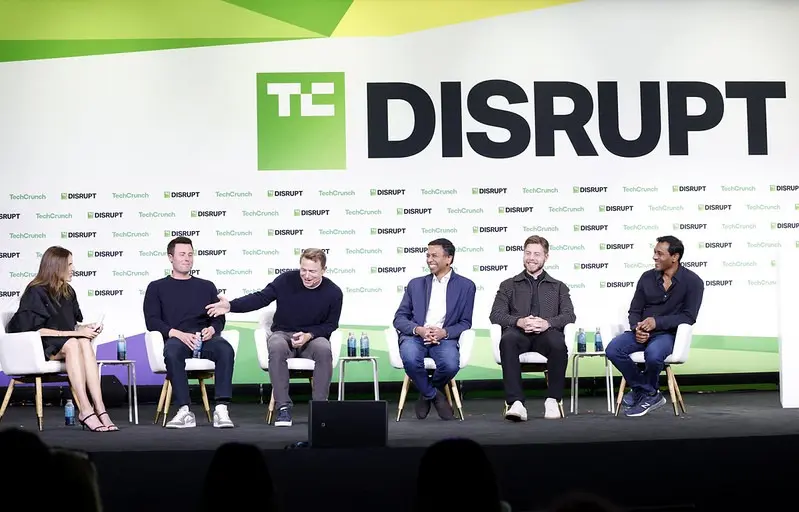
That stubbornness was on full display this week at TechCrunch Disrupt, where all five of Benchmark’s current general partners took to the stage together. Even as rival venture firms race to pump unprecedented quantities of capital into the market, Benchmark is decidedly refusing to put the pedal to the metal. The world may be speeding up, but the firm continues to invest at the measured pace it has maintained for decades: just two or three new bets per year, per partner. The information age may be overflowing with noise and real-time market panic, but Benchmark’s Monday partner meetings still operate without a formal agenda. And while traditional economic indicators continue to flash warning signs about a looming downturn, the partners remain largely unbothered, viewing much of the current hysteria as little more than a product of X-fueled social media panic.
Gathered together on stage, Peter Fenton, Ev Randall, Jack Altman, Eric Vishria, and Chethan Puttagunta offered a rare, collective look into how a legendary partnership functions, how they view the chaotic artificial intelligence boom, and why maintaining a small, human-centric approach remains their ultimate competitive advantage.
Evolving the Core While Guarding the Craft
Benchmark’s recent moves have drawn intense scrutiny from the broader venture ecosystem. This summer, the firm announced a massive $2 billion deployment across two distinct funds, marking only the second time in its three-decade history that it has veered from raising a far smaller, tightly controlled vehicle.
For Peter Fenton, the expansion represents a necessary adaptation to economic reality without sacrificing the foundational craft of early-stage investing. The core fund, he explains, remains fundamentally unchanged. Working closely with founders at the very beginning of their journey typically requires a 10-to-15-year commitment, shoulder-to-shoulder, which inherently refuses to scale.
However, Fenton acknowledges that economic inflation finally forced the firm’s hand. Benchmark held its core fund at a static $500 million for two decades before finally inflating it to match the broader economy—a step Fenton admits was perhaps overdue. Meanwhile, the firm’s new $1.25 billion growth fund represents an expansion of its mandate, giving the partnership permission to pursue opportunities that previously slipped through their fingers. In the past, being strictly restricted to early-stage investing meant missing out on mid-to-late-stage opportunities that could have returned anywhere from 10x to 1,000x.
When asked how many bets the firm plans to make with that massive growth fund, Fenton points to the beauty of a diverse partnership. Leaning into the wisdom of a recent J.P. Morgan paper detailing the "agony and ecstasy" of a concentrated portfolio, Fenton notes that if the fund is successful, a mere one or two investments will ultimately generate 90% of the returns. Consequently, the growth portfolio is expected to consist of just four to six, or perhaps seven to eight, carefully selected companies.
The Appeal of a Small, Cohesive Partnership
For newer additions to the partnership, joining Benchmark represents a deliberate pivot away from the bureaucratic and sprawling structures seen elsewhere in the venture capital industry. Ev Randall, who joined the firm late last year after stints at Founders Fund, Bond, and Kleiner Perkins, explains that every venture firm is ultimately defined by the people inside it and how they collaborate.
While some firms operate with massive, hierarchical investment teams numbering 50 or 60 people—federating decisions through Byzantine corporate structures and product groups—Benchmark operates on a radically different scale. Randall notes that he was drawn early in his career to small partnerships because they allow for higher throughput and genuine conversational fidelity. Working at Benchmark feels less like navigating a corporate machine and more like playing on a sports team, where you are side-by-side on the field with people you not only like, but deeply admire and learn from.
Jack Altman, who joined the firm in February just a year after successfully raising a $275 million fund for his own firm in a single week, echoed those sentiments. Having built a massively popular podcast and spent time as an independent investor, Altman admits he wondered how he would feel navigating a market as crazy as the current one entirely on his own. Collaborating with a group of hyper-focused, driven peers who genuinely care about helping founders has provided an unmatched environment for learning and execution.
Monday Meetings and the Power of No Agenda
A legendary piece of Benchmark lore is that the partners hold their weekly Monday meetings with zero agenda. When the topic arose on stage, Chethan Puttagunta joked that Altman had actually tried to bring an agenda to his first meetings, a playful jab that highlights the firm’s preference for organic, free-flowing dialogue.
Eric Vishria explains that having a structured agenda is "weirdly arbitrary" in an era defined by rapid technological shifts. In a market where artificial intelligence is constantly unlocking possibilities that were impossible just six months ago, the goal is to track who is "bending light." The partners discuss the companies they are meeting, the ideas that piqued their interest, and the challenges unfolding in their board meetings. Trying to systematize that process would strip away its value. Instead, the lack of an agenda leaves essential space to be reactive—ensuring that if a founder needs immediate help landing an executive or a strategic partnership, all five general partners can immediately place themselves at the founder’s disposal.
That unstructured approach extends to the firm’s investment decisions. When asked if a single partner can put a veto on a deal, Puttagunta admits with a laugh that nobody actually knows because they do not have formal rules around it. Because the firm maintains a low volume of deals, it avoids the rigid bureaucracy, customer relationship management databases, and formal voting procedures common at funds that back 100 or 200 companies a year.
Fenton adds that a defining aspect of the Benchmark brand is an absence of the aggressive, "Shark Tank"-style posturing often seen in modern venture capital. The partners approach new ideas with a sense of awe rather than rushing to label founders as outright winners or losers. If an entrepreneur happens to be polarizing and a partner in the room feels a genuine clash, the firm recognizes that they simply aren’t the right fit.
Navigating AI Volatility, Conflicts, and Unicorns
As artificial intelligence drives companies to grow faster than ever, founders and investors alike face intense pressure to keep pace. Yet, Puttagunta insists that Benchmark’s investment cadence remains entirely consistent. The firm accepts that it will never participate in every successful company, focusing instead on identifying distinct strengths in specific entrepreneurs and finding ways to amplify them, regardless of capital requirements or market structures.
This hyper-ambitious AI era has also brought new complexities regarding competitive conflicts, particularly as software development costs approach zero and startups aggressively expand into each other’s territories. Vishria notes that while Benchmark enters an exclusive commitment to work closely with an entrepreneur on a specific vision, the harsh reality is that modern startups evolve, pivot, and expand rapidly, making conflicts an unavoidable part of the current dynamic. While the firm maintains strict confidentiality and counts its blessings for avoiding the insane direct conflicts seen among some industry rivals, Vishria acknowledges that overlapping trajectories are bound to happen more frequently as ambitious founders attack every available surface area.
For Jack Altman, diving into the partnership meant immediately expanding beyond his software roots to back companies in chips, robotics, and infrastructure. Reflecting on his onboarding experience, Altman describes it as "perfect" simply because there was none. When he felt a bit of pressure regarding his first deals, his partners offered sage advice, reminding him that venture capital is governed by power laws and that his first investment didn’t have to be the one that defines his career.
Lessons from Cerebras and Public Market Realities
Benchmark’s willingness to embrace unorthodox bets is perhaps best illustrated by its 2016 investment in AI chipmaker Cerebras—a stark departure from the firm’s decade-long hiatus from hardware. Vishria recalls that on the eve of the partnership pitch, Peter Fenton admitted the investment went against everything he had learned in venture capital. Yet, after hearing the pitch on Monday, Fenton completely flipped his perspective.
Fenton describes Cerebras co-founder Andrew Feldman and his team as "heretics" whose unorthodox thinking mirrors the polarization currently seen in public markets surrounding the stock. For Benchmark, finding polarizing ideas is a prerequisite; if an idea has complete consensus, it begs the question of why a startup needs to exist in the first place.
Discussing the wild public market fluctuations of companies like Cerebras—which priced at $185, surged to $350, and later returned near its original level—Vishria emphasizes that weathering public listings takes a stomach of titanium. Drawing comparisons to the historical volatility of giants like Amazon, DoorDash, and Datadog, he notes that public companies must simply focus on executing what they can control while updating the market every 12 weeks.
When the conversation turned to the broader health of the tech economy, including recent high-profile startup bankruptcies and questions over inflated cash burns, Ev Randall dismissed macroeconomic predictions as a fool’s errand. Randall argued that much of the public panic and perceived "AI chill effect" is little more than an echo chamber driven by hyperactive social media accounts and misinterpretations of secondary data. Underlying metrics within Benchmark’s portfolio show strong, organic demand from customers who cannot get enough compute, pointing to an ecosystem that is fundamentally healthy despite public market volatility.
The Gravitational Pull of San Francisco
Finally, the partners addressed the growing centralization of the AI industry in San Francisco. While Altman notes that founders do not strictly have to reside in the Bay Area, it remains by far the easiest place to secure talent, capital, and customers. Fenton points out that historically, over 90% of capital returns have originated from companies founded locally, driven by a self-reinforcing ecosystem where successful enterprises continually produce ambitious executives and raise the bar for success.
Randall reinforces this sentiment, observing that nearly every non-SF-based company he has met with over the past 18 months is either actively opening a local office, spending half their time in Northern California, or planning a permanent relocation. In the current era of artificial intelligence, where iron sharpens iron, San Francisco remains unmatched as a crucible for building world-changing technology.


Leave a Reply