
The United Kingdom has officially levied sweeping economic sanctions against Cryptomus, a high-volume and shape-shifting cryptocurrency platform that digital forensics experts say has long functioned as a critical financial conduit for ransomware gangs, narcotics traffickers, darknet marketplaces, and online fraud operations. According to international investigators, the platform’s illicit payment infrastructure has played a major role in helping the Russian government and associated financial entities circumvent existing Western financial restrictions and sanctions.
Announced on October 8, the U.K. government formally targeted Cryptomus—which has operated under various corporate guises, including Certa Payments and Xeltox Enterprises—for processing high volumes of transactions that directly benefit the Russian state and its financial institutions. The newly enacted sanctions freeze any financial assets linked to Cryptomus held within British banking institutions and strictly prohibit any U.K.-based companies or individuals from engaging in commercial or virtual business relations with the platform. Alongside Cryptomus, the U.K. targeted several other virtual payment platforms and services, including VexPay, TokenSpot, and the Tsunami Payments service.
The crackdown follows extensive long-term investigations into how illicit digital assets are converted into fiat currency. Back in December 2024, specialized security reporting exposed how Cryptomus had entrenched itself as a primary payment processor for dozens of Russian cryptocurrency exchanges and dubious websites peddling cybercrime services. Emerging onto the digital landscape in 2022, the platform engaged in a recurring pattern of corporate rebranding. Most recently, following a massive regulatory penalty levied by Canadian authorities, the platform spawned an operational parallel service known as "Heleket" to continue its financial operations under the radar.
The broader implications of the U.K. action were underscored by blockchain data intelligence firm Chainalysis, which noted that the sanctions directly strike at the vital infrastructure sustaining Russia’s wartime economy. In an October 8 blog analysis, Chainalysis detailed that Cryptomus and its offshoot Heleket had rapidly evolved into dominant payment hubs for global illicit activity. According to the firm’s data tracking, these interconnected services processed a higher volume of illicit funds across monitored categories than all cryptocurrency mixers combined within their dataset. Furthermore, the number of distinct illicit counterparties utilizing the platforms surged to more than 900 in a single month during late 2025.

Additional findings from blockchain analytics company TRM Labs in April 2026 revealed that Cryptomus had processed more than $7 billion in cumulative transactions since its inception four years prior. This staggering financial volume included funds tied to severe criminal enterprises, such as vendors distributing child sexual abuse material, international terrorist financing networks, and human trafficking operations. TRM Labs also observed that while Cryptomus experienced a temporary cratering of transaction volume after instituting stricter "know your customer" (KYC) compliance rules, the platform actively evaded these restrictions by launching Heleket as a parallel platform dedicated to maintaining no-KYC payment processing.
Richard Sanders, an experienced blockchain analyst and investigator who spent months painstakingly mapping out the sprawling infrastructure of Cryptomus and executing test transactions with its users, emphasized the fundamental difference between regulatory fines and targeted sovereign sanctions. Sanders pointed out that while financial penalties carry significant headline weight, they are frequently difficult to enforce across international borders.
Writing on professional networking platforms, Sanders noted that a monetary fine ultimately fails to stop a determined cryptocurrency payment processor from continuing to move funds, whereas targeted economic sanctions effectively dismantle the underlying operation, making the operational distinction vital for law enforcement.
Investigative timelines trace Cryptomus back to a modest Vancouver office address that it shared with dozens of other foreign currency dealers and money transfer businesses—none of which maintained a physical presence at the location. Following a record CAD $176 million fine issued by Canada for severe anti-money laundering violations, Cryptomus formally appealed the penalty while simultaneously spinning up Heleket as a shadow service, allowing it to maintain its steady stream of high-risk transactions.
Sanders also highlighted the unprecedented nature of the U.K. action, marking the first known instance of a "Five Eyes" intelligence-sharing nation—comprising Australia, Canada, New Zealand, the United Kingdom, and the United States—imposing official sanctions against a cryptocurrency platform formally incorporated within the jurisdiction of another Five Eyes partner.

A persistent mystery surrounding entities like Cryptomus and Heleket has been the legal origin of their authority to issue international financial services. Deep-dive investigations have revealed that these operations often rely on a web of fake financial institutions overseen by fabricated regulatory bodies positioned within disputed or obscure territories.
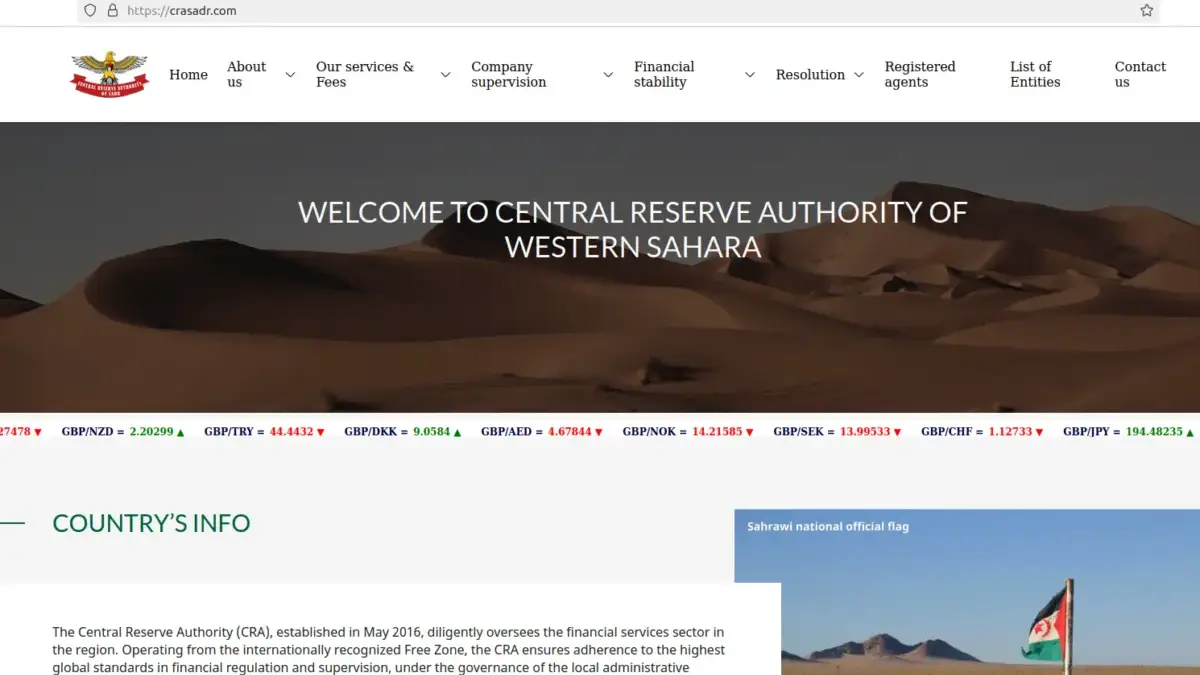
The corporate trail behind Cryptomus revealed that the sole shareholder of its parent company, Certa Payments, was a 25-year-old Ukrainian woman who simultaneously managed several other corporate entities. Among these was the WS Management and Advisory Corporation, an organization that marketed itself as an exclusive regulatory body responsible for overseeing licensing for cryptocurrency, foreign exchange, and online gaming businesses incorporated within the disputed northwest African territory known as the Western Sahara.
The regulatory website operated by this entity, crasadr.com, actively pitched services to prospective applicants seeking assistance with offshore bank setup, corporate formation, online gaming licenses, and the creation of foreign exchange brokers. Digital footprint analysis further linked Certa Payments to network infrastructure sharing, revealing that one of its former corporate domains shared a server with a dozen other suspicious web properties, including rasd-state.ws, which purported to be the official online presence for the Central Reserve Authority of the Western Sahara.
Leave a Reply