
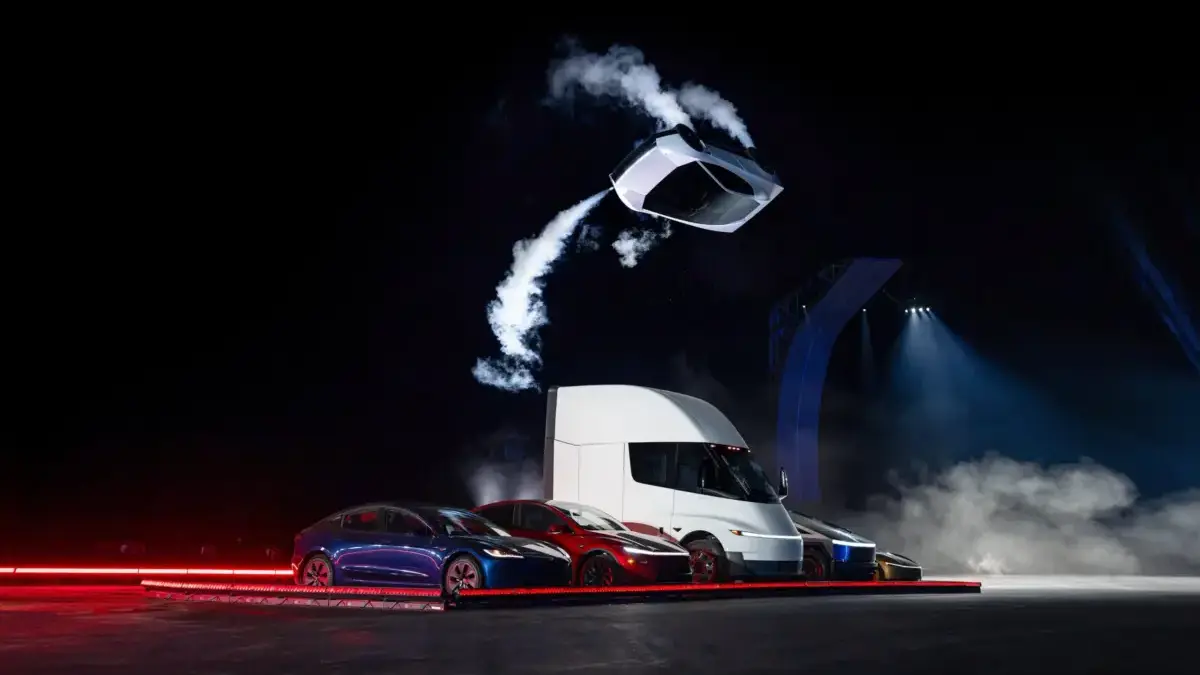
Last night, Tesla CEO Elon Musk delivered a spectacle that certainly gave a specific corner of the internet what it wanted: an electric supercar driving vertically up a multi-story ramp, launching off the edge, executing a mid-air “kickflip” over a lineup of Teslas, and landing via cold-gas thrusters.
That is what the public has been promised for years, in a sense. The cultural adage has long maintained that society was promised flying cars, but as analysts and observers quickly pointed out, isn’t the operative word in that statement “we”? Because as far as real-world utility goes, everything demonstrated during the late-night event in Waco, Texas—while undeniably cool and incredibly impressive from an engineering standpoint—will not result in a production-ready car that ordinary drivers can park, or realistically land, in a residential driveway.
Tesla’s late-night demonstration certainly gave its digital base what it craved. The gushing praise and wide-eyed reactions on X, a social media platform already predisposed to celebrating Musk’s technological gambits, were hard to avoid in the hours following the reveal. Taken purely as a stunt, the presentation was undeniably jaw-dropping. Equipping an electric supercar with 600 liters of compressed air, 10 directional cold-gas thruster nozzles, and a 2G suction-fan system directly inspired by SpaceX aerospace engineering is a striking feat of technical bravado. Seeing a vehicle achieve a zero-to-sixty-miles-per-hour launch in under a second pushes the absolute outer limits of physics, even if such extreme G-forces could theoretically lead to a detached retina or two for an unprepared driver.
Yet, characterizing this demonstration as a traditional “car reveal,” or viewing the flying Roadster variant as a viable commercial product that can be purchased by an unaffiliated third party for private ownership, stretches the definition of a consumer vehicle beyond recognition. Tesla executives noted that the “Rocket” configuration of the Roadster—the specific iteration that performed the airborne stunts—will be available on an “invite-only” basis. But even that designation strains credulity. That high-performance version of the Roadster removes the passenger seat entirely to make room for the ultra-high-pressure gas tanks, trading conventional road practicality for short bursts of thruster-powered levitation. Where an owner could legally take a flying Tesla remains an open question, given that the company itself acknowledges the configuration will not be approved for public road use.
Even for wealthy supercar collectors and enthusiasts who traditionally comprise the market for ultra-exclusive vehicles, the event offered almost nothing of substance regarding practical ownership. Tesla skipped fundamental commercial details, including final pricing and realistic battery range specifications. Notably, the Roadster’s estimated driving range was quietly downgraded from an initial projection of 600 miles down to 300 miles. Furthermore, Musk casually pushed the anticipated production window out to 2028, marking more than a decade since early adopters initially handed over $50,000 deposits to secure a reservation.
Musk himself has previously acknowledged that the Roadster is ultimately a “small potato” project that will not move the needle financially for the automaker when compared to high-volume, mass-market vehicles like the Model Y. He has also referred to it as “the last best driver’s car,” offering a nod to his broader corporate philosophy that autonomous driving will define the primary commercial future of Tesla as an enterprise.
Financial analysts are already theorizing about alternative motives behind the timing of the Roadster’s re-release, suggesting the event may be an attempt to set the stage for a rumored corporate merger between Tesla and SpaceX. Musk’s most dedicated followers on social media have actively expressed enthusiasm for the prospect, despite acknowledgments that such a structural consolidation could result in the dilution of their own equity stakes. For many market watchers, however, such financial maneuvering is viewed as standard procedure in Musk’s ongoing quest to consolidate centralized control across his portfolio of companies.
In a broader sense, the vehicle arguably had to perform extraordinary feats like flying to make the preceding decade of missed production deadlines feel somewhat justified to the public. Tesla has already been lapped several times in the fiercely competitive electric hypercar market. Even some of the Roadster’s most visually impressive engineering tricks have already been achieved or surpassed by rival manufacturers. Across the global automotive landscape, engineering firms have developed vehicles capable of driving upside down, jumping vertically into the air to clear obstacles, and accelerating at staggering rates.
For instance, BYD’s Yangwang U9 Extreme utilizes a quad-motor setup—featuring one more electric motor than the Roadster—to produce an astonishing 3,000 horsepower, achieving a tested top speed of 308 miles per hour and surpassing previous benchmarks set by brands like Rimac. Meanwhile, the McMurtry Spéirling single-seater currently holds documented records for explosive acceleration from zero to sixty miles per hour in just 1.35 seconds. While the Roadster claims it can potentially best these figures, independent testing and verification will be required to confirm Tesla’s performance metrics.
Ultimately, no executive puts on a spectacle quite like Elon Musk. If the primary corporate goal was to score an undeniable public relations victory, dominate global social media feeds, and cement Tesla’s brand identity as a frontier technology pioneer, the Roadster demonstration accomplished its mission. Established automotive competitors such as Rimac, Porsche, and BYD will undoubtedly continue manufacturing and shipping real, track-ready hypercars to paying customers while Tesla spends the next several years refining its rocket-boosted prototype.
As a conventional consumer product, the vehicle remains completely impractical. But as a thirty-minute exhibition of raw engineering muscle and theatrical showmanship, it was a sight to behold.

Leave a Reply