

The evolution of OLED monitor technology has been nothing short of transformative for PC gaming, offering near-instantaneous pixel response times, infinite contrast ratios, and striking visual fidelity. Yet, a persistent hurdle has always remained for everyday users: text clarity. Traditional OLED panels have long relied on unconventional subpixel layouts that cause distracting color fringing around fine text, turning routine productivity tasks like drafting documents, browsing the web, and managing spreadsheets into a frustrating visual chore.
Now, Alienware’s new AW3226Q addresses this compromise head-on. Priced at $699, the 32-inch 4K monitor pairs a gorgeous Tandem OLED panel with a traditional RGB-stripe subpixel layout, effectively eliminating text fringing while delivering high-end gaming performance. For many users, it represents a long-awaited milestone: an OLED display that feels completely uncompromised as an everyday desktop monitor.

The RGB-Stripe Breakthrough and Text Clarity
When Alienware first announced the AW3226Q, industry attention quickly zeroed in on its adoption of an RGB-stripe Tandem OLED panel. While recent advancements in OLED technology have pushed panel brightness and overall efficiency to new heights, the shift toward a conventional red, green, and blue subpixel arrangement addresses the most glaring weakness of previous-generation OLED monitors.
Most OLED gaming displays utilize alternative subpixel configurations that fail to match the standard expected by Microsoft Windows. This mismatch creates visible colored fringes around fine text. While higher pixel densities can help mask the effect to some degree, and individual sensitivity varies, users who notice the fringing often find it difficult to ignore.

The AW3226Q changes that dynamic entirely. By incorporating a traditional RGB stripe, text rendered on the screen appears crisp, clean, and properly defined. Word documents, emails, and web pages finally look correct on an OLED panel, removing the visual tax that previous models forced productivity-focused users to pay. For professionals who spend their daylight hours immersed in text-heavy applications, this seemingly modest architectural change matters far more than incremental gains in refresh rate.
Balancing Professional Work and High-End Gaming
The appeal of the AW3226Q lies in its dual capability. Historically, enthusiasts with demanding workflows often found themselves maintaining separate setups or rotating hardware depending on whether they were working or gaming. OLED monitors conquered entertainment with their perfect blacks and luscious colors, but making them equally suitable for mundane office tasks remained a formidable engineering challenge.

Alienware has managed to bridge that gap. During the day, the monitor functions as a spacious, sharp 4K workspace with clear typography that avoids the visual distractions of older OLED panels. When the workday concludes, the display transitions seamlessly into a high-performance gaming rig.
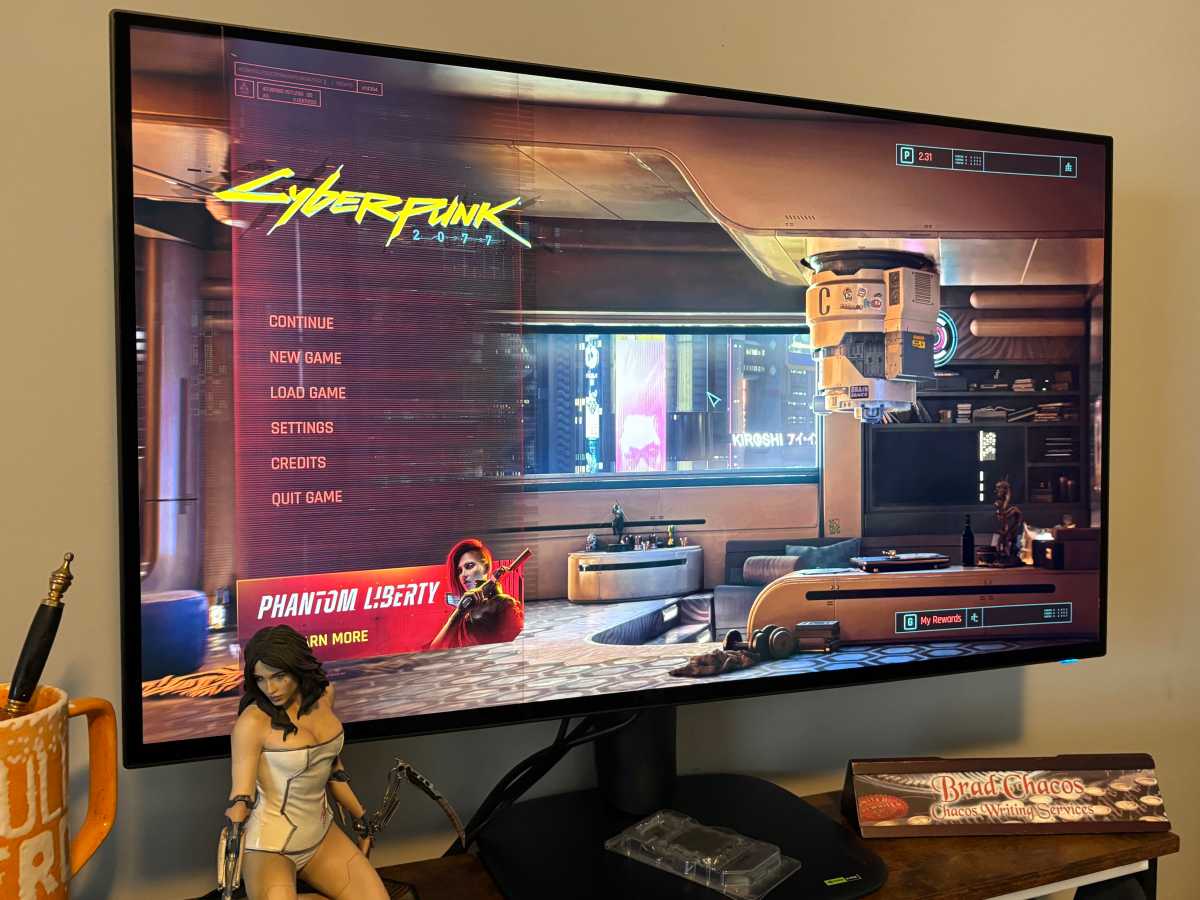
Running visually intensive titles like Alan Wake 2 highlights the panel’s strengths. The glossy 4K Tandem OLED screen delivers vibrant colors that leap off the canvas against deep, inky blacks, providing a visual punch that makes returning to conventional LCD technology difficult. The 32-inch canvas provides ample screen estate for multitasking during the day, while offering razor-sharp resolution and immersive contrast when the lighting goes down and gaming sessions begin.

Evaluating the 165Hz Refresh Rate and Strategic Compromises
Calling the AW3226Q a completely uncompromised monitor does require one major caveat: its refresh rate tops out at 165Hz. In an era where competitive esports monitors frequently reach 240Hz, 360Hz, 480Hz, and beyond, 165Hz is decidedly more modest. For hardcore competitive players who tune every graphics setting for maximum frames and absolute minimum input latency, alternative displays may offer a better fit for those specific priorities.
However, for the vast majority of users, 165Hz is more than fast enough. The instantaneous pixel response times inherent to OLED technology keep motion exceptionally crisp, ensuring that fast-paced shooters and sprawling single-player adventures alike feel smooth and responsive. Furthermore, driving modern 4K games at up to 165 frames per second places heavy demands even on top-tier graphics cards, meaning the panel’s ceiling aligns well with realistic hardware performance capabilities.

Alienware applied a similar pragmatic philosophy to the rest of the monitor’s feature set. The AW3226Q omits built-in speakers, relies on DisplayPort 1.4 rather than the newer DisplayPort 2.1 standard, and skips the elaborate USB-C docking hubs commonly found on productivity-centric displays. By trimming these extras, Alienware directed its manufacturing budget toward the core display hardware, pairing the high-end panel with HDMI 2.1 support and a comprehensive three-year warranty that includes coverage for OLED burn-in.
This pricing and feature strategy mirrors Alienware’s broader approach to its recent display lineup. While budget-friendly models like the $350 AW2726DM make deeper concessions regarding panel brightness and text fringing to hit an aggressive price point, the $699 AW3226Q moves upmarket to deliver a refined, premium experience without crossing into prohibitive pricing territory.
For users who have hesitated to adopt OLED technology because of productivity concerns or high costs, the Alienware AW3226Q redefines expectations. By successfully solving the text clarity issue while maintaining stellar gaming performance at a reasonable price, it delivers the exact balance that many desktop users have been waiting for.

Leave a Reply