
As manufacturers across global industries increasingly strive to reduce their heavy reliance on Chinese suppliers for critical components and materials, Indian startup Scimplify has successfully raised $25 million in a new funding round. The fresh capital is earmarked to expand its innovative, artificial intelligence-powered approach to producing specialty chemicals and critical materials, with high-tech sectors such as semiconductors, defense, and energy rapidly emerging as its primary growth markets.
The all-equity strategic funding round was led by prominent backer Hitachi Ventures, alongside new investments from major industrial customers Henkel and Teknor Apex. Meanwhile, existing financial backers—including Accel India, Bertelsmann India Investments, Omnivore, and 3one4 Capital—also participated in the round. According to a person familiar with the transaction, this latest capital injection values the Bengaluru-based startup at $250 million. This represents a substantial valuation increase from the $150 million valuation it achieved following a $40 million Series B round held in March 2025. With this transaction, Scimplify’s total equity funding brought to date reaches $80 million, though the company chose not to publicly disclose the exact valuation figures in its official statements.
The broader industrial landscape has seen a growing adoption of artificial intelligence and advanced computational tools in recent years, significantly accelerating the pace of materials discovery and scientific research. Despite these digital advancements in the laboratory, however, the practical reality of turning a promising piece of chemistry into a commercially available product at scale remains a notoriously slow, expensive, and complex process. Manufacturers are consistently required to develop complex production processes, rigorously qualify manufacturing facilities, and meet stringent quality standards. All of this must be achieved while simultaneously navigating tight supply chains that are often dangerously concentrated within just a handful of countries. Scimplify is actively seeking to fundamentally shorten that arduous process.
In certain operational cases, the startup—which was founded in 2023—has managed to compress timelines drastically. From the moment it receives a customer’s specific technical requirements to the final delivery of the finished material, the entire cycle has taken as little as two months. This stands in stark contrast to the traditional industry standard, where such complex material development work would typically require anywhere from 12 to 18 months to complete, according to co-founder Sachin Santhosh during an interview.
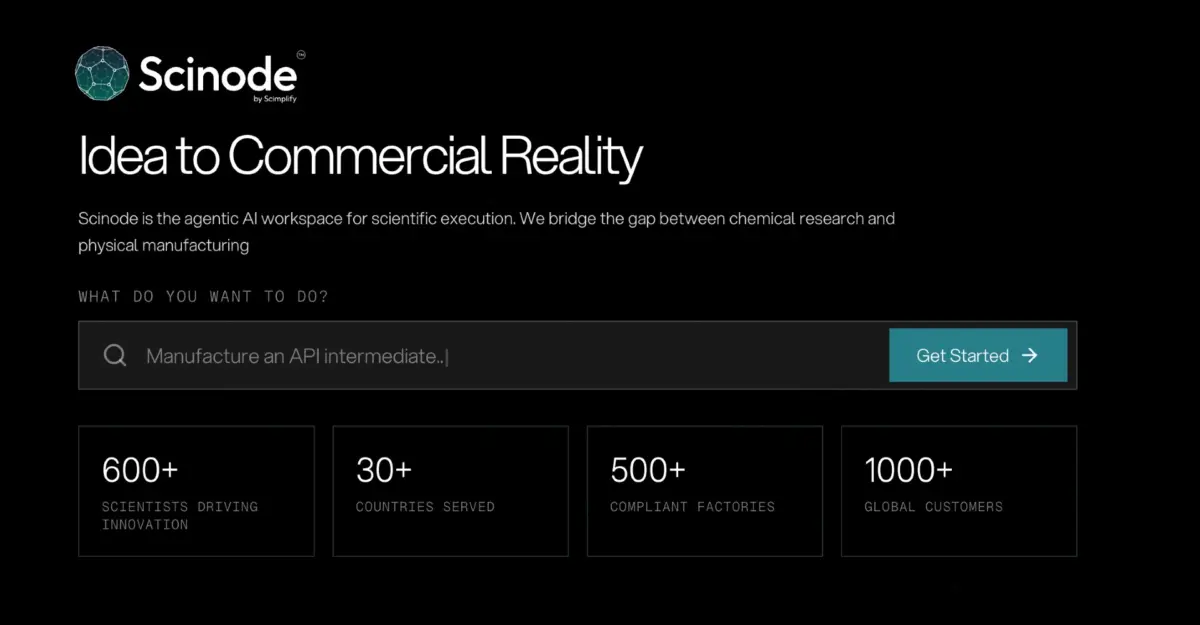
Once Scimplify receives a formal order from a client, its internal team begins the precise work of developing chemical manufacturing processes at its advanced research facilities located in Bengaluru and Hyderabad. Once optimized, these processes are then seamlessly transferred to a vast network of partner factories for full-scale commercial production. To coordinate these intricate multi-step operations, the startup relies on its proprietary AI platform, known as Scinode. This platform assists the team by identifying the most suitable production routes and appropriate manufacturing facilities, while simultaneously tracking complex quality parameters and international regulatory requirements. Santhosh explained to TechCrunch that the platform functions by deploying specialized AI agents tailored for distinct operational functions, including dedicated research, manufacturing supervision, and rigorous quality control.
Each of these autonomous agents is fundamentally designed to solve for precisely what a customer desires, working directly backward from the customer’s unique technical specifications, Santhosh noted. This intelligent architecture helps the company move forward at a much faster operational pace while retaining critical customer context even for future reference and repeated orders.
Scimplify’s in-house team of skilled scientists and engineers actively oversees production across a sprawling network comprising more than 500 manufacturing facilities. Through this operational backbone, the startup helps its growing roster of global customers establish reliable alternative sources for critical materials whose global supply has historically remained overwhelmingly concentrated in China and a few other select nations.

At present, approximately 90% of Scimplify’s overall manufacturing activities take place within India. However, the startup has outlined clear strategic plans to expand its operational production network into the United States and Japan over the course of the coming year. This geographical expansion is designed to actively attract and service a larger volume of customers directly within those key industrial markets, Santhosh stated.
The United States has rapidly emerged as a vital growth market for the enterprise. Scimplify’s annualized revenue run rate originating from the U.S. has experienced a dramatic sixfold surge, climbing to approximately $60 million compared to just $10 million a year prior. Today, the American market accounts for roughly 30% of the company’s total business volume. Furthermore, customers based outside of India now collectively contribute more than half of the startup’s overall revenue, a striking shift from roughly 18 months ago when international clients accounted for less than 5% of its business.
Overall, Scimplify currently serves a diverse portfolio of more than 1,000 corporate customers and has successfully delivered specialty products to more than 40 countries worldwide. The startup has reached an impressive annualized revenue run rate of approximately $200 million, effectively tripling its financial scale from a year earlier. Looking ahead, management is aggressively targeting a $400 million annualized revenue run rate over the next year. On the financial sustainability front, Scimplify has achieved EBITDA-positive status for the past two months consecutively and proudly anticipates turning fully profitable after tax within the current month, according to Santhosh.
Sectors tied to energy, electronics, and defense now account for an estimated 45% to 50% of Scimplify’s total revenue, representing a steep increase from less than 15% a year ago. This sharp upward trajectory is largely driven by macro-level trends: the rapid proliferation of artificial intelligence is fueling unprecedented demand for specialized materials used in electronics and advanced energy infrastructure, while ongoing geopolitical conflicts and defense modernizations are simultaneously driving high-stakes demand from the global defense industry.
Demonstrating its focus on critical supply chain vulnerabilities, Scimplify is actively working on producing valuable tungsten derivatives derived directly from scrap materials, thereby offering its industrial customers a reliable alternative source for materials whose global supply chain remains heavily concentrated in China. Additionally, the startup is heavily engaged in research and development surrounding rare-earth materials, which represent another critical industrial category where global supply chains remain overwhelmingly dependent on China.
Scimplify’s blue-chip client roster includes major multinational corporations such as Japanese electronics manufacturer TDK, German chemicals giant BASF, and industrial conglomerate Hitachi. Santhosh pointed to a collaborative project involving TDK as a prime example of the startup’s proven capability to radically shorten the timeframes required to develop and deliver highly specialized advanced materials, though he noted that exact timelines naturally vary from project to project depending on technical complexities.
With the deployment of its latest capital injection, Scimplify plans to allocate approximately $7.5 million specifically toward its ongoing U.S. expansion strategy, which includes building out its local manufacturing and partnership network. Santhosh noted that this financial allocation remains flexible and could adjust as the startup’s operational plans continue to mature. Additionally, the company has earmarked another $2 million to further advance and scale the development of its proprietary Scinode AI platform.
The startup currently maintains a total headcount of approximately 340 employees, a talent pool that includes roughly 70 dedicated scientists. While the vast majority of its workforce is situated in India, Scimplify also maintains established local operational teams stationed across the United States, Japan, Indonesia, and the United Arab Emirates to support its widening international footprint.


Leave a Reply