
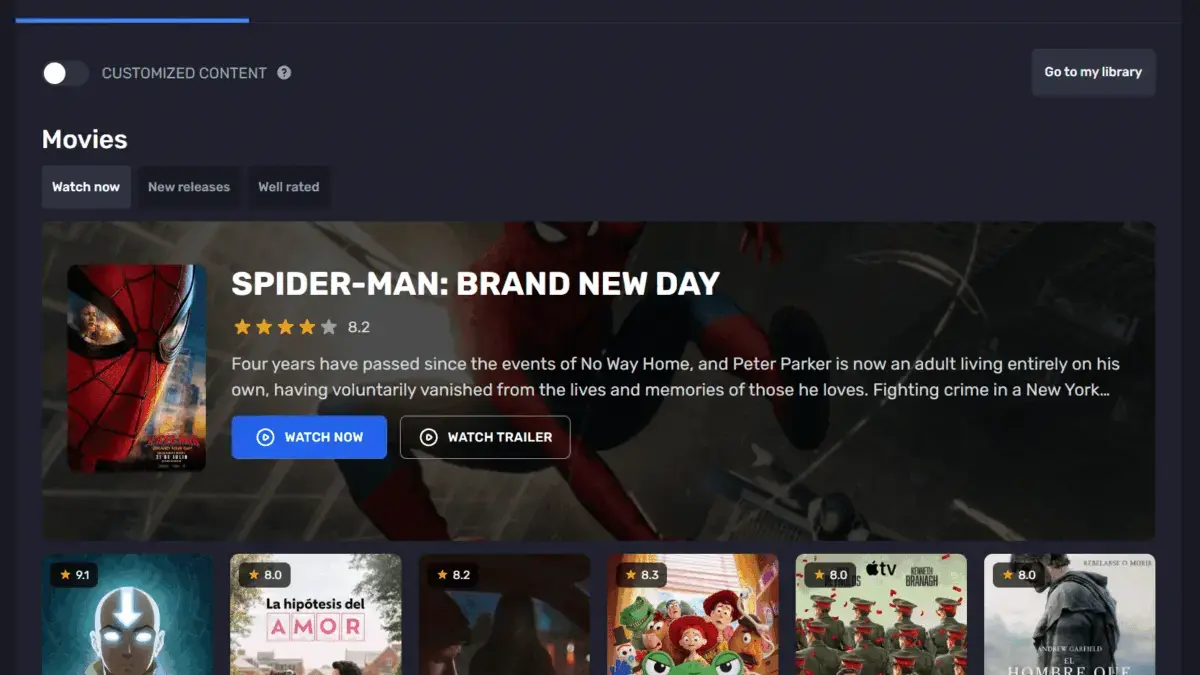
Series.ly, once one of the most prominent and widely recognized pirate link-sharing platforms in Spain, has found itself trapped in the crosshairs of international copyright enforcement once again. Although the original operations of the notorious site were abruptly halted and stripped of their illicit indexing capabilities back in late 2014—resulting in a protracted legal saga that eventually led to the acquittal of its former administrators years later—the domain itself was given a completely new lease on life. In 2021, a fresh team of operators purchased the domain name at a public auction, repeatedly maintaining that they had no historical, operational, or financial ties to the original creators who built the platform’s contentious reputation.
Under its new management, the revamped iteration of Series.ly evolved into a password-protected environment, requiring users to log in before they could gain access to the platform’s features. Despite this gatekeeping measure, the site quietly amassed a substantial following, drawing nearly two million monthly visits at its peak. Data analytics indicated that a commanding majority of this traffic—roughly 90 percent—originated directly from Spain, cementing the site’s enduring domestic appeal and making it an impossible target for local rightsholders to ignore.
The renewed popularity inevitably attracted the fierce attention of the Spanish entertainment industry. In May, EGEDA, the prominent audiovisual producers’ rights management group in Spain, escalated the situation by officially filing a formal complaint with the Second Section of Spain’s Intellectual Property Commission. Operating directly under the umbrella of the Ministry of Culture, this specialized commission was tasked with investigating the platform and enforcing statutory measures to shut the site down permanently.
To substantiate the complaint, an investigator appointed by the Commission randomly selected a sample of 42 titles out of the 110 individual works cited in EGEDA’s initial grievance. The investigation yielded immediate results when the official discovered that 35 of those copyrighted titles could be seamlessly streamed or directly downloaded directly from Series.ly at the time of the inspection. Armed with this evidence, the Commission formally instructed the site’s operators in July to voluntarily remove all infringing material. According to regulatory filings, the operators never formally responded or complied with the takedown directive.

From Google to a Libyan Registrar
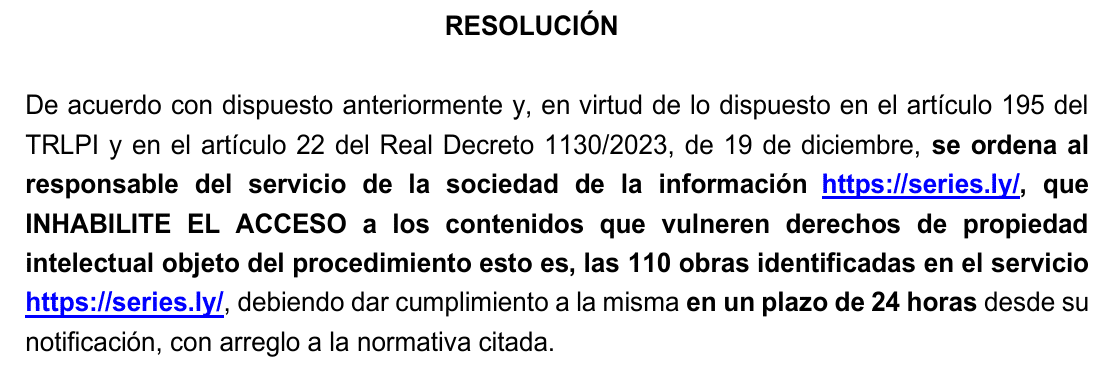
Following the platform’s failure to respond to the administrative warnings, the Commission escalated its approach at the end of July by sanctioning a comprehensive suite of anti-piracy enforcement measures. Rather than focusing solely on the elusive site operators, the resolution targeted a broad network of third-party internet intermediaries, forcing major technological gatekeepers and infrastructure providers to sever their ties with the domain.
Under the terms of the administrative resolution, tech giants Google and Bing were officially required to completely scrub the domain from their search engine result pages. Simultaneously, domestic Internet Service Providers (ISPs) operating within the region that boast a market share greater than one percent were ordered to implement strict network-level blocks against the primary domain name.
Furthermore, these telecommunication providers were instructed to actively intercept incoming traffic, redirecting unwitting visitors away from the infringing platform and toward a mandatory government-hosted landing page. This informational notice explicitly informed users that the domain had been blocked by the Commission on the legal grounds that it had illegally facilitated digital access to intellectual property protected under Spanish law.
The sweeping enforcement order also formally listed several foundational infrastructure providers, including content delivery network Cloudflare and Ukrainian hosting provider Virtual Systems—whose primary data centers situated in Kyiv were severely impacted by Russian missile strikes earlier in the year. Also caught in the regulatory crosshairs was Series.ly’s domain registrar, the Libyan Spider Network. Crucially, the Commission mandated that these severe preventative measures would apply not only to the platform’s current domain name but would automatically extend to any alternative or newly created domains that the operators might attempt to utilize for the exact same purpose in the future.

Because administrative bodies in Spain require judicial backing to enforce systemic internet blocking orders, the resolution was submitted to the Spanish courts for formal authorization. On September 28, a presiding judge stationed at the Central Court of First Instance in Madrid thoroughly evaluated the case, ultimately concluding that the requested anti-piracy measures were entirely proportionate to the scale of the infringement, thereby approving the enforcement requests exactly as petitioned.
The Libyan Registrar Acts
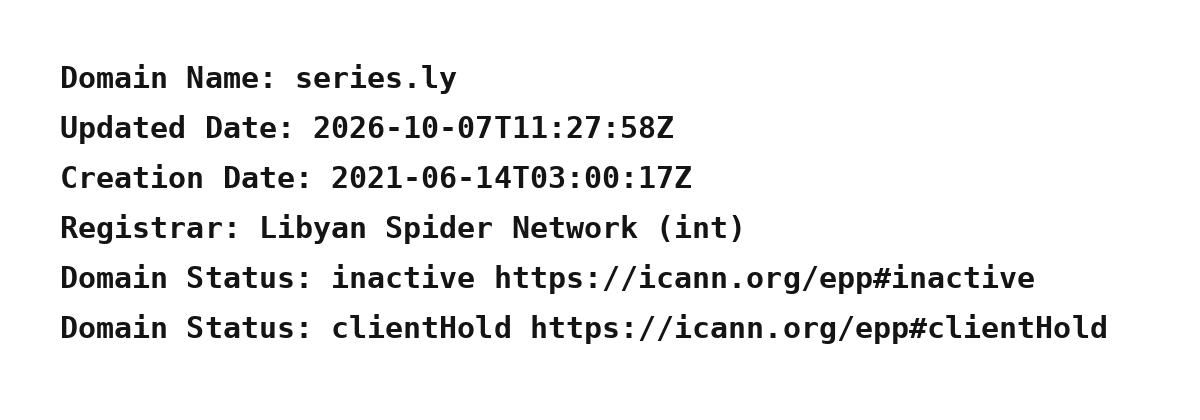
Little more than a week following the judicial authorization, the complex web of digital intermediaries began to enforce the mandate. Early in the week, users noticed that Series.ly had abruptly vanished from the internet, having unexpectedly lost its domain name after the Libyan domain registrar, Libyan Spider, intervened directly.
Updated WHOIS registration records quickly confirmed that the series.ly domain had been placed into a "clientHold" status. This specific operational designation is exclusively utilized by domain registrars to pull a domain offline entirely by removing its records from the global .ly zone, rendering the web address completely unresolvable across the global Domain Name System.
While Libyan Spider refrained from issuing a formal public statement regarding the administrative action, representatives for Series.ly confirmed that the registrar’s official notice explicitly cited the Spanish regulatory resolution and the subsequent court order. The notification had traveled to the operators through an indirect administrative chain, reaching them via the original auction house that had sold them the domain, which routinely acts as a local reseller for the registrar.
"The reason they gave us was a Spanish copyright resolution and a court order authorizing suspension measures against the domain," the Series.ly operator explained in a translated statement provided to investigators and researchers.
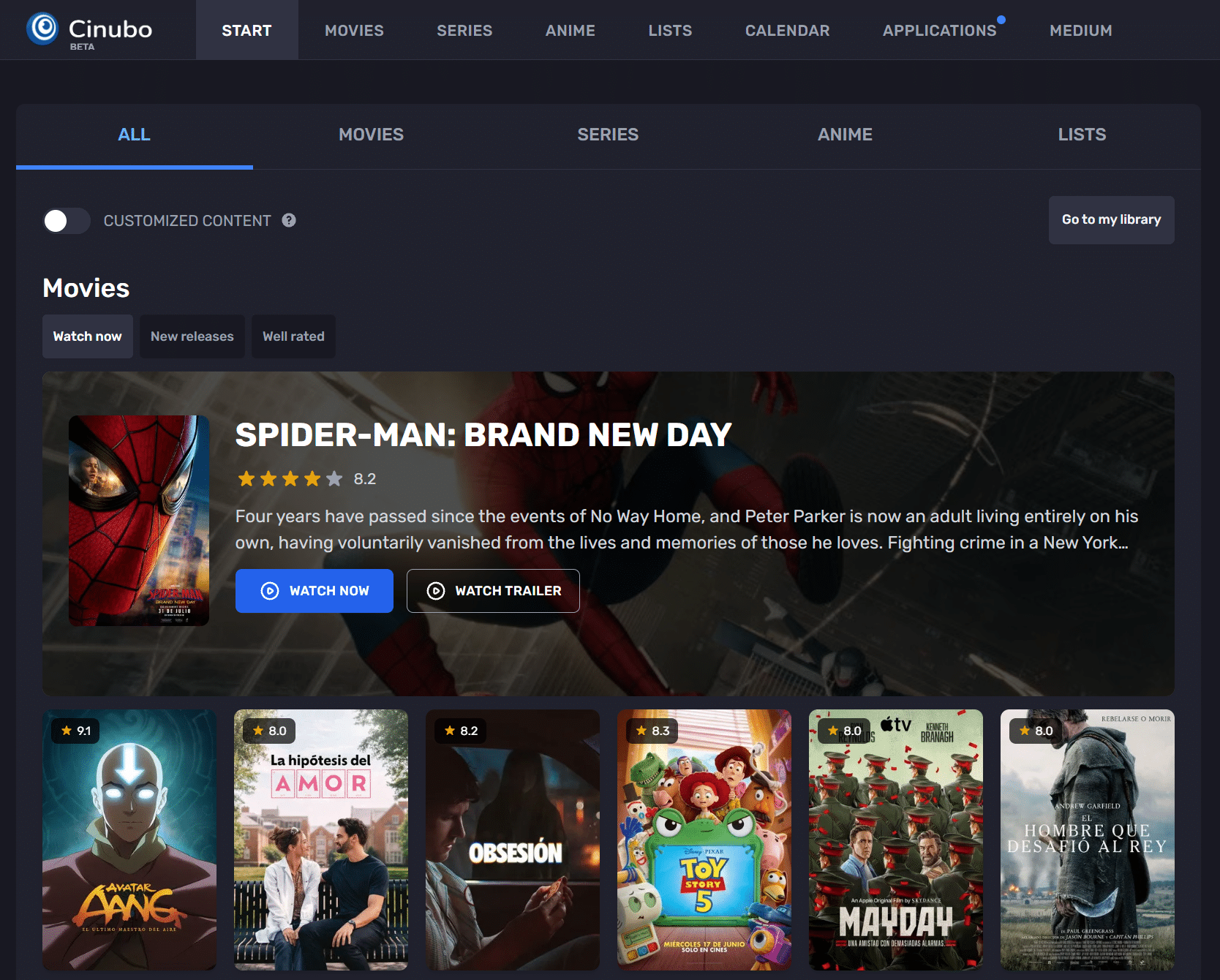
Although it remained unclear whether all the targeted intermediaries had fully implemented their respective blocks at the time, the judicial validation ensured that the underlying court order remained fully enforceable. Interestingly, shortly after the abrupt suspension of the Series.ly domain, a remarkably similar streaming and linking project operating under the brand name Cinubo emerged online. At the same time, the official Series.ly community channels on Telegram and Discord were swiftly renamed to reflect the new Cinubo branding, hinting at a rapid pivot by the platform’s administrators.
No Plans to Appeal
Addressing the sudden domain seizure, the operator asserted that they had failed to notice the regulatory warnings before the suspension hammer fell. An earlier warning email dispatched by EGEDA had apparently been routed to an administrative inbox that went unchecked, while a separate electronic mail address listed visibly on the website’s public interface received little attention until it was too late.
In their defense, the operator characterized Series.ly as a non-profit endeavor that had continuously failed to generate any form of financial revenue since its public relaunch. They emphasized that the website itself did not physically host any pirated video files or digital media assets on its own servers; instead, any links directing users to external streaming or hosting services were allegedly generated and contributed entirely by the platform’s active community members.
"Our position is that complaints about those video files should be directed at the services that host or distribute them," the operator stated through translated remarks. "We think it’s disproportionate that a complaint about content hosted by third parties ends up getting our entire domain suspended, including email and the personal library features."
Despite the severity of the blow, the operator initially indicated that they harbored no immediate plans to mount a formal legal appeal against the Spanish enforcement order. Highlighting the international nature of the internet, the operator pointed out that the corporate entity legally backing the digital project is officially established and based in the Caribbean island nation of Nevis, raising substantive questions regarding the legitimate international reach and extraterritorial jurisdiction of Spanish regulatory authorities.
"We question whether a procedure handled in Spain justifies suspending our domain worldwide, which also affects email and services that have nothing to do with the works in question," the operator noted.
Even with these jurisdictional arguments, the legal battles surrounding the project are far from settled. The expansive wording of the Spanish court order explicitly covers any newly deployed domain names utilized for identical infringing purposes, a clause that immediately placed projects like the newly minted Cinubo under intense regulatory scrutiny. Furthermore, with the foundational framework validated by the Madrid court, additional intermediaries remain legally empowered to enforce further technical restrictions.
Subsequent developments, however, introduced an unexpected twist to the ongoing saga. A few days after the initial enforcement action took the site offline, the series.ly domain mysteriously reappeared under the active control of its rightful owner. The operator confirmed that the domain registrar ultimately chose to lift the restrictive suspension, though this administrative reprieve came with the strict caveat that the domain could never again be utilized to host, index, or link to copyright-infringing content of any kind.
In compliance with these updated operational boundaries, the web address was repurposed entirely. Series.ly now hosts a static informational webpage dedicated strictly to documenting the extensive historical timeline of the domain name itself, permanently shedding its past identity as an active streaming and linking portal.
Leave a Reply