
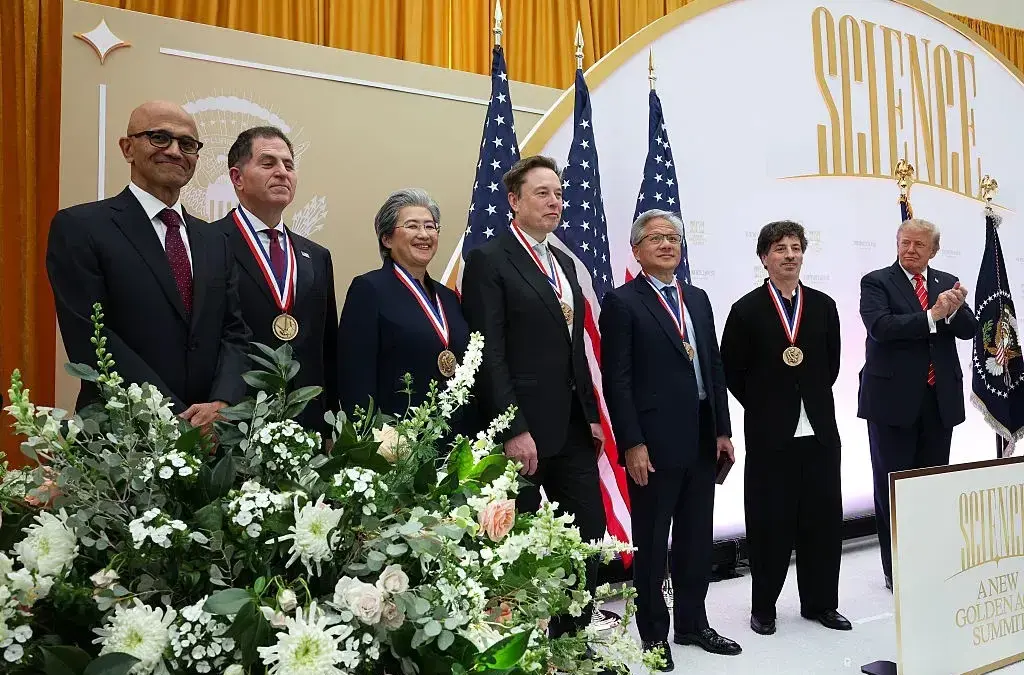
WASHINGTON — In a high-profile ceremony held on Thursday at the White House’s Golden Age of American Innovation Summit, President Trump bestowed the nation’s highest scientific and technological honors upon several of the most influential figures in the modern technology sector. The recognition celebrated monumental breakthroughs in artificial intelligence, semiconductor manufacturing, and digital infrastructure, though the event has quickly drawn intense scrutiny due to the recipients’ substantial financial contributions to political and administrative initiatives.
During the proceedings, President Trump presented the National Medal of Science—the United States’ top science prize—to Tesla and SpaceX chief Elon Musk, Nvidia CEO Jensen Huang, Alphabet co-founder Sergey Brin, and AMD CEO Lisa Su. Alongside these honors, Dell Technologies founder and CEO Michael Dell and Microsoft CEO Satya Nadella were awarded the National Medal of Technology and Innovation, recognizing their profound impact on the evolution of computing, enterprise technology, and digital communication networks.
Addressing the gathered dignitaries, industry leaders, and government officials, President Trump praised the honorees for their relentless drive and visionary contributions. He stated that the awardees had helped "pioneer an incredible future for America," adding that because of their collective ingenuity and industrial leadership, "we will always be on top. No one else can compete with us." The remarks underscored the administration’s stated focus on solidifying American technological dominance on the global stage, particularly amid fierce international competition in critical sectors like artificial intelligence and advanced microelectronics.
Political Contributions and Public Scrutiny
While the White House framed the summit as a celebration of American ingenuity and economic leadership, the ceremony has ignited widespread debate regarding the intersection of corporate philanthropy, political fundraising, and federal awards. According to public reports and investigations highlighted by outlets including The New Republic, the tech executives and their respective companies honored at the summit have collectively donated nearly $6 billion to efforts directly or indirectly tied to President Trump and his administration.
The financial ties span a wide array of political and civic initiatives. Major technology giants such as Alphabet and Microsoft contributed significantly to the president’s inauguration fund as well as high-profile White House renovation projects, including the construction of the new White House ballroom. Meanwhile, semiconductor manufacturer AMD directed funds toward a prominent pro-Trump Super PAC, aligning corporate political spending with broader electoral strategies during the election cycle.

Among the largest contributions highlighted in public records, Michael and Susan Dell pledged an astounding $6.25 billion to support the Trump Accounts, a signature administration savings and investment program designed to build long-term financial assets for American children. While supporters of the philanthropic pledge emphasize its potential to foster generational wealth and economic security for youth, critics and ethics watchdogs have raised questions regarding the timing and optics of awarding the nation’s highest civilian technological honors to individuals and families who have provided unprecedented financial backing to the administration’s political and policy goals.
A Complex Regulatory Landscape
The glittering White House ceremony also unfolded against a backdrop of complex and sometimes contradictory regulatory developments between the federal government and the tech sector. The juxtaposition of policy friction and public accolades was starkly illustrated in the case of Microsoft CEO Satya Nadella.
Nadella accepted the National Medal of Technology and Innovation just moments after the administration announced a major policy action directly impacting his company: the indefinite suspension of Microsoft from the H-1B visa program. The federal program has long served as a crucial pipeline for U.S. technology companies seeking to recruit highly skilled foreign engineers, researchers, and specialists from around the globe. The sudden suspension has sent shockwaves through the tech industry, raising urgent questions about how major enterprises will source specialized talent moving forward, even as their top executives are being fêted at the highest levels of government.
The simultaneous occurrence of the H-1B suspension and the presidential honors underscores the intricate, transactional, and often unpredictable relationship between the federal government and Silicon Valley. Tech leaders are increasingly navigating a dual reality where they are simultaneously courted for their capital, innovation, and economic influence, yet subjected to aggressive regulatory enforcement, shifting immigration policies, and intense political oversight.
As the tech sector continues to drive the nation’s economic growth and shape the geopolitical landscape through advancements in artificial intelligence, quantum computing, and advanced hardware, the Golden Age of American Innovation Summit has cemented a complex precedent. It highlights an era where technological leadership and political alignment are more intertwined than ever, leaving industry observers to weigh the long-term implications of corporate largesse on public honors and federal policymaking.


Leave a Reply