
A French court has dealt a significant blow to pay-TV broadcaster Canal+ in its ongoing efforts to crack down on unauthorized sports streaming. The Paris Judicial Court has formally rejected a request by the network to impose daily fines of €50,000 against internet infrastructure giant Cloudflare over its compliance with site-blocking orders. The decision provides a temporary victory for Cloudflare, which has maintained that technical constraints prevent it from implementing blocks across all of its services, particularly its public DNS resolver.
Over the past two years, French courts have increasingly ordered internet intermediaries to block access to pirate sports streams. While these legal measures initially focused on traditional internet service providers, they have progressively expanded to target a wide variety of digital infrastructure services. Today, public DNS resolvers, virtual private network services, search engines, and content delivery network providers are frequently named in court orders, as rightsholders seek to shut down every potential avenue that users might exploit to bypass existing blockades.
Cloudflare, a major player in global internet infrastructure, has found itself repeatedly caught in the crosshairs of these legal mandates. In April, the Paris Judicial Court issued rulings ordering the company to block a total of 37 domains linked to unauthorized broadcasts of major sporting events. Specifically, the company was told to block 21 domains associated with pirate Formula 1 streams and 16 domains connected to MotoGP broadcasts.

The scope of these orders covered both Cloudflare’s DNS resolver and its content delivery network services. However, the court’s directives did not prescribe a specific technical method for how the sites must be blocked. Instead, they simply required that access from French territory be prevented by any effective means.
Canal+, the broadcaster that originally requested the blockades, quickly concluded that Cloudflare’s compliance efforts were insufficient. Dissatisfied with the results, the network returned to court in May to demand punitive financial measures against the infrastructure provider.
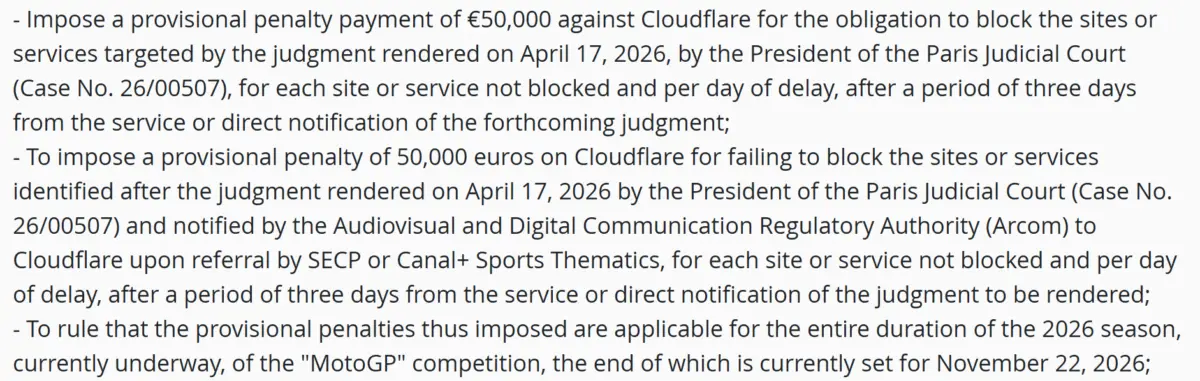
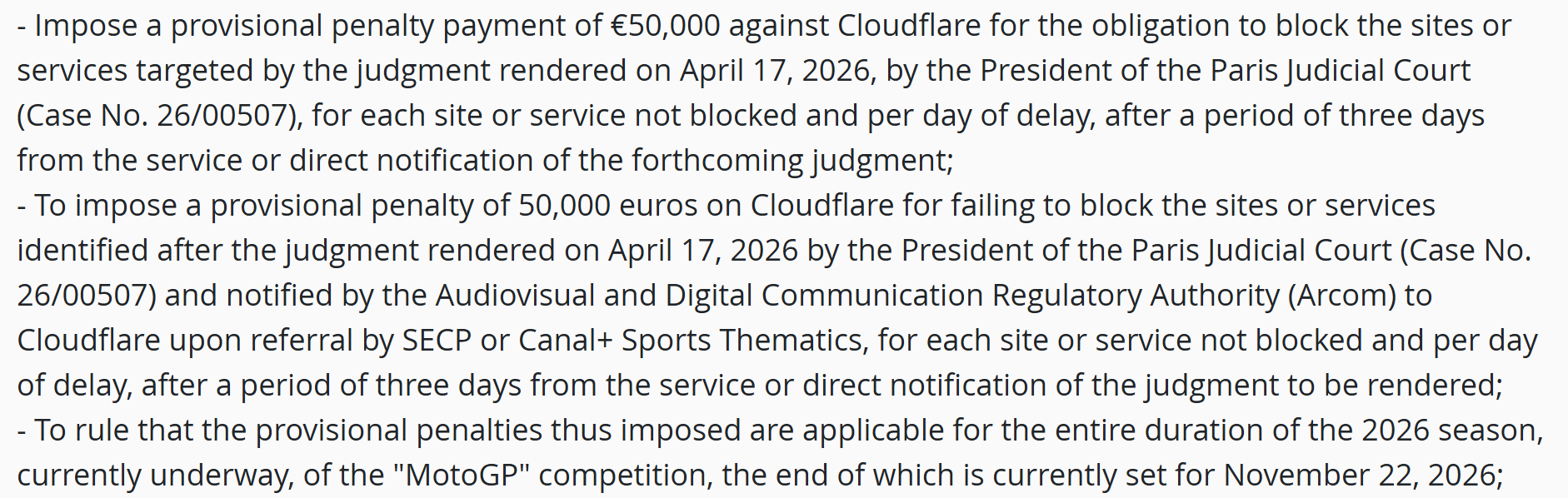
Canal+ Requested €50,000 a Day
Seeking to enforce stricter compliance, Canal+ asked the Paris court to attach heavy daily penalties to the April orders. The broadcaster requested a fine of €50,000 per day for every targeted site that remained accessible through Cloudflare’s infrastructure. Furthermore, it demanded the exact same daily penalty for any new site that French media regulator Arcom subsequently reported to Cloudflare.

According to legal arguments presented by Canal+, Cloudflare had deliberately failed to fully comply with the judicial blocking mandates. The broadcaster asserted that the company had circumvented the spirit of the decisions by limiting its blocking implementation solely to its content delivery network service. Canal+ argued that this restricted approach resulted in only three of the 21 domain names listed in the Formula 1 case actually being blocked.
A similar outcome was reported in the MotoGP case, where Canal+ counted only three blocked domains out of the 16 ordered by the court. To compound matters, the broadcaster noted that two of the three initially blocked sites managed to return online within a single week. According to Canal+ filings, one of the infringing sites successfully switched to an alternative content delivery network provider, while the other simply redirected traffic to a mirror site.
Court Sides With Cloudflare
Following a review of the arguments, a panel of three judges rejected the penalty requests on September 17. During the proceedings, Cloudflare highlighted the fundamental technical constraints of its network architecture, which only permitted practical compliance through its content delivery network services. The company also reminded the court that the original injunctions had intentionally left it free to choose which of its services to utilize, provided its actions contributed meaningfully to combating piracy.
The court acknowledged that there was no dispute regarding the methods Cloudflare used. In its written ruling, the panel noted that it was undisputed that Cloudflare implemented the ordered measures exclusively by blocking through its content delivery network service whenever a target site utilized that specific service.
Cloudflare argued before the court that blocking via a content delivery network is vastly more effective than attempting to implement blocks at the DNS level. The company further explained that the architecture of its public DNS resolver simply does not possess the technical capability to execute such blocking measures, rendering demands for DNS-level intervention unreasonable.
While Canal+ argued that Cloudflare had failed to block a substantial portion of the designated domain names, the court viewed the company’s actions as evidence of a genuine willingness to assist in halting copyright infringements. The judicial panel also dismissed the notion that Cloudflare should be held legally or financially accountable when cunning site operators managed to evade the blocks by migrating to competing content delivery networks or establishing alternative mirror domains.
The court explicitly noted that holding Cloudflare responsible for third-party migrations would be unfair. Instead, the judges pointed out that the burden rests on rightsholders like Canal+ to identify new intermediaries and petition them for additional blocks, or to report newly minted mirror sites to regulatory authorities such as Arcom.

Furthermore, the court rejected Canal+’s interpretation of European Union case law. Canal+ had cited a ruling by the EU Court of Justice to argue that intermediaries are obligated to ensure total blocking effectiveness. The Paris court disagreed with this reading, concluding instead that EU jurisprudence only requires intermediaries to take reasonable measures—a threshold that the judges determined Cloudflare had successfully met through its content delivery network blocks. Consequently, the court dismissed the requested penalties as neither necessary nor proportionate, while also denying a separate request from Canal+ for €20,000 in legal costs.
1.1.1.1 Stays Block-Free
As a direct result of the ruling, Cloudflare will not face financial penalties under the disputed orders, ensuring that its widely used 1.1.1.1 public DNS resolver remains entirely block-free in France. This outcome aligns with the company’s consistent public stance that it does not manipulate or interfere with DNS traffic processed through its public resolver.
In recent transparency reports, Cloudflare has repeatedly emphasized that it has never blocked content through the 1.1.1.1 public DNS resolver, despite facing formal orders from courts in jurisdictions including France and Italy. At the same time, the company continues to utilize content delivery network geoblocking to address valid legal complaints. Its latest transparency disclosures show that it geoblocked well over a thousand domains in France under various court orders over the course of the year.

Cloudflare has previously articulated this distinction to European regulators, including in a formal submission to the European Commission’s Counterfeit and Piracy Watch List consultation. In those filings, the company argued that global public DNS resolvers are fundamentally unsuited for content blocking or restricting user access.
Instead of DNS interference, Cloudflare promotes its real-time pirate stream mitigation program. This initiative allows vetted rightsholders to directly flag unauthorized live streams running across its network infrastructure. According to the company, these flagged streams can be disrupted within seconds, bypassing the need for cumbersome DNS or IP address blocking mechanisms.
For the time being, Cloudflare is permitted to continue addressing pirate sites solely through its content delivery network operations, leaving its public DNS resolver untouched. Because Canal+ retains the right to appeal the recent decisions, the legal battle in French courts may yet continue. Meanwhile, other infrastructure providers face similar high-stakes legal pressures. Non-profit DNS resolver Quad9, for instance, is currently facing a potentially catastrophic penalty request from sports broadcaster beIN Sports for declining to implement piracy blocks on its own DNS resolver, with a judicial decision in that case expected shortly.

Leave a Reply