
Belgium has quickly emerged as one of Europe’s most aggressive enforcers in the ongoing legal battle against digital piracy. Though the country was historically relatively late to join the wider European movement toward large-scale website blocking, the establishment of a dedicated anti-piracy department has dramatically accelerated its enforcement efforts. The modern regulatory regime has proven both swift and formidable, introducing sweeping measures that extend far beyond traditional Internet Service Providers (ISPs) to target the foundational infrastructure of the internet itself.
The first major legal salvo under this intensified enforcement regime was fired in April 2025, when major sports rightsholder DAZN secured a landmark blocking order. Rather than targeting standard retail ISPs alone, the initial directive took a remarkably aggressive stance by requiring major public DNS providers—specifically Cloudflare, Google, and Cisco—to stop resolving pirate streaming domains through their public Domain Name System services. Non-compliance carried the threat of severe financial penalties, mounting to €100,000 in daily fines per company.
The corporate responses to the unprecedented mandate varied widely. Cisco reacted with immediate, drastic countermeasures, announcing that it would pull its OpenDNS service out of Belgium entirely rather than comply with the directive. Google and Cloudflare chose alternative paths, complying with aspects of the order while pursuing legal challenges alongside Cisco.
The initial tension eased temporarily in July 2025, when a Belgian court suspended the DNS blocking requirement against Cisco pending a definitive final ruling. Following that reprieve, OpenDNS promptly returned to the Belgian market, putting subsequent pressure on alternative DNS providers on hold. However, that fragile status quo has now collapsed following a definitive judicial decision from the nation’s capital.
Court Upholds DNS Blocking
The anticipated final ruling has arrived, dealing a definitive blow to the strategic defenses mounted by the DNS providers. On August 20, the President of the French-speaking Business Court of Brussels rejected the core arguments presented in their legal challenge, ensuring that the controversial DNS blocking requirement remains fully intact.
While the complete court order has not been published in full, a subsequent implementation decision issued by Belgium’s anti-piracy department provides a comprehensive summary of the outcome, outlining precisely how the blockades will function in practice. According to the decision, the court concluded that it is technically feasible for alternative DNS resolvers to implement domain blocking mechanisms and that the companies failed to demonstrate that the associated costs would be disproportionately burdensome. Furthermore, industry worries that users residing near national borders might experience technical errors or overblocking due to geolocation inaccuracies were dismissed as insufficient grounds to overturn the mandate.

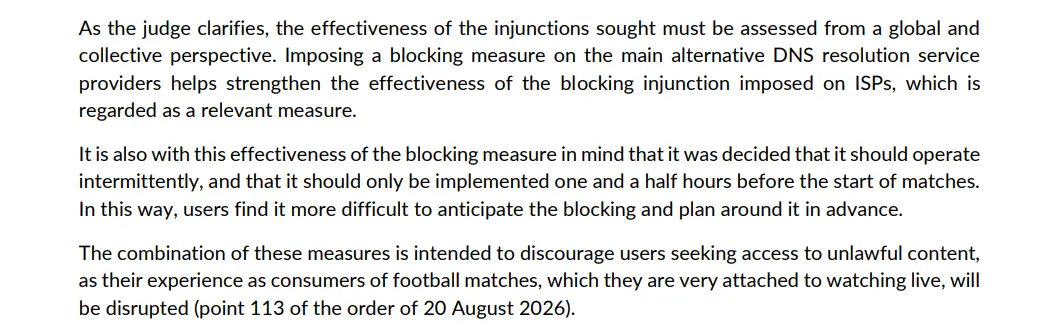
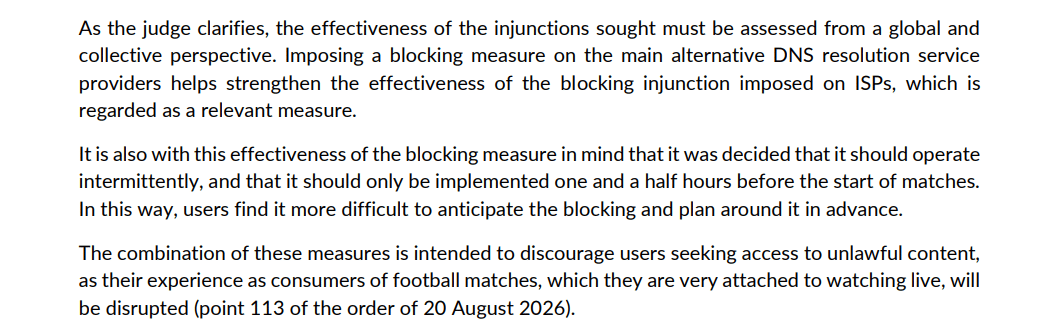
"Imposing a blocking measure on the main alternative DNS resolution service providers helps strengthen the effectiveness of the blocking injunction imposed on ISPs, which is regarded as a relevant measure," the administrative decision reads.
"The combination of these measures is intended to discourage users seeking access to unlawful content, as their experience as consumers of football matches, which they are very attached to watching live, will be disrupted," the document adds.
Despite ruling in favor of the rightsholders on the primary issue, the court order did include minor concessions for the DNS providers. Notably, the court scrapped a contentious requirement compelling providers to redirect users attempting to access blocked sites to a formal warning page, acknowledging that such messaging tools cannot be reasonably imposed on fundamental DNS resolvers.
The severe financial penalties for non-compliance were also modified and softened by the court. While the baseline threat of a €100,000 daily fine remains on the books, the penalty will now only accrue on days when live DAZN matches are actively broadcast. Moreover, the court established a maximum liability cap of €20 million per company, and crucially stipulated that fines will not be applied in instances of under-blocking caused by exceptional geolocation errors.
Evolving Blocklist with a 90-minute Clock
The implementation decision details the logistical framework governing how the blocks will operate during live sports broadcasts. The enforcement scope is specifically tailored to cover matches from major Belgian football competitions, most notably the Jupiler Pro League. As the competitive season progresses, DAZN is permitted to submit a single blocklist update per week, containing a maximum threshold of 100 newly targeted domains.
The update schedule is designed to remain flexible rather than rigid. DAZN must inform the anti-piracy department which specific matchday it wishes to target with an updated blocklist at least seven working days in advance. Once notified, the affected DNS resolvers are granted a window of five working days to implement the requested changes across their networks.

To maximize the disruption of unauthorized streams, the actual technical blockades are mandated to go live precisely 90 minutes before a scheduled match begins, catching illicit operators and viewers off guard.
"It is also with this effectiveness of the blocking measure in mind that it was decided that it should operate intermittently, and that it should only be implemented one and a half hours before the start of matches," the implementation order explains.
"In this way, users find it more difficult to anticipate the blocking and plan around it in advance."
The dynamic and expanding nature of the enforcement effort is clearly reflected in publicly available data. Records indicate that the volume of domains blocked under the evolving order has steadily climbed from an initial 58 domains up to 258 following its initial deployment.
OpenDNS Exit Looms
While Google and Cloudflare adapted their operations to comply with the original mandate last year—a posture that remains unchanged under the latest ruling—Cisco faces a vastly different operational reality.
During the legal proceedings, Cisco representatives informed the anti-piracy department that the company cannot accommodate the court’s demands within its technical framework. Consequently, Cisco intends to pull OpenDNS out of Belgium for a second time.
The networking giant argued that its public DNS system "does not allow for the implementation of selective, geolocated and dynamic blocking as required by the order." Furthermore, the company maintained that attempting to force such custom modifications "would compromise the performance, stability and security of that service."
Faced with these technical limitations, withdrawing from the Belgian market is the only concrete measure Cisco considers "technically able" to implement in response to the legal pressure. The Belgian anti-piracy department has formally accepted this drastic step as a valid form of compliance under the terms of the order.
The affected DNS resolvers have been granted a three-month grace period to implement the mandated blocking measures. For the time being, OpenDNS remains fully operational in Belgium, and Cisco has indicated its intention to formally appeal the ruling, though a definitive public statement from the company was still being finalized as of publication.
Unless a higher court intervenes and alters the legal landscape on appeal, everyday users of OpenDNS in Belgium can anticipate that the popular public resolver will go dark across the country later this year.
In a brief statement addressing ongoing inquiries, a Cisco spokesperson reiterated the current status: "OpenDNS currently remains available in Belgium."
A complete copy of the Belgian anti-piracy department’s implementation decision has been made publicly available via official legal channels.



Leave a Reply