
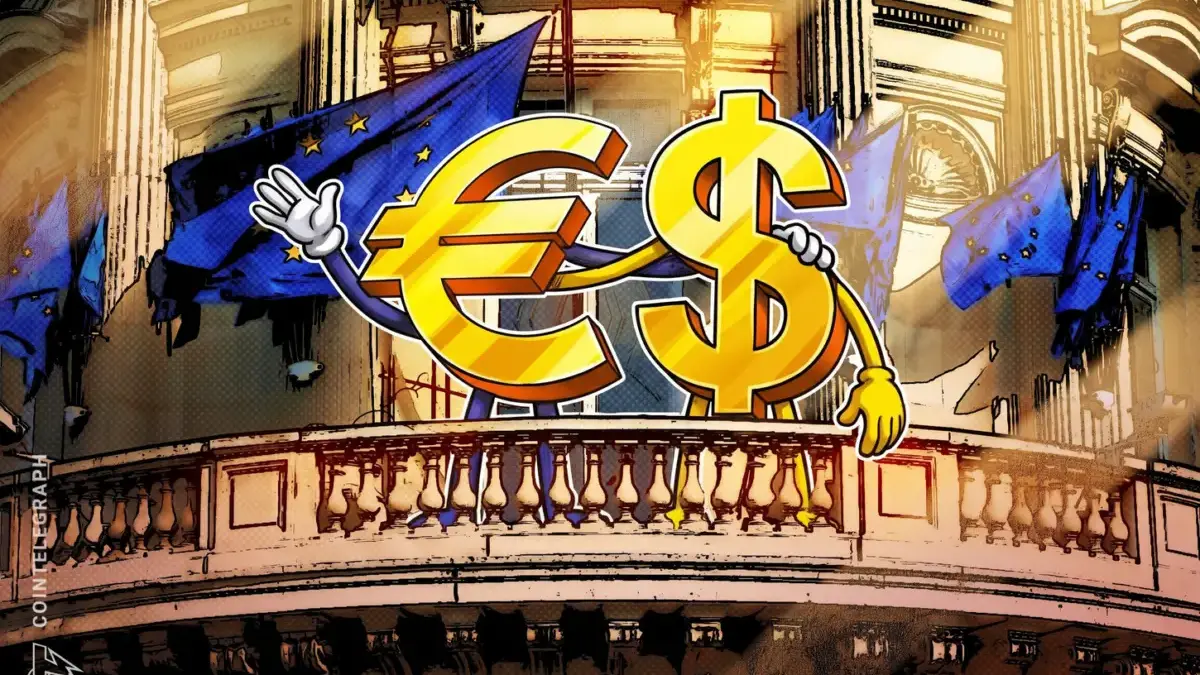
European stablecoin issuers are mounting a concerted case for regulated United States dollar tokens, arguing that Europe’s broader policy push to strengthen the international standing of the euro does not eliminate the fundamental operational need for dollar liquidity among regional businesses.
The debate comes as digital asset firms navigate the evolving regulatory landscape in the European Union, balancing compliance with the Markets in Crypto-Assets (MiCA) framework against the practical demands of global commerce. Industry leaders contend that while European institutions remain cautious about the dominance of foreign fiat currencies, the daily realities of international trade dictate a continuous requirement for dollar-denominated digital cash solutions.
Reflecting this ongoing commercial reality, AllUnity, a German stablecoin issuer, officially launched its US dollar-pegged stablecoin, USDAU. The rollout expands the company’s MiCA-regulated product lineup beyond traditional European currencies, positioning it to capture institutional demand for compliant dollar rails originating within the EU.
For European corporations engaged in international commerce, relying strictly on regional currency instruments is often seen as commercially restrictive. In global trade and foreign exchange markets, the US dollar functions as the primary medium of exchange and settlement. Alexander Höptner, CEO of AllUnity, emphasized this dynamic, noting that for European corporates executing cross-border payments on a global scale, offering solely a euro stablecoin is simply insufficient to meet operational requirements.
The strategic pivot by European issuers into dollar stablecoins coincides with a critical juncture for regional policymaking. The European Union is currently reviewing its landmark MiCA regulatory framework, which has already reshaped how digital assets operate within member states. Simultaneously, the European Central Bank (ECB) has repeatedly raised concerns regarding the proliferation of stablecoins, warning that the widespread adoption of private dollar tokens could reinforce the global dominance of the United States dollar and potentially complicate the ECB’s monetary sovereignty objectives.
Europe cannot "wish away" dollar demand
Industry executives argue that the persistent demand for dollar stablecoins across Europe is driven by practical, everyday business necessities rather than speculative trends that policymakers can simply steer toward the euro. James Bennett, CEO of Stable Mint, addressed the friction between regulatory aspirations and market realities, asserting that the economic gravity of the dollar cannot be legislated out of existence.
According to Bennett, demand for dollar stablecoins is where the market currently operates, and Europe cannot simply wish that demand away. Instead, he suggested that the most pragmatic approach for European authorities is to focus on regulatory oversight—controlling who issues these tokens to European users and under what precise rules they operate.
Data shared by Stable Mint illustrates the tangible scale of this niche within the European ecosystem. The company’s USDSM stablecoin has recorded more than $380 million in onchain volume across approximately 3.8 million individual transfers. Furthermore, the asset is actively held by more than 2,600 distinct addresses, reflecting steady transactional utility among its user base.
The practical necessity of round-the-clock liquidity was echoed by Adam Bialy, CEO of Fiat Republic. Bialy pointed to consistent demand originating from crypto platforms, financial technology firms, and stablecoin operators that require continuous, 24/7 dollar settlement capabilities to manage operations smoothly.
Bialy reiterated that the demand observed in the market is fundamentally practical rather than speculative. He added that the introduction of a regulated dollar token issued within a compliant framework can significantly reduce friction in cross-border settlements flowing between Europe, the United Kingdom, and North America.
Not "euro versus dollar"
Rather than framing the emergence of regulated dollar-pegged assets as a hostile challenge to European monetary policy, major institutional participants are advocating for a diversified approach. Societe Generale-FORGE (SG-Forge), the specialized digital asset subsidiary of French banking giant Societe Generale, argues that the overarching objective should be to foster a resilient and varied ecosystem rather than an adversarial zero-sum game between currencies.
A spokesperson for SG-Forge noted that the goal should not be to oppose dollar stablecoins. Instead, the focus ought to be on cultivating a diversified and resilient market environment where corporate and retail users can seamlessly access both euro and dollar-denominated digital cash solutions, all operating securely within a robust regulatory framework.
SG-Forge has already tested these waters with its own digital offerings. The company’s USD CoinVertible (USDCV), launched in 2025, has steadily attracted institutional interest for a variety of use cases, including digital asset trading, automated settlement, collateral management, and corporate treasury operations.
Despite the growing institutional momentum and the establishment of compliant issuance paths, Europe-issued dollar stablecoins still occupy a very small fraction of the broader global market. They remain tiny when compared to dominant global giants like Tether’s USDT and Circle’s USDC. Market data from CoinGecko indicates that smaller regional alternatives like USDSM and USDCV command market capitalizations of roughly $13 million each. This stands in stark contrast to the massive circulating supplies of USDT at approximately $184 billion and USDC at around $74 billion.
AllUnity’s Höptner framed the long-term market opportunity through a lens of integration rather than division. He argued that the emerging market structure is not about a geopolitical contest between the United States and Europe, but rather about constructing interoperable financial infrastructure that successfully bridges global dollar liquidity with European banking institutions and commercial enterprises.



Leave a Reply