

British multinational banking giant Standard Chartered has issued a bullish forecast for the decentralized finance sector, projecting that the supply of Ethena’s USDe stablecoin will experience an eightfold increase to reach $40 billion by the end of 2028. According to the bank’s analysis, this substantial growth will be driven largely by the protocol’s strategic efforts to expand its yield generation mechanisms far beyond traditional cryptocurrency markets and into broader institutional and real-world asset classes.
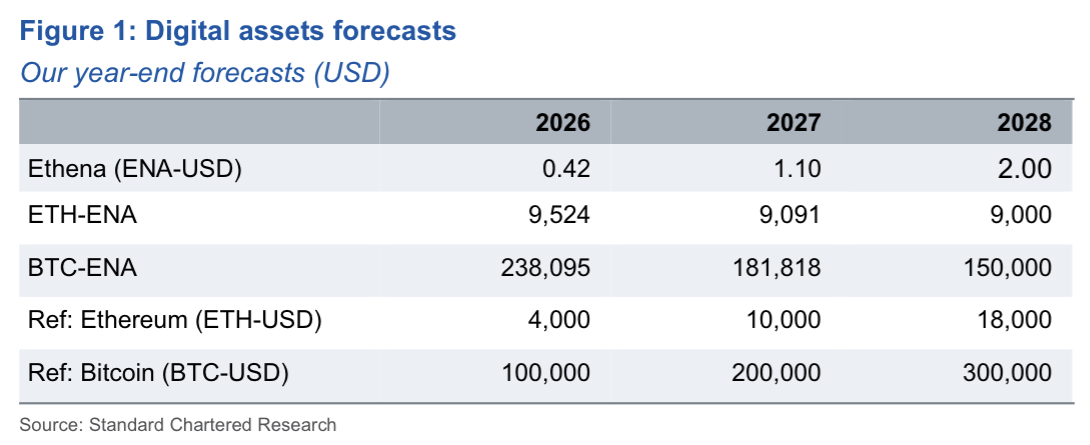
In a comprehensive research report published on Wednesday and shared with Cointelegraph, Standard Chartered officially initiated coverage of Ethena’s native utility and governance token, ENA. The financial institution established a definitive year-end 2028 price target of $2 for the asset, a projection that sits roughly seven times higher than the $0.28 valuation cited within the text of the report. Furthermore, the bank’s macroeconomic and digital asset models suggest that USDe is well-positioned to slightly outpace the growth rate of the overall stablecoin market throughout the forecast period.
The bank’s ambitious outlook implies that ENA would outperform foundational digital assets such as Bitcoin and Ether over the same timeframe. Within the same research framework, Standard Chartered outlined expectations for Bitcoin to climb to $300,000 and Ether to reach $18,000 by the conclusion of 2028. This comparative outperformance highlights traditional finance’s growing interest in specialized decentralized finance protocols that successfully bridge on-chain liquidity with off-chain financial instruments.

According to Standard Chartered, the primary catalyst behind Ethena’s strategic evolution is the declining return profile associated with USDe’s original crypto basis trade. The classic strategy typically involves holding spot cryptocurrencies while simultaneously shorting perpetual futures contracts to capture funding rates. As these specific crypto-native yields have moderated, Ethena has been actively compelled to diversify its revenue streams. The protocol has branched out into decentralized finance lending markets, institutional borrowing, real-world assets, and alternative basis trades tied directly to equities and commodities.
These emerging and diversified sources currently generate a healthy blended yield of approximately 5.2%, providing USDe with a sustainable foundation and considerably more room to scale its supply without relying exclusively on volatile crypto market dynamics. This expansion aligns seamlessly with macroeconomic projections for the broader tokenized asset ecosystem. Standard Chartered forecasts that the total market for tokenized real-world assets will expand dramatically from an estimated $350 billion today to an impressive $4 trillion by the end of 2028, significantly widening the pool of viable assets that protocols like Ethena can leverage to generate consistent yield.
USDe Growth Could Fuel ENA Buybacks
The direct economic relationship linking USDe supply expansion to potential ENA token buybacks forms the cornerstone of Standard Chartered’s valuation thesis for the asset. A pivotal fee-switching mechanism, which was officially approved by Ethena governance early in September, fundamentally alters the token’s economic design. Once the circulating supply of USDe achieves specific predetermined milestones, this mechanism directs 95% of the net revenue generated across the protocol’s various business lines directly toward open-market ENA buybacks.
To contextualize the scale of this mechanism, Ethena estimates that if the supply of USDe reaches $25 billion, the protocol could theoretically generate up to $375 million in annual ENA buybacks. This projection assumes a conservative 6% gross protocol yield paired with a 25% net revenue take rate, demonstrating the powerful cash-flow generation capabilities embedded within the protocol’s architectural framework.
Standard Chartered extended these projections further, calculating that if USDe successfully attains its forecasted $40 billion benchmark while the price of ENA remains stagnant, the resulting annual buyback volume would amount to roughly 23% of ENA’s total circulating market capitalization. However, the bank noted that such an extraordinarily high buyback rate would likely prove unsustainable over the long term. Consequently, analysts expect that market dynamics will drive ENA’s price upward until annual buyback expenditures naturally settle at a much lower, more sustainable percentage of the token’s overall market value.
To illustrate this economic stabilization process, the bank drew a direct comparison to decentralized exchange Uniswap. Standard Chartered pointed out that the annualized buyback rate for Uniswap’s UNI token naturally stabilized in the range of 3% to 4% as the valuation of the token increased to reflect the protocol’s underlying utility and revenue generation.
Reflecting the growing optimism among institutional analysts and market participants alike, ENA was trading at approximately $0.27 on Wednesday. Market data from CoinGecko indicates that the token has experienced strong upward momentum, gaining roughly 28% over the preceding week and an impressive 77% over the past month. With these recent gains, ENA commands a circulating market capitalization of approximately $2.65 billion, positioning it as one of the closely watched alternative digital assets within the rapidly evolving decentralized finance landscape.



Leave a Reply