

Spain’s premier professional football league, LaLiga, is escalating its efforts against digital piracy by petitioning the European Commission to add major VPN providers and a popular streaming application to its official Counterfeit and Piracy Watch List.
Every few years, rights holders are given the opportunity to present evidence to the European Commission regarding which pirate sites, services, and online intermediaries deserve a designated spot on the EU Counterfeit and Piracy Watch List. These submissions have historically focused on traditional digital copyright threats, including peer-to-peer torrent platforms, cyberlockers, and unauthorized Internet Protocol Television (IPTV) services. In more recent editions, however, the scope has expanded to include vital internet infrastructure intermediaries such as hosting providers and the domain name and security service Cloudflare.
LaLiga is now pushing that expanding reach significantly further. In its formal submission for the upcoming 2027 edition of the watch list, the Spanish football league is asking the European authorities to place four of the industry’s most prominent virtual private network providers—NordVPN, ProtonVPN, ExpressVPN, and Surfshark—under the regulatory microscope.
The extensive 14-page submission addresses a wide array of online sites and services, blending traditional piracy targets with the entirely new category of commercial VPN operations. LaLiga is careful to note in its filing that it does not take direct issue with the underlying encryption and privacy technology itself. Instead, the league’s grievances are directed at how these specific commercial providers are marketed to consumers by third parties through expansive affiliate marketing programs.
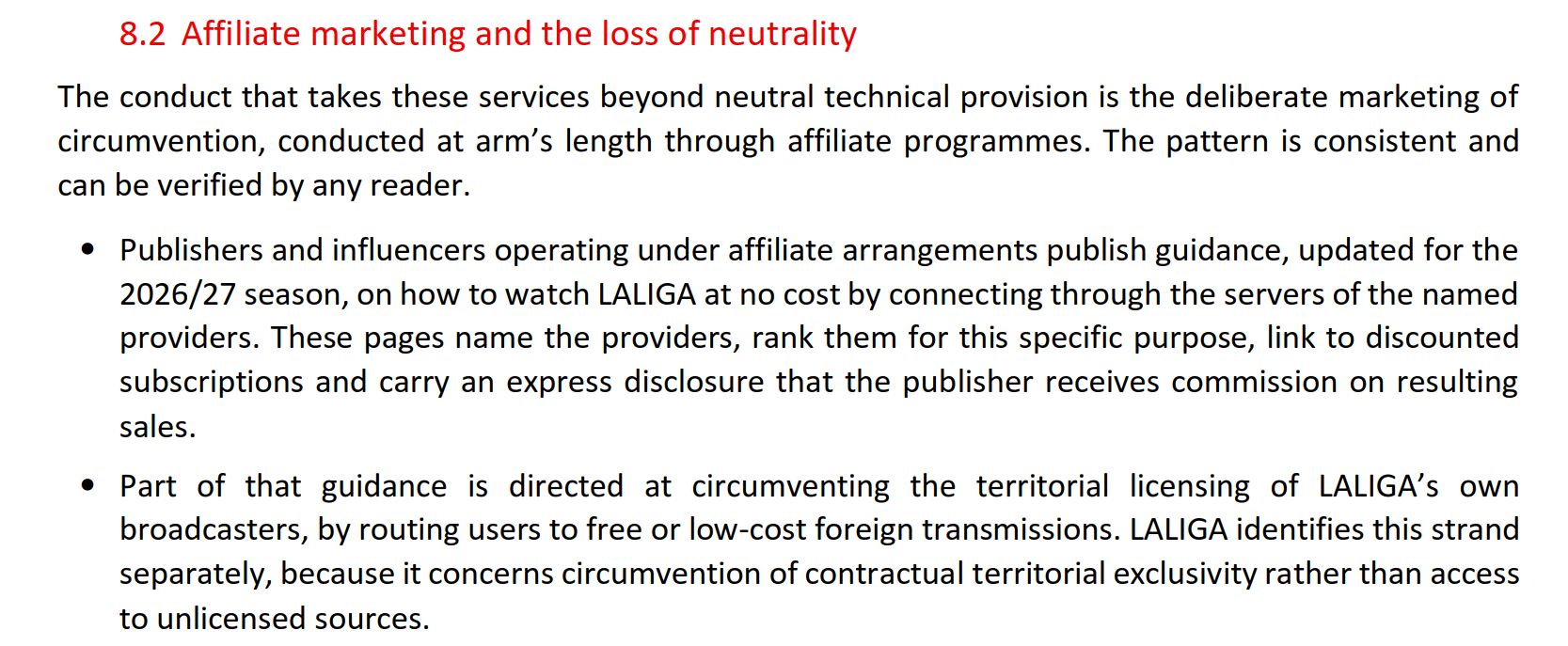
The conduct that takes these services beyond neutral technical provision is described by LaLiga as the deliberate marketing of circumvention, conducted at arm’s length through commercial affiliate networks.
Geo-Unblocking Free Football Broadcasts

To illustrate its point, LaLiga details how online publishers, content creators, and social media influencers leverage lucrative affiliate deals to publish specialized guides, frequently updated for the 2026 and 2027 football seasons. These guides instruct consumers on how to watch live Spanish league matches for free or at a reduced cost by routing their internet traffic through foreign servers via these commercial VPNs.
Such online pages typically rank the various VPN providers and embed direct affiliate links to discounted subscriptions, allowing the publishers to earn a direct financial commission on resulting sales.
Some of these guides explicitly advise football fans that they can utilize VPN software to bypass standard geographic licensing restrictions, known as geoblocking. This allows viewers to access free or low-cost official broadcasts intended exclusively for audiences in other countries. While this specific tactic may not always involve traditional illegal pirate video streams, LaLiga argues that the practice severely undermines the territorial exclusivity upon which its multi-million-euro broadcasting rights and licensing deals are built.
Guides of this nature are readily accessible across the web. Independent reviews of online media have frequently encountered Spanish-language web pages, meticulously updated for the current sports calendar, that explicitly recommend connecting to foreign VPN server locations to view live matches on overseas free-to-air television networks.
These explicit recommendations are published and maintained by independent affiliate marketers rather than the VPN companies themselves. LaLiga’s official submission stops short of claiming that the corporate VPN providers write the promotional guides directly, but it strongly contends that the providers ultimately profit from the traffic and subscriptions generated by these campaigns.
Circumventing Pirate Site Blockades
Beyond the circumvention of geographical broadcasting boundaries, the league’s submission also flags affiliate guides that it views as presenting a much more severe legal threat. These are promotional pages that explicitly name illegal pirate streaming websites and services, while assuring readers that a commercial VPN can be used to seamlessly bypass court-ordered site-blocking measures implemented by national internet service providers.

LaLiga asserts that anyone can easily verify the existence of this affiliate marketing activity across the internet. However, the regulatory submission does not specifically name or hyperlink to a single individual guide, publisher, or influencer crossing the line.
According to LaLiga, the publishers operating these guidance sites are not always entirely independent entities. The submission highlights corporate connections, such as linking the prominent vpnMentor review portal to Kape Technologies, a holding group that simultaneously owns several major consumer VPN services.
Publishers of the guidance are in some cases not independent, the submission reads, noting that within one of the corporate groups identified, VPN review and ranking publications operate under the same ultimate ownership as the commercial products they evaluate and recommend—a financial relationship that those specific publications routinely disclose to their readers.
Which specific publications among these networks feature the exact guides described by LaLiga is left unspecified in the public documents.
The submission further claims that certain VPN providers have historically rolled out promotional marketing campaigns strategically timed to coincide with high-profile match calendars. While this allegation is not heavily fortified with direct evidence within the text of the EU filing, a Spanish court in Córdoba reached a strikingly similar conclusion earlier in the year. In February, the court issued an ex parte site-blocking injunction against ProtonVPN and NordVPN.
Without hearing arguments from the VPN providers beforehand, the Spanish court concluded at the time that both NordVPN and ProtonVPN actively advertised their technical capability to bypass regional geo-restrictions, pointing to the inclusion of football match schedules in promotional materials and describing the virtual private network companies as active participants in the digital piracy ecosystem.
That legal battle remains far from settled. In May, the exact same court in Córdoba declined to issue financial penalties against NordVPN for failing to fully comply with the blocking orders, accepting technical arguments that the targeted IP addresses of the pirate streaming sources change with immense frequency. The core legal proceedings regarding the broader liability of the providers are still ongoing.
VPN Technology is Fine
In its formal request to the European Commission, LaLiga asks for the four major providers to be listed due to their alleged role in facilitating unauthorized access to blocked pirate sites and services. The football league repeatedly stresses that it is not waging a war against the underlying software or privacy protocols.
This request is based not on the provision of VPN services as such, but on the commercial exploitation and active promotion of their ability to circumvent court-ordered blocking measures, LaLiga writes in the filing.
The submission also opens with an explicit legal disclaimer, clarifying that the document does not assert any definitive finding of legal liability against the specific corporate entities named within its pages.
The primary legal argument relies heavily on the affiliate promotion angle, though it operates without pointing to specific, named guides. Whether this evidentiary approach will satisfy the European Commission remains to be seen, particularly as the broader legal debate continues in courts and among lawmakers regarding whether VPN providers should ever be legally mandated to implement national site-blocking orders.
AFTVnews Downloader Short Codes
Virtual private networks are not the only general-purpose digital tools featured in LaLiga’s extensive submission to European authorities. The Spanish football league has also taken direct aim at Downloader by AFTVnews, a widely used application designed for Amazon Fire TV and Android TV hardware that allows users to download files simply by entering a direct URL or a short numeric code.

LaLiga states that it successfully catalogued 341 of these numeric short codes, discovering that 262 of them directed users straight to applications offering unauthorized pirate streams. The league characterizes these codes as a deliberately curated catalogue operating under the exclusive editorial control of the application’s operator.
The ease and simplicity with which applications can be discovered and installed through this catalogue is itself demonstrative of its nature as an editorially-curated platform, distinct from the underlying distribution infrastructure, LaLiga argues in the text.
AFTVnews, an outlet and platform boasting more than 100 million active users, has previously explained that these short codes are generated organically by the AFTVnews URL Shortener, suggesting they are frequently created from inbound links submitted directly by users of the system.
The Downloader application is no stranger to regulatory scrutiny. In 2023, Google temporarily removed the utility application from its official Play Store following formal complaints lodged by Israeli television broadcasting companies, and later removed it again following a Digital Millennium Copyright Act (DMCA) notice filed by brand protection firm Markscan. The app was subsequently reinstated after legal discussions and adjustments.
Whether the European Commission will choose to incorporate Downloader or any of the four targeted VPN providers into its finalized 2027 piracy watch list remains to be seen. The most recent Counterfeit and Piracy Watch List, published by the EU in 2025, ultimately chose not to include any commercial VPN services, though it did single out various international hosting providers, the InterPlanetary File System (IPFS), and domain privacy service Njalla.
A complete copy of LaLiga’s formal submission to the European Commission has been made publicly available through legal documentation archives. Representatives for ProtonVPN, the VPN Trust Initiative, and AFTVnews were contacted for professional comment prior to publication, but did not respond in time.


Leave a Reply