
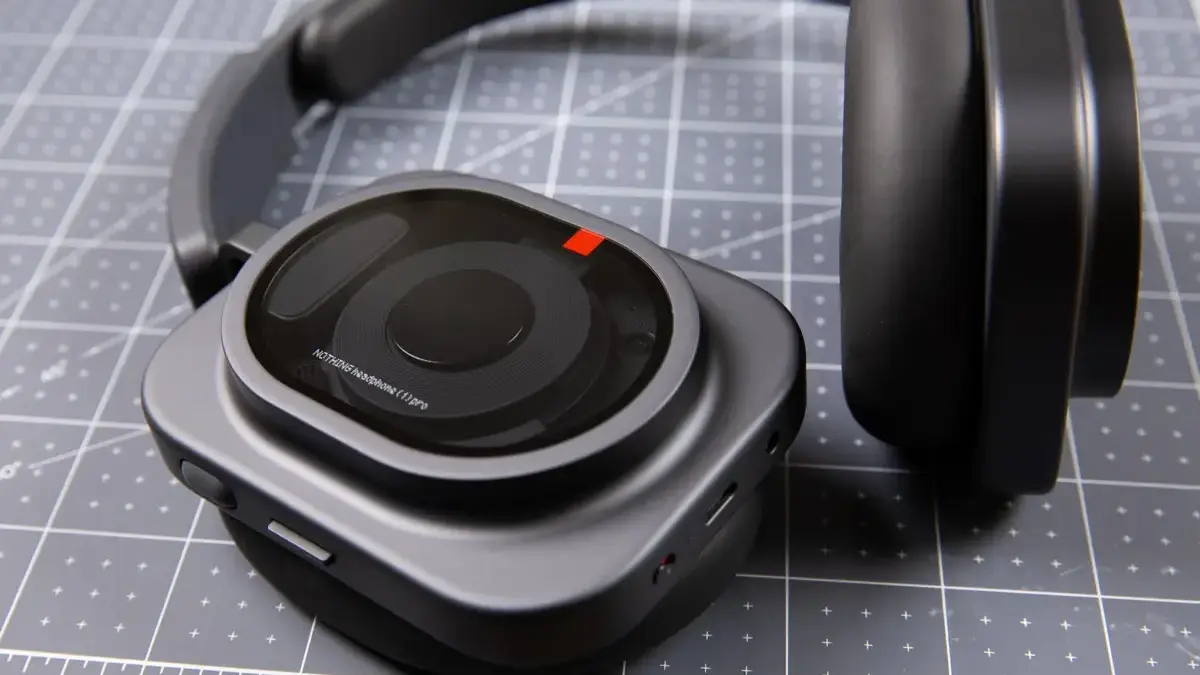
The audio industry has recently trended heavily toward adding more layers of EQ customization to headphones rather than taking them away. Even Apple finally added a three-band equalizer option for the AirPods with its recent iOS 27 software update, giving users more granular control over their sound signatures. But the Headphone 1 Pro takes the opposite approach by including a hardware switch designed to instantly disable all custom EQ adjustments and spatial audio options found within the Nothing X app. The primary stated goal of this feature is to give studio professionals the precise ability to hear exactly what they are mixing without any artificial coloration from the headphones themselves. This intriguing idea came to life through a collaborative partnership with Metropolis Studios, a renowned recording and mastering space located in London where producer Mark Ronson notably worked on Amy Winehouse’s legendary album Back in Black.
Nothing’s default Balanced EQ sound setting tends to be forward in both the midrange and high frequencies, giving the audio profile a distinct character. Vocals sound prominent with a noticeable bit of bite, and percussion elements like cymbals come through with extra sizzle. There is a marked and immediate difference when the physical switch is flipped. Turning on the Flat EQ mode brings those forward mid and high frequencies much more in line with the low-end bass response, ensuring that nothing sticks out too aggressively in the mix. However, this adjustment does come with a trade-off, as it takes away some of the natural airiness and openness of the music. For everyday casual listening, many users will likely prefer taking off some of the high-end edge by utilizing the advanced parametric EQ available within the companion app instead of relying solely on the Flat EQ switch.

The physical switch itself is refreshingly well-designed for practical use. It is small and positioned discreetly on an inside corner of the left ear cup, keeping it safely tucked away from any of the other primary controls. Because of its out-of-the-way placement, there is virtually no worry about accidentally toggling it on or off while handling or wearing the headphones during daily commutes or listening sessions.
The underlying concept of a flat equalization response curve sounds appealing on paper, promising to let the listener experience audio the way it was intended in the mixing room without the headphones imposing their own distinct sound signature. However, extensive audio research conducted by Dr. Sean Olive and his colleagues at Harman demonstrates that the vast majority of human listeners actually prefer a very specific frequency curve. This preferred profile features an elevated bass response, relatively neutral midrange frequencies for natural-sounding vocals, and slightly boosted highs that roll off gently above around 5kHz, a benchmark widely known as the Harman Curve. Consequently, while there is a clear, functional use case for an unaffected EQ curve when performing critical studio monitoring and mixing work, a truly flat EQ will often sound off, sterile, or fundamentally wrong to regular consumers. Furthermore, audio experts note that even within a professional studio environment, flat EQ headphones are largely unnecessary because most modern studio monitors are already meticulously tuned to follow the Harman Curve.
Another major engineering choice that sets the Nothing Headphone 1 Pro apart from mainstream heavyweights like the Sony XM6, AirPods Max 2, and Bose Ultra Headphones Gen 2 is the acoustic driver layout. While those three prominent competitors rely on a single traditional driver for each side, Nothing has opted for a sophisticated triple-driver architecture. This system incorporates a 40mm dynamic driver dedicated strictly to handling the bass, a separate dedicated midrange driver, and an xMEMS driver—which is a tiny, innovative solid-state silicon driver—handling the upper frequencies. This complex division of labor allows each individual driver to focus exclusively on a specific frequency range, resulting in a cleaner, faster attack in the higher frequencies and improved overall clarity across the entire audio spectrum.

In addition to its unique driver configuration, the Nothing Headphone 1 Pro supports high-resolution audio codecs including LDAC, enabling both wired and wireless high-res streaming up to 24-bit/96kHz. For purists who prefer a wired connection, the headphones also support lossless audio over USB-C up to an impressive 24-bit/192kHz. Furthermore, the headphones are capable of acting as either an Auracast transmitter or a receiver directly through the Nothing X app. This is a forward-looking feature that all flagship headphones ought to include as standard, a philosophy shared by the Sony XM5 and XM6, alongside recent firmware updates that brought similar capabilities to the Bose Ultra Headphones.
The active noise cancellation performance on the Nothing Headphone 1 Pro proves genuinely impressive during daily use, effectively rising to the occasion against stiff market competition. The ANC system does an excellent job of blocking out persistent low-end rumbling sounds, such as roaring airplane cabin noise or nearby commercial air conditioning units, while also handling urban street traffic with a high degree of competence. While it may not quite match the absolute industry-leading isolation offered by the current top three tier-one competitors—namely the Sony XM6, Bose Ultra Headphones Gen 2, and Apple AirPods Max 2—turning on music is more than enough to completely isolate the listener from the surrounding world. For Nothing as a hardware manufacturer, this represents by far the best noise cancellation performance the company has ever delivered in an audio product.
Aesthetic and ergonomic choices remain a central pillar of the brand’s identity, meaning there is zero chance of mistaking the Headphone 1 Pro for anything other than a Nothing product. The over-ears feature the exact same distinctive design language seen across the company’s previous audio gear, incorporating the same tactile physical controls that fans have come to appreciate, particularly the satisfying volume roller wheel. However, not every design decision is bound to win universal praise. The headphones ship with a hard-shell carrying case reminiscent of Apple’s controversial AirPods Max smart case, closing tightly around just the ear cups while leaving the headband completely exposed to act as a convenient built-up handle. While this protective shell has a distinct advantage over Apple’s fabric-style sleeve by utilizing a sturdy hard structure, many users will likely wish the case enclosed and protected the entire pair of headphones.

Durability and longevity are also taken into account, with the Headphone 1 Pro carrying an IP52 rating for dust and water resistance, providing a reasonable layer of protection against unexpected weather or sweat. When it comes to power, the headphones deliver exceptional battery life, offering up to 30 hours of continuous playback with active noise cancellation turned on, or a staggering 68 hours of total listening time with ANC switched completely off.
Having spent considerable time evaluating the hardware and running comparisons against key market rivals, the Nothing Headphone 1 Pro makes a remarkably strong statement. They stand easily as the best-sounding and most capable headphones Nothing has released to date. While the dedicated Flat EQ switch will likely remain an intriguing niche novelty for the vast majority of regular consumers, professional studio engineers and mixing enthusiasts may find genuine utility in the option. For everyone else, the strong active noise cancellation, excellent build quality, high-resolution audio support, and appealing sound profile—especially for listeners who appreciate a bit more high-end presence—make them a compelling alternative in the crowded flagship audio space, all wrapped up in the unmistakable Nothing aesthetic for those who want to stand out from the crowd.



Leave a Reply