
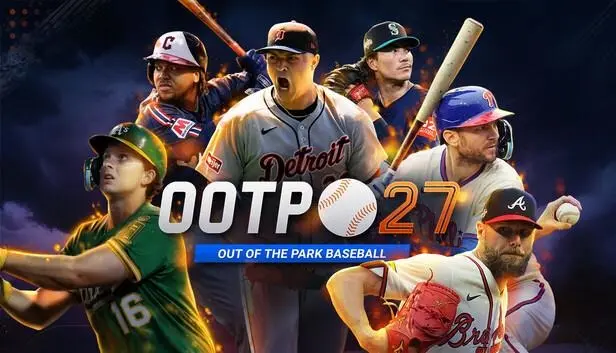
If you were to ask dedicated fans what game or game series they have sunk the most time into, the answers might range from sprawling open-world role-playing epics to massive online multiplayer battle arenas. For a very particular brand of sports nerd, however, the answer is a singular, text-heavy simulation: Out of the Park Baseball, universally known as OOTP. According to Steam metrics, some players have logged roughly 2,300 hours into various editions of the franchise. It is a staggering amount of time spent not on hyper-realistic graphics or pulse-pounding arcade action, but on a deep, intricate statistical simulation.
OOTP is fundamentally different from mainstream sports titles like MLB The Show or arcade hits like Super Mega Baseball. It is not graphically impressive, nor is it designed to deliver a quick burst of simple, casual fun. Instead, it is essentially a sophisticated spreadsheet disguised as a video game. It offers the core fantasy of baseball management, but without the agonizing six-month real-world wait to see if a sleeper draft pick pans out, because players can plow through an entire grueling 162-game season in as little as a few hours.
While players have the option to step down into the dugout to play individual games and dig into granular, pitch-by-pitch management, that approach quickly becomes tedious. Frankly, it is not where the game shines brightest or delivers the most entertainment. Instead, the experience reaches its peak when you sit firmly in the general manager’s chair, looking down from the executive suite, and perhaps offering some helpful, authoritative "suggestions" about how the coaching staff should structure the batting lineup or manage the bullpen.
The user interface is notoriously complicated and dense. Roughly 90 percent of the time spent playing OOTP consists of staring intently at endless rows of statistics, historical metrics, and exhaustive scouting reports. The sheer level of detail embedded within the software is remarkably deep. The database does not merely include the current rosters of Major League Baseball; it stretches backward across generations to encompass historical MLB players, filters down through every single level of minor league organization, spans international borders to feature South Korea’s KBO League, and even models the entire global landscape of the World Baseball Classic.
There is a distinct, undeniable thrill that comes from digging through this mountain of information and trying to unearth that elusive diamond in the rough during an amateur draft. Finding someone who might eventually blossom into the new cornerstone franchise player for your favorite team in this alternate reality is intensely rewarding. Conversely, making the high-stakes executive decision of whether to place your financial and competitive bets on an unproven prospect developing into a superstar, or instead trading them away for an undeniable, battle-tested big-league All-Star, can be deeply stressful. The simulation even models external pressures, forcing you to worry about whether the fan base will riot or abandon the franchise entirely if you fail to re-sign a beloved fan favorite.
In the author’s personalized alternate universe with the New York Mets, Brandon Nimmo transcends the status of a merely good player to become a household superstar. Pitcher Kodai Senga has racked up three Cy Young Awards. After successfully signing marquee free agent Juan Soto, a shrewd trade involving a raft of mid-tier prospects brought Ronald Acuña Jr. to Queens, leading the franchise to four consecutive playoff appearances and, ultimately, an elusive World Series title. For a long-suffering Mets fan navigating the trials of real-world fandom, having this digital sanctuary is a vital coping mechanism, providing a virtual escape where championship rings are entirely within reach.
Perhaps the greatest triumph of OOTP Baseball, however, is that it accommodates virtually any playstyle. It is deeply customizable from the ground up. If you want a slow, methodical pace, you can manually play out every single inning of every game. If you prefer a macro-level approach, you can speed-simulate entire decades in a single afternoon. For those seeking a more relaxed experience where players do not shatter their ligaments or strain obliques, the injury sliders can be turned down or switched off entirely. If you tire of dealing with the financial constraints imposed by stingy ownership, you can activate commissioner mode and essentially tell the team owner where to stick their budget limitations. Because the simulation sits quietly and statically waiting for your next input, it is remarkably easy to leave it running in the background of your desktop, dipping in and out to make a quick trade or check a box score whenever you have a few spare minutes during the workday.
Ultimately, OOTP Baseball serves as a remarkably cozy simulation tailored for a very specific niche of sports enthusiasts. If you love fantasy baseball and frequently find yourself wishing you could play it year-round—without having to deal with chaotic group chats and friends arguing over whether a waiver wire bid came in on time—or if you happen to enjoy the quiet, low-stress appeal of cozy management titles like Tiny Bookshop, but desperately wish they possessed a far heavier Sabermetric bent, OOTP Baseball might just be the ideal digital obsession.
The current iteration of the franchise, OOTP Baseball 27, is available now for purchase on Steam or directly through the official developer website.


Leave a Reply