
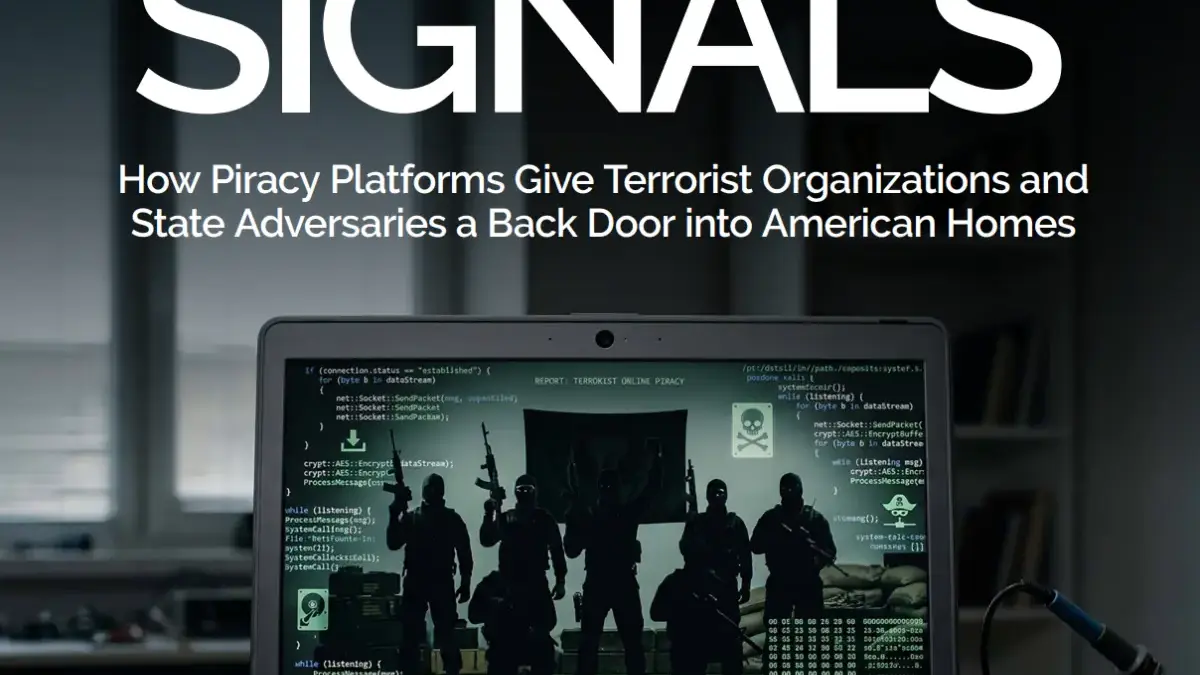
Rightsholders have spent several decades linking copyright infringement and digital piracy to serious organized crime and terrorism. This strategic framing first emerged in the late 1990s, when the International Federation of the Phonographic Industry (IFPI) raised growing concerns about underground criminal networks smuggling mass-produced, pirated compact discs across international borders.
The terrorism angle was formally introduced in 2003 during a U.S. House of Representatives hearing examining the financial connections between digital piracy, organized crime, and global terrorism. Around that exact same period, then-Interpol Secretary General Ronald Noble testified before the U.S. Congress, asserting that intellectual property crime had evolved into a preferred method of financing for a number of active terrorist groups worldwide.
The most frequently cited connection appeared in 2009, when a prominent movie industry-funded research report published by RAND explicitly linked film piracy, transnational organized crime, and terrorist activities. Although that report famously blurred the precise lines between physical counterfeiting and digital piracy, its findings have been continuously referenced by intellectual property advocates ever since.
"Never Forget"
More recently, the Washington, D.C.-based Digital Citizens Alliance, working in close cooperation with the creative industries, has kept this long-standing advocacy tradition alive. In 2017, the organization bundled digital piracy alongside ISIS recruitment videos, dangerous malware distribution, and fake news campaigns in a comprehensive study. As recently as May of this year, the group published findings linking pirate IPTV subscriptions to illicit drugs, illegal weapons trafficking, and organized mafia syndicates.
Yesterday, the Washington advocacy group expanded its terrorist connection argument with an entirely new angle. Titled "Hostile Signals," the newly released report argues that illegal streaming networks do not merely provide illicit financial income to bad actors, but can also act as an unmonitored, sanction-circumventing broadcasting channel for hostile foreign states and extremist organizations.

To add substantial emotional weight to its findings, the report notes that the 25th anniversary of the tragic September 11 terrorist attacks is rapidly approaching, and it closes with the solemn phrase, "Never Forget." Given that the press release was distributed yesterday, the timing of the report’s public rollout is notably calculated to capture maximum political attention in the nation’s capital.
Pirate IPTV Services Carry Terrorist Channels
To investigate the prevalence of illicit broadcasting, researchers from Atlanta-based cybersecurity firm risk3sixty purchased and analyzed 25 commercial pirate IPTV services from standard U.S. internet connections between May and August. The technical audit revealed that 17 of these tested pirate platforms carried at least one television channel directly tied to a designated terrorist organization or a heavily sanctioned state broadcaster.
Al-Manar, the official television station of Hezbollah—an organization with a documented history of attacking American targets and responsibility for at least 291 U.S. deaths over the decades—was available on all 17 of the pirate platforms identified as carrying such content. Additionally, the Houthi-run Al-Masirah channel appeared on nine of the services, Iran’s state-backed Al-Alam network was found on seven, and Hamas-affiliated Al-Aqsa TV was accessible on two.
"Al-Manar, the broadcast outlet of Hezbollah, which has a long history of attacking American targets and is responsible for at least 291 U.S. deaths over decades, is carried by all 17 piracy platforms identified to allowing carriage," the report states.
The security study specifically names several allegedly problematic services, including Lion OTT, Sansat VIP, OTTOcean, Belitvision, and Wish IPTV, all of which were successfully accessed and evaluated from standard residential U.S. internet connections during the testing period.

The United States government officially banned Al-Manar’s satellite transmission feed back in 2004, and a Brooklyn resident was subsequently sentenced to 69 months in federal prison for providing material support to a designated foreign terrorist organization after selling the banned channel to local New York customers. Despite these historical regulatory crackdowns and enforcement actions, modern pirate IPTV services appear to offer a convenient digital back door.
"A piracy subscription has restored what two decades of federal action removed," the report concludes.
Concerns and Nuance
The conclusions presented in the report are undeniably alarming, suggesting that commercial pirate IPTV services could potentially be exploited to radicalize vulnerable individuals within Western nations.
"National security officials, policymakers and citizens alike should be concerned," the report warns readers.
"Piracy platforms have created a new avenue for terrorist organizations and state adversaries to distribute recruitment messaging to U.S. audiences, including content intended to inspire acts of violence."

At the same time, however, the report acknowledges that its empirical findings do not provide concrete data regarding the actual viewership numbers of these specific foreign channels. Furthermore, these channels broadcast entirely in Arabic and typically lack English subtitles or translation features. They also exist merely as a fraction of a vastly broader commercial offering that often includes thousands of international entertainment, sports, and news channels.
Additionally, it is worth pointing out that many of these controversial program streams, including those originating from Hezbollah, remain freely accessible directly through the broadcasters’ own official websites over the open internet. This notably includes the main digital presence of Al-Manar.
Although the U.S. Department of Justice seized 13 Hezbollah-linked domain names in 2023—including seven that directly incorporated the channel’s name—the station’s primary website continues to operate comfortably under Lebanon’s domestic .lb country-code top-level domain. Because this domain falls completely outside the territorial jurisdiction of the United States, it continues to stream its regular programming to international visitors, including users in America, to this day.
While the widespread availability of these feeds on the open web may slightly diminish the exclusive shock value of the report’s IPTV findings, it effectively lays the groundwork for the policy solution that the authors propose next.
Solution: Site-Blocking
The Digital Citizens Alliance report does not merely attempt to highlight an ongoing security problem; it also actively proposes a specific legislative solution. The study argues that the aggressive site-blocking measures currently advocated to combat conventional copyright infringement and pirate websites could equally be deployed to block access to dangerous terrorist and sanctioned state content.

"These findings reinforce the need for the United States to adopt measures to prevent overseas piracy networks from operating in the country," the report notes.
The timing for this policy request aligns closely with ongoing legislative efforts in Washington, where U.S. site-blocking bills have returned to the political agenda. Representative Darrell Issa’s American Copyright Protection Act (ACPA) and Representative Zoe Lofgren’s Foreign Anti-Digital Piracy Act (FADPA) are both currently on the table, and Representative Issa has publicly indicated that a bipartisan, bicameral legislative compromise is drawing close.
Earlier in August, Motion Picture Association chief Charles Rivkin and the head of the National Intellectual Property Rights Coordination Center utilized high-profile World Cup domain seizures to push the exact same site-blocking arguments before lawmakers.
As site-blocking discussions continue to unfold in Washington legislative circles, industry stakeholders on the content-owner side are expected to leverage the newly released "Hostile Signals" report as fresh evidence that cracking down on digital piracy can yield broader national security benefits.
"‘Never Forget’ became the enduring rallying cry for those who experienced the 9/11 attacks. It’s also a reminder to never let the terrorists back in, in any form," the report concludes.


Leave a Reply