
Discord is officially rolling out a brand-new global age assurance system, marking a significant pivot for the platform seven months after it was forced to pause its previous verification measures due to widespread user backlash. Starting today, the updated system goes live in every country across the world with two notable exceptions: Australia and the UK, where distinct regional regulatory frameworks apply. Under this new initiative, Discord will automatically assign its millions of users to an estimated age group by evaluating what the company describes as “multiple account signals.” For users whom the platform’s predictive models believe to fall between the ages of 13 and 17, specific account restrictions will be automatically put in place to ensure a safer online environment.
The introduction of these updates follows a turbulent period for the popular chat and community platform, which slammed the brakes on its earlier age verification rollout back in February. That previous implementation had sparked intense data privacy concerns among the user base. Under that discarded framework, adults were required to actively verify their identities by submitting video selfies or official government identification documentation. The backlash intensified significantly after a security incident involving a data breach at a third-party vendor utilized by Discord. That breach ultimately exposed sensitive user information, including scanned photo IDs, turning a controversial policy into a major public relations and privacy crisis for the company.
In the wake of that fallout, Discord has pivoted entirely toward a frictionless system that is designed to operate seamlessly in the background, theoretically sparing the vast majority of its users from having to take any manual action themselves. According to an official announcement published by Discord co-founder Stanislav Vishnevskiy, the various signals examined by the platform’s sophisticated age group estimation model include foundational metrics such as account age and historical usage patterns. Additionally, the system looks at general activity levels across various communication channels and servers, as well as the types of connected communities, public servers, and integrated games associated with the profile.

Crucially, Vishnevskiy emphasized that the automated system maintains strict privacy boundaries, noting that it does not inspect private user messages, personal voice and video calls, or other direct content exchanged on the platform. Furthermore, the company claims that the predictive accuracy of this new age estimation model is roughly on par with what has traditionally been possible using biometric scanning technologies. Based on internal modeling and testing, Discord anticipates that under this passive system, a staggering 90 percent of its total user base will never even be asked to manually confirm their age, sidestepping the friction and privacy anxieties that plagued the previous rollout.
Under the architecture of the new system, users whose profiles are determined to belong to individuals over the age of 18 will be securely placed into the adult age category, ensuring that there are no noticeable changes or disruptions to their standard account functionality or server access. Conversely, users who are sorted into the teen age group will find that certain protective safety features are enabled automatically by default. These built-in safeguards include robust content filters and automatic blurring for sensitive media, alongside restricted access to designated 18-plus servers and specific messaging features designed to shield minors from inappropriate content.
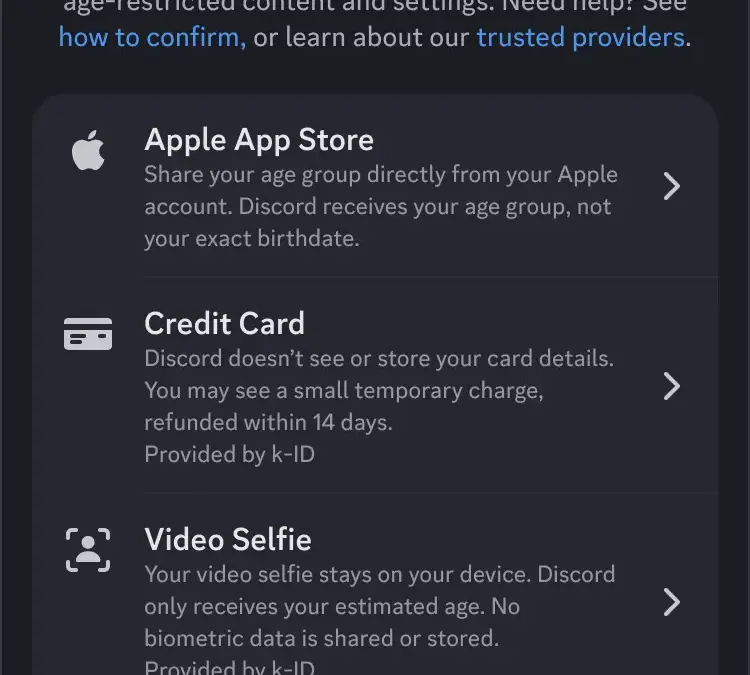
When Discord initially paused its original age assurance launch months ago, company leadership made a firm public pledge to introduce a much wider variety of alternative verification options if manual confirmation ever became strictly necessary. Those promised options are now officially rolling out alongside today’s update. In addition to the previously supported face scans and ID documentation checks, users now have the freedom to choose alternative verification methods. These newly integrated choices include confirming age via traditional credit cards, Apple’s App Store, Google’s Play Store, Google Wallet, and the specialized AgeKey credential system.
In scenarios where Discord’s automated background models are simply unable to determine or estimate a user’s age with sufficient confidence, certain platform settings and advanced features will remain temporarily unavailable. To regain full access, users will be required to provide supplementary information to confirm their accurate age group by navigating directly to User Settings and selecting the Account Status section. This same dedicated settings area also serves as a recourse for adult users who believe they have been mistakenly misassigned to the restrictive teen category, allowing them to supply additional verification details to correct their account status swiftly.

Reflecting on the philosophy behind the new system, Vishnevskiy articulated a clear vision for balancing user safety with personal privacy. He noted that the company firmly believes meeting modern online age requirements should not have to rely on mandatory ID checks or intrusive biometric selfies for every single person on the platform. Instead, the objective is to provide consumers with a broader array of choices, prioritizing less intrusive methods that respect user data by avoiding mandatory biometrics or the collection of sensitive personal information whenever possible.
Vishnevskiy expressed optimism that this revamped approach will demonstrate to the community that a major technology platform can successfully preserve the unique qualities that make Discord special, while simultaneously taking the heavy responsibilities of digital safety and child protection seriously. As the global rollout commences today, the company will be closely monitoring how the automated signals perform in practice, hoping to strike a sustainable balance between regulatory compliance and user trust across its vast digital ecosystem.



Leave a Reply