
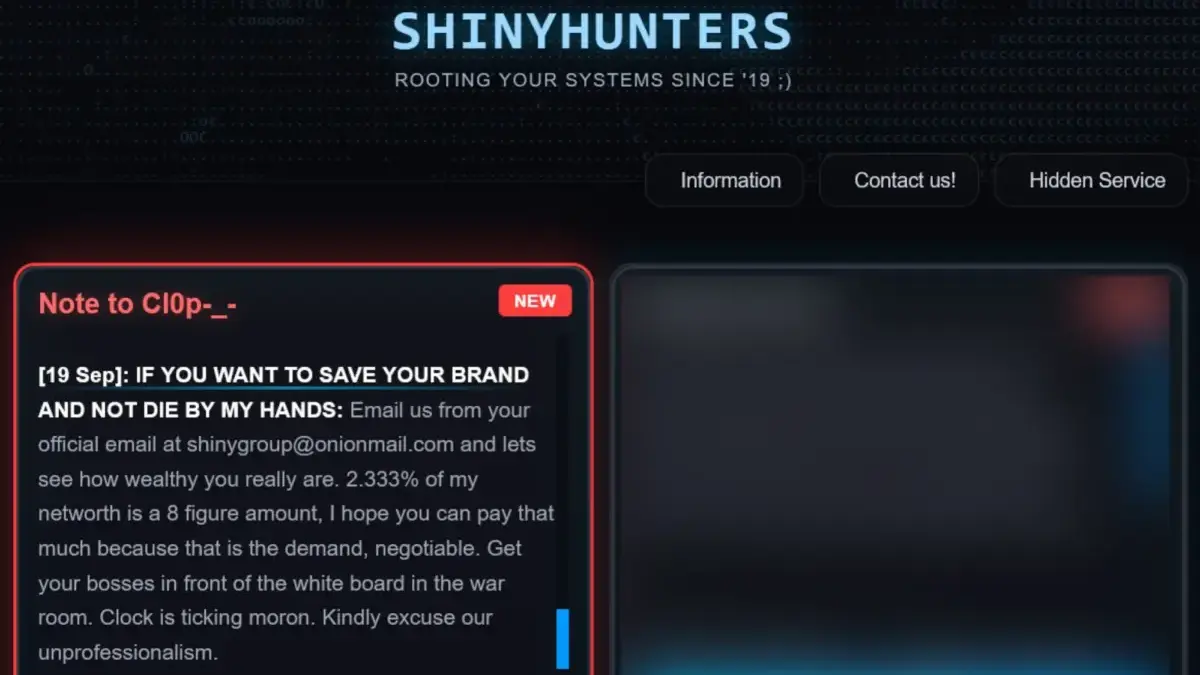
Back in May, the Federal Bureau of Investigation issued a public warning detailing the tactics of a malicious cybercriminal group known for breaching sensitive databases and utilizing stolen information to extort organizations and individuals. Months later, it appears that the bureau itself has become the latest high-profile target of that exact threat group.
The notorious cybercriminal collective ShinyHunters has claimed responsibility for a sweeping breach involving the personal information of FBI employees and job applicants, according to multiple cybersecurity and tech media reports published on September 22. The group asserts that it successfully exfiltrated between two and three terabytes of data from servers managed by the FBI and hosted on Amazon Web Services (AWS) GovCloud. According to early reports from outlets like 404 Media and The Register, the alleged haul includes sensitive personal data such as full names, home addresses, personal phone numbers, dates of birth, and in certain instances, detailed information concerning employees’ spouses and family members.

The primary catalyst behind the breach, according to ShinyHunters, is not financial extortion, but rather a direct demand for retaliation and reputation management. The group is publicly demanding that the FBI retract or correct a specific public service announcement and threat intelligence flash report published earlier this year that characterized the collective’s operations and tactics as exaggerated or deceptive.
As part of their aggressive campaign, the hackers reportedly defaced an official FBI recruitment portal, replacing normal functionality with a mock law enforcement seizure notice. Screenshots of the incident showed the FBI Jobs website displaying a system unavailable banner across portals such as Apply.fbijobs.gov and the Special Agent Applicant Portal, accompanied by threatening messaging directed at high-ranking bureau officials, including FBI Director Kash Patel and Brett Leatherman, the assistant director for the cyber division.
In an effort to substantiate their claims, ShinyHunters provided media organizations with a data sample reportedly containing the personal records of approximately 5,000 FBI employees. Independent verification attempts conducted by tech publications using open-source intelligence tools, including OSINT Industries, revealed that several of the phone numbers contained within the sample accurately corresponded to the names of individuals listed alongside them. Further cross-referencing via databases tracking previously compromised corporate and government data linked some of the exposed numbers directly to personnel associated with the United States Department of Justice.

In response to inquiries regarding the incident, the FBI acknowledged that it is actively looking into the situation. The agency told tech publication PCMag that it is fully aware of the claims circulating online regarding unauthorized activity affecting FBIjobs.gov and that a comprehensive investigation is currently underway. However, federal authorities have not yet officially confirmed the scale of the breach, the exact nature of the data accessed, or whether the attackers genuinely managed to infiltrate deep-seated internal infrastructure beyond the recruitment portal.
The public feud between ShinyHunters and federal law enforcement stems directly from a May 15 public service announcement issued by the FBI and the Internet Crime Complaint Center. That advisory was released in the wake of a coordinated cyberattack targeting a prominent educational learning management platform, an incident that severely disrupted schools and students nationwide. The bureau’s bulletin warned the public that the threat group frequently relies on real or exaggerated claims of possessing sensitive data to pressure victims into paying ransoms. Furthermore, the advisory highlighted aggressive harassment strategies allegedly employed by ShinyHunters, which included persistent threatening phone calls, targeted text messages to victims and their families, and swatting incidents—where perpetrators place fraudulent emergency calls to dispatch armed police officers to a victim’s residential address.
ShinyHunters has strongly rejected these characterizations, maintaining that their threats and operational capabilities are entirely genuine. In communications shared with security journalists, a spokesperson for the group stated that the operation is entirely non-financial and focused exclusively on forcing the bureau to alter its public stance. The group issued an ultimatum giving federal authorities a one-week window to correct or completely remove the second-quarter flash report containing what they termed false allegations regarding their tactics and the veracity of their claims.

Regarding the technical execution of the alleged intrusion, ShinyHunters claims to have gained initial access through a zero-day vulnerability—a previously undiscovered software flaw—affecting Oracle PeopleSoft applications used by the bureau. According to the group’s statements to reporters, this vulnerability allowed them to execute unauthorized commands directly on remote servers without requiring valid authentication credentials. From that initial foothold on the recruitment website, the attackers assert they pivoted into other secure environments, explicitly naming human resources databases, the MedLink service, and the Criminal Justice Information Services division as part of the compromised architecture.
Despite these detailed assertions, cybersecurity experts have urged caution, noting that public claims made by threat actors often lack the technical transparency required for independent validation. An analysis published by the cybersecurity firm CyPro highlighted that the group’s public statements did not include specific vulnerability references, PeopleSoft component identifiers, precise exploit requests, or details regarding affected product configurations and versions. Furthermore, independent security analysts noted that current reporting has yet to definitively establish how the hackers supposedly transitioned from a public-facing recruitment website into highly segregated internal federal networks.
Even so, the methods attributed to ShinyHunters closely align with recent campaigns documented by cybersecurity researchers. In June, threat intelligence teams at Google published findings detailing a widespread ShinyHunters campaign actively exploiting vulnerabilities within Oracle PeopleSoft software, with a primary focus on the education sector. Moreover, just days before claiming the FBI breach, ShinyHunters made headlines by briefly hijacking the leak website of a rival ransomware organization, the Cl0p gang, using a strikingly similar digital aesthetic and demanding an eight-figure payment alongside a mock seizure notice.

For the federal employees, job applicants, and family members whose personal information may be included in the alleged data leak, the implications extend far beyond the ongoing digital standoff between a cybercriminal collective and the nation’s premier law enforcement agency. The exposure of home addresses, direct telephone numbers, dates of birth, and familial relations creates severe downstream risks, potentially opening victims up to targeted social engineering schemes, offline harassment, stalking, or exploitation by foreign intelligence services. The breach poses a significant security concern even for applicants who ultimately were not hired by the bureau, as their background information and contact details may still reside within the recruitment systems.
This incident compounds a difficult year for the bureau regarding cybersecurity and high-profile security lapses. In March, Iran-linked hackers successfully gained unauthorized access to the personal email account of FBI Director Kash Patel, subsequently publishing historical photographs and documents online. While the Department of Justice and the FBI maintained at the time that the compromised material was purely historical and contained no classified government secrets, the episode underscored lingering vulnerabilities within digital communications used by top-tier officials.
As the investigation into the ShinyHunters claims continues, federal authorities have kept official commentary minimal while digital forensics teams work to determine the veracity of the exfiltration claims and secure affected systems. For the individuals whose private details may have been swept up in the alleged intrusion, the immediate future involves navigating the anxiety of potential exposure while federal agencies assess the fallout.



Leave a Reply