
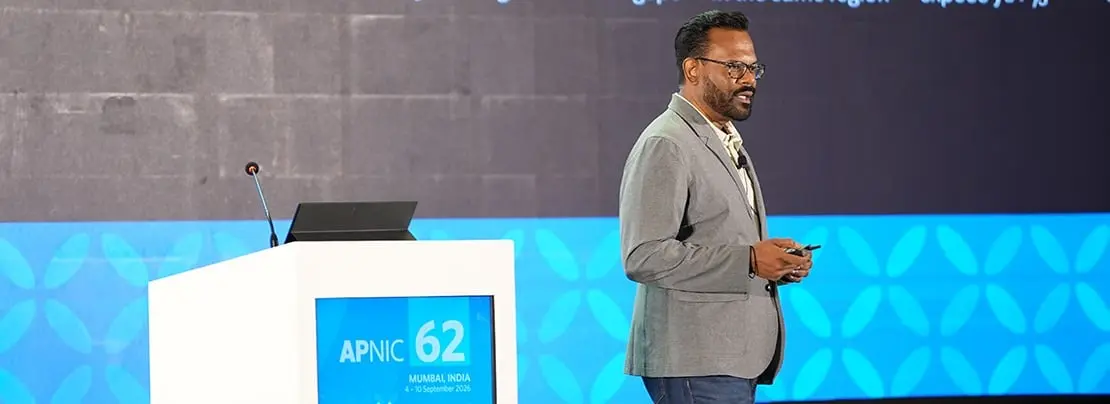
Network operators, researchers, and core Internet infrastructure experts from across the Asia Pacific region gathered in Mumbai, India, for APNIC 62. Running from 4 to 10 September 2026, the regional conference provided a crucial forum for discussing operational experiences, emerging technologies, and enduring challenges in global Internet operations.
Technical Session 1 focused heavily on foundational Internet operations, highlighting critical developments in DHCP and DNS management, the upcoming DNSSEC root Key-Signing Key (KSK) rollover, structural limitations within X.509 certificate revocation frameworks, and the ongoing evolution of Border Gateway Protocol (BGP) security. Industry leaders took the stage to address how network administrators can secure infrastructure against increasingly sophisticated routing vulnerabilities and administrative bottlenecks.
ISC Stork Integrates Management for Kea DHCP and BIND DNS
For decades, the core software developed by the Internet Systems Consortium (ISC)—particularly BIND and DHCP services—has served as the architectural backbone of Internet service delivery worldwide. While ISC is perhaps most widely recognized today for operating the global F-root DNS service, software engineering remains a central pillar of its mission. BIND 9 continues to power authoritative name servers and recursive resolvers across the globe.
During the opening technical session, Marcin Siodelski, Senior Software Engineer at ISC, detailed the evolution of these foundational tools, focusing heavily on Kea DHCP and Stork. With legacy ISC DHCP servers having officially reached end-of-life (EOL) status, Kea DHCP has emerged as its designated successor. Because modern enterprise and carrier-grade DHCP environments are exceptionally complex, ISC developed Stork to streamline administrative workflows.
Stork is a modern graphical management platform designed to integrate seamlessly with BIND 9 and PowerDNS, offering operators a centralized pane of glass to manage core network services. Furthermore, Stork integrates deeply with Prometheus and Grafana, providing robust monitoring, reporting capabilities, custom dashboards, and an intuitive web-based management interface.
DHCP remains an indispensable element of network service delivery, responsible for managing IP address pools, allocating subnets, and maintaining static address and prefix assignments for individual hosts using MAC addresses or client identifiers. Through Kea, network operators can efficiently handle high-availability configurations, failover mechanisms, lease tracking, and log inspections. Siodelski demonstrated these capabilities live, showcasing Grafana integrations, subnet management interfaces, and modern configuration tools.
The integration of BIND 9 into Stork represents a major step forward, enabling operators to oversee complex DNS deployments through a single interface. This visibility bridges operational teams and DNS infrastructure, simplifying tasks such as zone browsing and zone transfer monitoring, including the automated detection of serial number mismatches between primary and secondary servers. While PowerDNS integration remains experimental, it aims to deliver a unified management experience across heterogeneous infrastructure deployments.
Looking ahead, ISC has outlined an aggressive roadmap for Stork throughout 2026 and 2027. Planned features include stale DNS record detection and removal within dynamic DNS environments—a capability that aligns closely with existing DHCP pool management logic. Additional roadmap items feature zone cloning and validation, direct BIND 9 configuration editing, support for DNS catalogue zones, and enhanced BIND 9 log monitoring.
Root Zone KSK Rollover Scheduled for October 2026
Attention soon shifted to global cryptographic trust anchors as Champika Wijayatunga, Technical Engagement Director for the Asia Pacific region at ICANN, took the stage to discuss the impending rollover of the DNSSEC root Key-Signing Key (KSK), officially scheduled for 11 October 2026.
To establish context for the audience, Wijayatunga explained the mechanics of the DNSSEC chain of trust, which underpins the root zone Trust Anchor (TA). Situated at the absolute apex of the DNS hierarchy, the Trust Anchor cannot be cryptographically validated against a higher-level authority. Instead, validating resolvers must be pre-configured with this anchor as a trusted starting point, treating it as a foundational axiom.
The KSK slated for rollover is the public component of a carefully managed public-private key pair. The corresponding private key remains securely stored offline inside hardware security modules (HSMs) housed within highly secure ICANN facilities located on the east and west coasts of the United States. While the private key generates cryptographic signatures over root zone data, the published public key enables recursive resolvers worldwide to verify the authenticity, integrity, and absolute completeness of top-level domain data.
Periodic key rollovers are established as an essential operational best practice within cryptographic infrastructure. These events reduce long-term security risks, limit the potential impact of theoretical key compromise, and allow organizations to introduce stronger cryptographic algorithms and longer key lengths as computing technology evolves. This operational rigor is especially vital given the emergence of quantum computing threats, which could potentially shorten the effective operational lifespan of traditional RSA key pairs.
ICANN executes key management and rollover ceremonies publicly at its secure facilities, with proceedings involving Trusted Community Representatives (TCRs) and live-streamed for global visibility. Under normal operating conditions, root key material is designed to be refreshed every three to four years, though the upcoming rollover follows a previously delayed schedule.
Operators managing DNSSEC-validating resolvers must ensure their systems maintain up-to-date Trust Anchors. While many modern resolver deployments handle this update automatically via RFC 5011 mechanisms, certain legacy or specialized environments may require manual intervention. Wijayatunga strongly urged operators to verify resolver behavior during and after the transition window, noting that verified TAs remain accessible directly from IANA independently of automated protocol updates.
Examining the Structural Failures of X.509 Certificate Revocation
Shifting from DNS security to web transport encryption, Geoff Huston, Chief Scientist at APNIC, delivered a critical examination of the ongoing management challenges associated with X.509 certificates, which provide the cryptographic foundation for authentication and privacy across HTTPS and TLS.
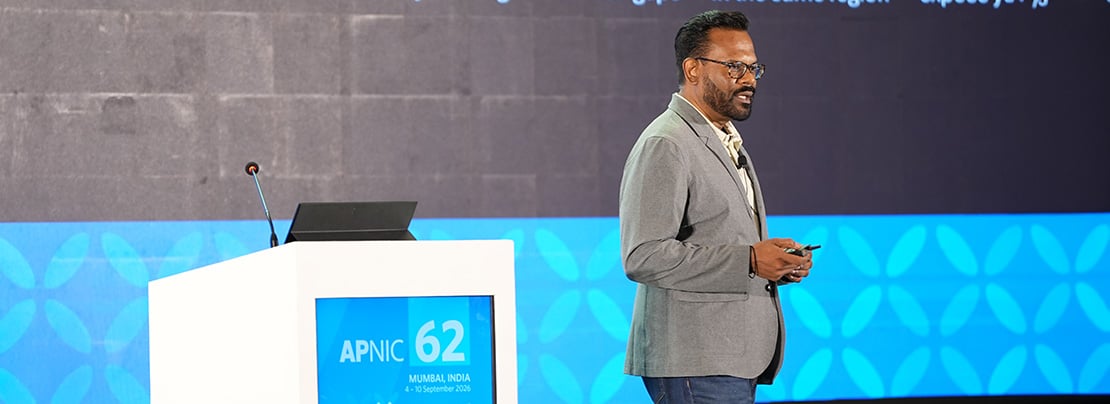
A digital certificate serves as a third-party attestation of identity. The issuing Certificate Authority (CA) functions as a private organization that generates cryptographic credentials based on information supplied by applicants. However, the CA is not inherently the official body responsible for issuing legal business names, domain ownership rights, or other external forms of identity.
Using an unauthorized banking portal as a case study, Huston raised a fundamental operational question: Does certificate revocation actually prevent users from accessing a compromised web site? Reviewing the domain resolution for a major financial institution, he demonstrated that the domain pointed directly to cloud infrastructure hosted by Amazon rather than servers managed internally by the bank. Furthermore, the site utilized a digital certificate issued by DigiCert months prior. Throughout that operational window, numerous security failures could theoretically occur, including CA key compromise, administrative credential theft, or simple configuration mistakes. The core dilemma lies in finding a reliable mechanism to invalidate a certificate the moment such an event takes place.
The traditional mechanism designed for this purpose is the X.509 Certificate Revocation List (CRL), which publishes the serial numbers of certificates that should no longer be trusted. In theory, web browsers fetch the CRL, validate its cryptographic signature, and inspect whether a given certificate appears on the registry. However, Huston noted that practical CRLs often contain tens of thousands of entries and are updated on weekly schedules, making them far too slow and cumbersome to support real-time browser validation.
While the Online Certificate Status Protocol (OCSP), defined in RFC 2560, was created to provide real-time status queries, it introduced significant privacy concerns by exposing user browsing habits to third parties, alongside potential denial-of-service vectors via centralized lookups. Consequently, global deployment has remained highly inconsistent.
Although HTTPS and TLS support OCSP stapling—whereby origin servers supply signed OCSP responses directly during the TLS handshake to improve privacy and reduce latency—a compromised server is unlikely to volunteer evidence that its own certificate has been revoked. Furthermore, browser support has fractured over time. Let’s Encrypt, currently the world’s largest CA, completely discontinued its OCSP service after handling massive traffic volumes, while native browser support for mechanisms like "Must Staple" has effectively vanished. Chrome discontinued reliance on real-time OCSP checking over a decade ago, and Safari employs entirely separate validation pathways.
Testing certificate issuance and revocation cycles under realistic conditions, Huston found that while revoked certificates correctly populated weekly CRL registries, modern browsers such as Chrome and Safari routinely failed to recognize the revocation, with only Firefox flagging the compromised asset. Given the combined market dominance of unflagging browsers, X.509 certificate revocation remains largely ineffective in real-world conditions.
Although the industry has responded by shrinking certificate validity lifetimes—with some CAs issuing credentials valid for as little as six days—Huston argued that even compressed lifespans remain inadequate because security breaches can occur in milliseconds. As an alternative, he proposed leveraging the Domain Name System (DNS) alongside native cache expiration mechanisms. DNS-based Authentication of Named Entities (DANE), paired with DNSSEC, allows cryptographically signed keying material to be published with drastically shorter lifespans, offering a viable path away from the traditional X.509 ecosystem toward an infrastructure capable of responding to threats almost instantaneously.
Addressing the "Good Neighbor" Problem in BGP Security
Concluding the session, Ritesh Mukherjee, Product Management Leader for NOS and AI at Nokia, addressed the critical next stage of Border Gateway Protocol (BGP) security, focusing on the systemic risks posed by routing misconfigurations and malicious hijacks across the global default-free zone.
While Route Origin Validation (ROV) successfully verifies whether an autonomous system is officially authorized to originate a specific route, and Autonomous System Provider Authorization (ASPA) helps validate the structural integrity of AS paths, routing incidents continue to disrupt international traffic. Mukherjee presented several recent case studies illustrating the persistence of these vulnerabilities across the Asia Pacific region.
In one prominent incident, an Indian network operator blackholed Telegram prefixes, an event promptly detected by the RIPE RIS monitoring system as a false route origination. In response, the affected service provider began announcing more-specific prefixes, which the initial network continued to propagate globally. Because these unauthorized announcements extended beyond regional boundaries, overseas networks selected what appeared to be shorter administrative paths, turning a local misconfiguration into a widespread BGP hijack.
Although Internet Routing Registry (IRR) data confirmed the network was never authorized to originate the routes, and ROV would have instantly prevented the wider propagation, regional ROV enforcement remains critically low. Data indicates that only a minority of autonomous systems enforce ROV globally, with adoption levels remaining particularly depressed across parts of South Asia.
A secondary routing incident highlighted how partial deployment creates persistent blind spots. Even when specific route announcements were filtered by intermediate transit providers, traffic was inadvertently diverted through alternative paths that propagated more-specific routes downstream. Although some regional networks had implemented ROV, their dependency on upstream providers that lacked strict filtering compromised overall network resilience. Additional routing anomalies, including massive accidental prefix leaks from regional telecom providers, routinely cause widespread traffic misdirection due to inadequate path filtering and a general absence of strict maximum-prefix controls.
These operational challenges underscore the reality of the "Good Neighbor" problem in routing security—a vulnerability that has impacted networks for nearly two decades. Mitigating these systemic risks requires a comprehensive defense strategy combining strict ROV enforcement, advanced AS path validation, and disciplined administrative policies.
To combat these vulnerabilities, Mukherjee outlined a robust three-part protection model centered on broad industry adoption, strict prefix filtering, and proactive operational monitoring. He placed special emphasis on Nokia’s BGP Routing Security Monitor, known as RAVEN. Available as an open-source tool via Nokia’s GitHub repository, RAVEN is designed to help operators assess their internal routing security exposure and evaluate potential filtering policies before enforcement. Running as a single binary, RAVEN collects routing data via BGP Monitoring Protocol (BMP), integrates seamlessly with Resource Public Key Infrastructure (RPKI) validators such as Routinator, and supports comprehensive administrative auditing through Grafana dashboards, webhooks, and command-line interfaces.
By deploying BMP at the Adj-RIB-In, network operators gain unprecedented visibility into incoming routing behavior, enabling them to identify anomalies early and act as responsible neighbors within the global routing ecosystem. Mukherjee strongly encouraged network administrators to implement rigorous maximum-prefix limits on all external BGP sessions to prevent accidental route leaks from overwhelming core routing engines, while committing to long-term adoption of ASPA, drop-policy ROV configurations, and active participation in Mutually Agreed Norms for Routing Security (MANRS).
Leave a Reply