
Over the past three years, a mounting wave of legal challenges has transformed federal courtrooms into battlegrounds over the intersection of artificial intelligence and copyright law. Authors, journalists, and media organizations have filed a comprehensive series of lawsuits accusing leading AI companies of harvesting pirated books, articles, and copyrighted works without permission or compensation to train their foundational models. While some early cases have yielded mixed legal outcomes—including a bittersweet fair use ruling secured by Meta in California—litigation in New York has taken a sharply contentious turn.
In the U.S. District Court for the Southern District of New York, Judge Sidney Stein is overseeing a consolidated proceeding that bundles several prominent copyright lawsuits against artificial intelligence heavyweights OpenAI and Microsoft. This coordinated docket includes the Authors Guild’s high-profile class action, a pioneering lawsuit filed by a group of nonfiction writers who were the first to name Microsoft as a corporate defendant, and the Tremblay and Silverman lawsuit. The latter case originally commenced in California in 2023, where it successfully survived a partial dismissal before being transferred to New York to proceed alongside related claims.
This legal pressure escalated significantly when the plaintiff authors filed a sweeping motion for summary judgment. Ahead of any formal trial, the writers are asking Judge Stein to issue a decisive ruling that OpenAI copied their copyrighted works without authorization and that this unauthorized utilization cannot qualify under the legal doctrine of fair use. Covering 194 distinct titles, the motion specifically seeks a finding of direct liability rather than an immediate assessment of monetary damages.
In their legal brief, the authors paint a stark picture of the industry’s trajectory. OpenAI’s advanced GPT models pose an existential threat to those who write, publish, and make a living through books, the filing asserts, adding that AI-generated literature of all types is already flooding the market and undercutting human creators.
Built on Mass Piracy

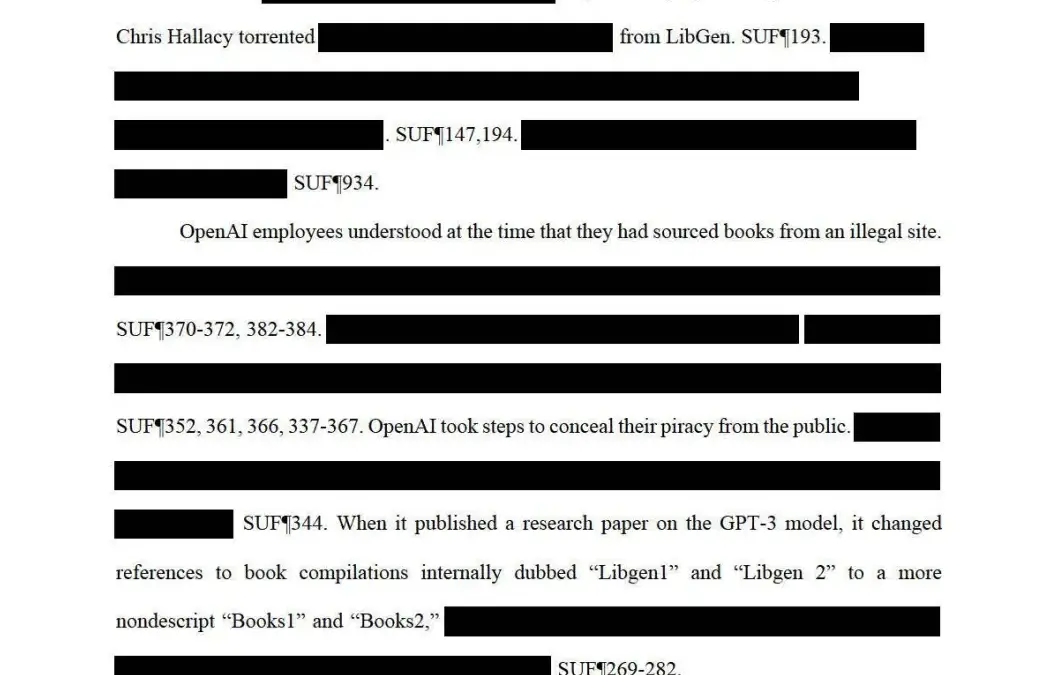
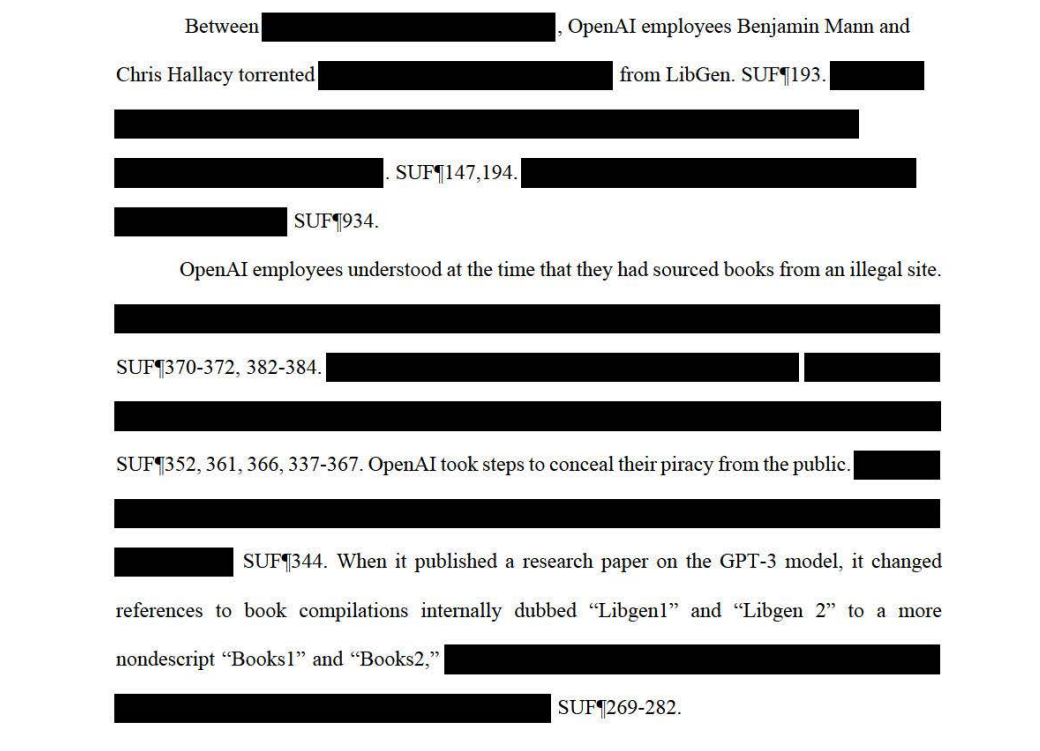
At the core of the authors’ summary judgment motion is a severe accusation: that OpenAI deliberately built the foundational datasets for its commercially lucrative models by obtaining book copies through unauthorized, illicit sources. Although portions of the public court filing remain heavily redacted, the plaintiffs allege that OpenAI utilized torrented copies of digital books downloaded directly from Library Genesis, a notorious online shadow library commonly known as LibGen.
According to the motion, OpenAI did not purchase the books it used for training. Instead, the company began by torrenting books from the illegal pirate repository LibGen. At the time these datasets were compiled, LibGen had already been formally identified and targeted by the Office of the United States Trade Representative in its annual list of notorious global piracy markets. The authors argue that OpenAI was fully cognizant of the controversial and illegal nature of the platform when it sourced the material.
Furthermore, the legal filing contends that OpenAI actively took steps to conceal its reliance on pirated sources from the public eye. As evidence, the authors point to the original academic paper that introduced GPT-3. In that documentation, OpenAI allegedly relabeled book compilations that internal records had previously designated as "Libgen1" and "Libgen 2," changing them to the more nondescript and obfuscated names "Books1" and "Books2."
Internal records and communications cited by the plaintiffs suggest that OpenAI employees understood at the time that they had sourced millions of books from an illegal site. The process of masking the origin of the training data did not stop with a change in nomenclature. The motion notes that OpenAI ultimately deleted its LibGen training files in the summer of 2022 amid growing legal concerns and scrutiny. According to the plaintiffs, these remain the only two training corpora that OpenAI has ever officially deleted from its systems.
Before purging the files, however, OpenAI allegedly relied on them to train its early generative models. The authors summarize this foundational phase by alleging that the artificial intelligence pioneer built the core architecture of its multi-billion-dollar business on a foundation of mass piracy.
Replacing George R.R. Martin

While the mechanics of torrenting and data acquisition form a central pillar of the complaint, the authors’ motion also targets the underlying philosophy of the company. The legal filing alleges that OpenAI deliberately engineered its models to eventually replace the human writers whose works it copied to train them. To substantiate this claim, the plaintiffs highlight a series of controversial public statements and tweets made by a key member of OpenAI’s technical staff.
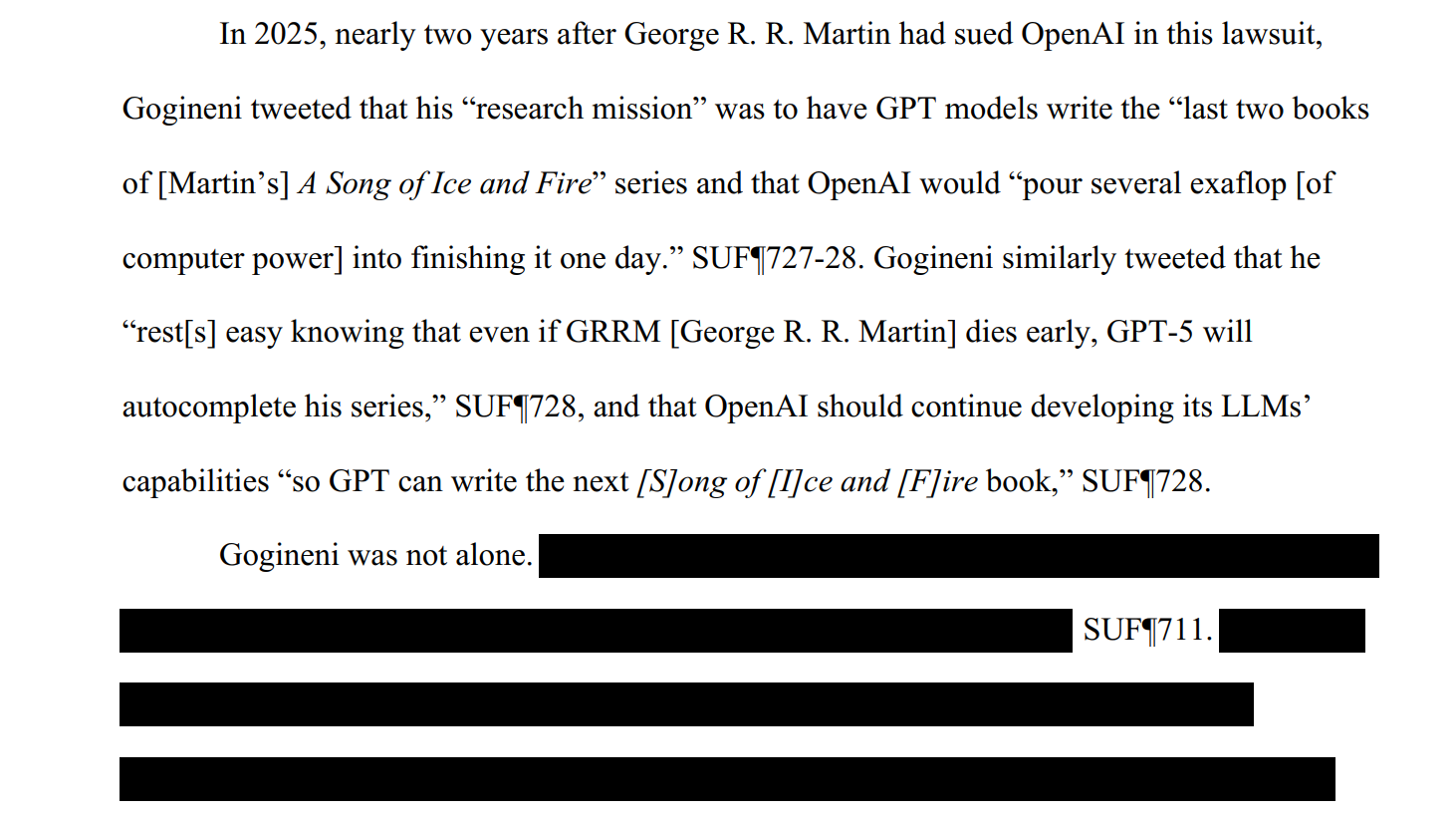
In 2022, OpenAI recruited Tarun Gogineni to lead specialized work focused on improving the creative writing quality and stylistic capabilities of its models. According to the motion, Gogineni was well aware that the advanced models he was training would inevitably displace human authors, a development he reportedly characterized as acceptable economic disruption.
This corporate stance gained heightened significance because Gogineni specifically singled out one of the prominent plaintiffs in the litigation: celebrated author George R.R. Martin, best known for penning the epic fantasy series A Song of Ice and Fire, which served as the basis for the hit HBO television series Game of Thrones. Nearly two years after Martin joined fellow authors in suing the AI firm, Gogineni posted messages on social media stating that his explicit research mission was to train GPT models to write the final two unreleased books of Martin’s iconic series.
Even if Martin dies early, Gogineni reportedly suggested in his posts, future iterations like GPT-5 would be capable of autocompleting his literary series, framing AI as a direct substitute for the human creator.
Not Fair Use
The central legal debate in these copyright actions revolves around the doctrine of fair use. OpenAI and other major generative AI developers have consistently argued that training artificial intelligence models on vast quantities of copyrighted books constitutes transformative fair use under United States copyright law. While federal courts have shown a willingness to entertain aspects of this defense in related proceedings, judges have simultaneously introduced vital caveats regarding the provenance of the training materials.
In their motion, the authors draw attention to the 2025 ruling in Bartz v. Anthropic, a California copyright case that classified certain forms of AI model training as potentially qualifying for fair use. Crucially, however, that same court drew a sharp distinction regarding the acquisition method, emphasizing that downloading materials from an underground pirate library was fundamentally distinct and unacceptable. The court found that pirating books that are readily available for purchase through legitimate legal channels is inherently and irredeemably infringing.
Building on this precedent, the authors argue that the copying of their specific texts was entirely avoidable for general training purposes. They contend that their individual books were never per se necessary or indispensable to the creation of a generalized, multi-purpose language model.
Broader Claims and Corporate Liability
The expansive summary judgment motion is not restricted to OpenAI alone. The plaintiffs are also asking the federal court to hold Microsoft vicariously liable for OpenAI’s alleged copyright infringement. The authors argue that Microsoft possessed the legal right and practical ability to supervise the conduct of its smaller partner and that the technology giant directly profited from the deployment and commercialization of the allegedly infringing models.
To underscore Microsoft’s deep involvement, the legal filing highlights the massive financial backing provided by the company. Microsoft has invested roughly $13 billion into its partnership with OpenAI across three major investment agreements signed in 2019, 2021, and 2023.
While OpenAI has yet to issue a direct public response to the latest specific allegations in the authors’ motion, the company has made its overarching legal stance clear in concurrent court filings. In a cross-motion for summary judgment filed on the same day, OpenAI maintains that its use of copyrighted books qualifies squarely as fair use as a matter of law. Furthermore, the company argues that any instances where its models regurgitate copyrighted text verbatim are vanishingly rare.
The filings submitted by the authors represent just one front in an escalating legal war. Over recent days, other high-profile institutional plaintiffs—including The New York Times, the Daily News, and the Center for Investigative Reporting—submitted a combined summary judgment motion of their own against OpenAI and Microsoft, targeting similar copyright violations related to journalistic content.
With tens of millions of dollars in potential damages at stake, alongside the long-term economic and structural future of AI training practices, these complex lawsuits are being fought aggressively by all parties involved, ensuring that the legal battle over intellectual property in the age of artificial intelligence is far from over.

Leave a Reply