

The consumer data broker Radaris.com has long cultivated a notorious reputation for ignoring requests to remove personal information from its vast empire of online people-search services. That enduring strategy of stonewalling and evasion finally caught up with the company in a New Jersey courtroom, where a judge ordered that radaris.com and more than a dozen other related data broker domains be transferred directly to the plaintiffs. The unprecedented ruling stems from a lawsuit alleging that Radaris violated a strict state privacy law providing for hefty fines against data brokers that publish the personal information of state law enforcement officials.
In February 2024, Radaris was targeted in a lawsuit filed by Atlas Data Privacy Corp, a company that has aggressively pursued data brokers alleged to be violating a New Jersey statute commonly known as Daniel’s Law. Named in honor of a tragic family shooting involving a federal judge, the statute allows state law enforcement officials, government personnel, judges, and their families to have their personal details completely removed from commercial data brokers and people-search services. Furthermore, the legislation provides for statutory damages and fines of $1,000 per violation against companies that willfully ignore valid removal requests.
Less than a month after Atlas initiated legal action, investigative reporting by KrebsOnSecurity published a deep dive into the elusive co-founders of Radaris: Igor and Dmitry Lubarsky, Russian-born brothers residing in Massachusetts who operate a dizzying array of people-search companies alongside a network of Russian-language dating services and affiliate programs.
Attorneys representing the Lubarsky brothers quickly pushed back, threatening to sue for defamation if the investigative story was not immediately retracted and a formal apology issued. Their legal counsel insisted that the reporting was wildly inaccurate and asserted that the true owners of the enterprise were actually Ukrainian nationals living in Ukraine.
However, follow-up reporting doubled down on the initial findings, documenting precisely how the Lubarsky brothers built and operated Radaris and other data broker entities using a fictitious CEO’s name. The subsequent investigation revealed that Radaris’s attorney—a lawyer with the Boston Law Group named Val Gurvits—admitted his clients had invented the CEO pseudonym "Gary Norden." Moreover, the investigation showed that Radaris had issued multiple corporate press releases over the years quoting the entirely fabricated executive while actively seeking capital from potential investors.
Legal representatives for Radaris waited until the absolute last minute to make an appearance in court and contest what seemed to be an inevitable default judgment in favor of the plaintiffs. Once present, they argued that Atlas had failed to properly serve the real owners and operators of Radaris and several of its interconnected sister companies.
To overcome these procedural hurdles, Atlas re-filed the lawsuit in June 2025, dramatically expanding the scope of the litigation to include a much broader network of Radaris family data brokers accused of violating Daniel’s Law. Matt Adkisson, the president and CEO of Atlas, noted that Radaris merely relied on a tried-and-true playbook of dragging out court proceedings until the final possible hour while playing endless shell games regarding the true country of origin and the individuals legally responsible for the sites.
"We refer to this period as their island-hopping phase," Adkisson explained regarding the corporate maneuvering. "Privacy policies changed constantly, and new entities kept appearing from places like the Marshall Islands, the British Virgin Islands, and Seychelles. Behind the scenes, it felt like a shell game. Defense lawyers told the court that certain entities merely operated the domains and were the proper parties to sue. But by the time a judgment neared, those entities would be discarded and new entities would appear. Meanwhile, the lawyers claimed the other entities that actually owned the domains should not be held responsible."
Adkisson noted that when the defendants updated their terms of service to claim that Radaris was suddenly managed by a company in the Marshall Islands, Atlas hired a local investigator in that jurisdiction and quickly discovered that the brand-new entity cited by Radaris did not even exist yet.
Mr. Gurvits had previously stepped forward as Radaris’s attorney in a class-action lawsuit that the company temporarily lost in 2017 because it failed to contest the claims in court. When the plaintiffs in that earlier matter informed the judge that they could not collect on a $7.5 million default judgment, the court ordered the domain registry Verisign to transfer the radaris.com domain name directly to the plaintiffs.
Mr. Gurvits appealed that verdict, arguing that the lawsuit had failed to name the actual owners of the Radaris domain name—a Cyprus-registered company called Bitseller Expert Limited—and that seizing the domain would therefore violate their due process rights. The judge in the 2017 case ultimately ruled in Radaris’s favor, halting the domain transfer and instructing the plaintiffs that they could refile their complaint. Shortly thereafter, the designated operator of Radaris shifted from Bitseller to Andtop Company, an entity formed in the Marshall Islands in October 2020. The plaintiffs in that specific case never re-filed their complaint.
"That seemed to be their modus operandi," said Raj Parikh, a partner at PEM Law in New Jersey who handles the majority of the Daniel’s Law litigation for Atlas. "In the past, they won by attrition. Plaintiffs’ attorneys tired of the procedural games and just gave up. That strategy worked for a decade, and it probably would have worked in this case too, since any financial recovery from foreign actors will be difficult. But we were acutely aware of the threat this website posed to law enforcement officers and other public officials in New Jersey, and decided early on to commit whatever time and resources were necessary to remove that threat."
On August 26, the presiding judge in the New Jersey case concluded that the defendants had been granted multiple opportunities to appear and defend against the claims but had consistently failed to do so. Mr. Gurvits declined to comment on the outcome of the case, stating that the matter had been reassigned to another attorney, Victor Worms. In response to inquiries, Mr. Worms maintained that the New Jersey court improperly transferred Radaris.com to Atlas as part of a default judgment against Radaris.com, which he argued is not a legal entity with the capacity to be sued.
"We have made a motion to vacate that default judgment on the grounds that it is void since a non-entity has no legal capacity to sue or be sued," Worms stated. "We also intend to pursue all appropriate appeals because we believe the transfer of Radaris.com amounts to a forfeiture in violation of various constitutional principles."
Although radaris.com continues to appear prominently in search engine results when individuals look up U.S. residents by name, the domain no longer functions as a marketplace selling detailed personal dossiers on millions of American citizens. Instead, its homepage now displays an official notice from Atlas detailing the court-ordered domain transfer alongside links to previous investigative coverage.
During the course of the litigation, Atlas reportedly gathered more than 10,000 internal emails and corporate documents. According to the plaintiffs, these records substantiate previous investigative findings regarding the true owners and operators behind Radaris and its sprawling network of affiliated companies.
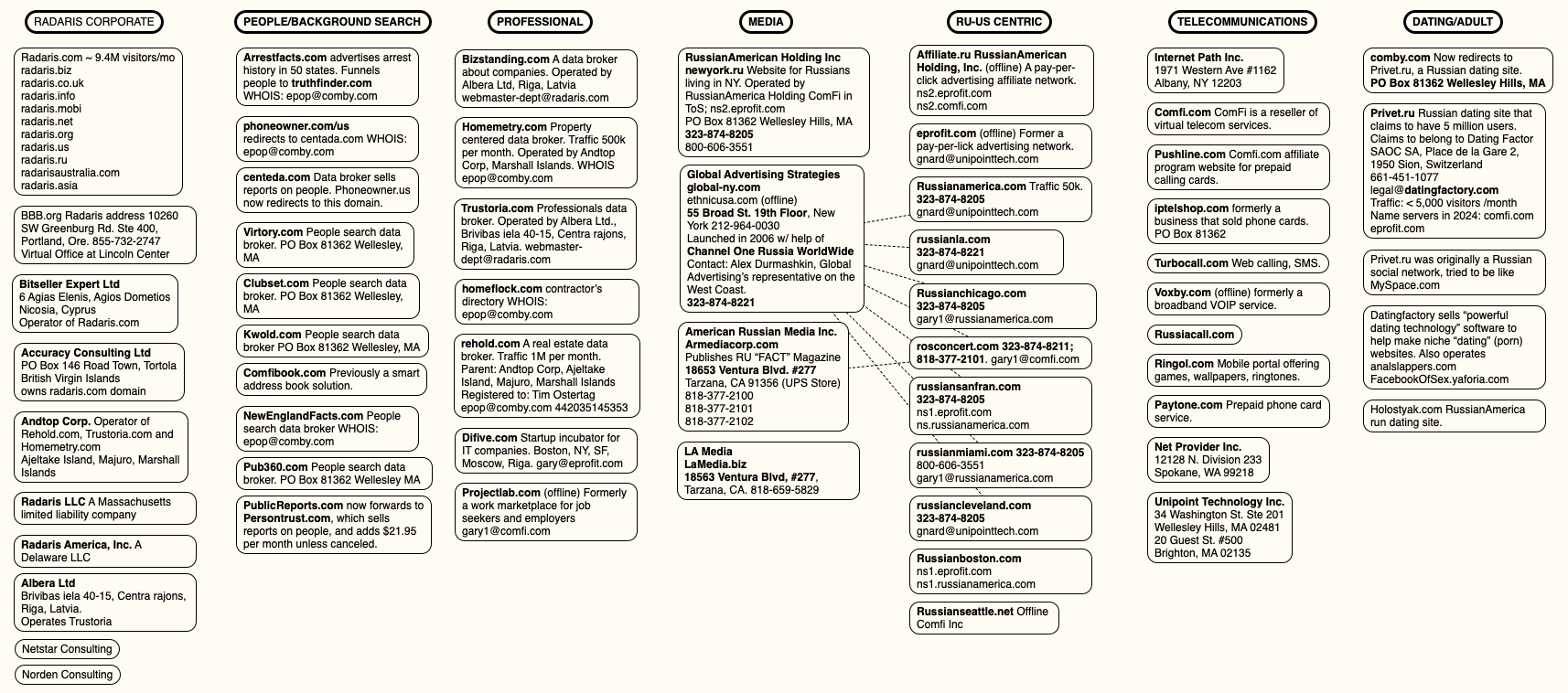
Atlas stated that the emails definitively establish how nominal legal vehicles—including Radaris America, Inc., Bitseller Expert Limited, Digital Orbit Corp, Core Solutions Group Inc, Lucky Solutions Inc, Virtura Corp, Veripages Inc., Nuform Solutions Inc., Growth Data Advisors Inc., and Property Experts, Inc.—are all administered by the same small group of individuals using shared mailboxes, unified banking or payment card arrangements, and a single virtual office address.
"The corpus establishes, with documentary evidence generated independently by banks, payment processors, hosting providers, registrars, software-as-a-service vendors and the operators’ own systems, that radaris.com and at least twenty-five other people-search websites are one operation run by a small Boston-area group whose administrative, financial and technical functions sit on the difive.com mail domain and its successors," reads an internal summary shared by Atlas.
Financial records uncovered in the emails further revealed that Radaris.com generates approximately $42,000 per month, while a sister site, Veripages.com, brings in roughly $45,000 monthly through partnerships with the Lifetime Value Company, a marketing and advertising firm that oversees brands such as PeopleLooker, PeopleSmart, NumberGuru, and the vehicle history platform Bumper.
Additionally, the documents indicated that the Radaris family of websites earns up to $25,000 per month through a partnership with Onerep, a privacy-focused company that markets services to help individuals remove their personal data from people-search directories. Previous investigative reporting revealed that the Belarusian founder of Onerep had launched and operated numerous people-search platforms over the years and continued running sites like Nuwber, effectively profiting from both sides of the data exposure cycle.
In total, the New Jersey court has thus far transferred 14 domain names associated with the Radaris network to Atlas. While radaris.com now redirects entirely to the transfer notification page, the broader enterprise still potentially faces substantial statutory fines for alleged violations of Daniel’s Law.
However, Daniel’s Law itself faces a broader constitutional challenge spearheaded by virtually all of the roughly 150 other consumer data broker firms currently facing lawsuits from Atlas. The data broker industry has successfully maneuvered to have at least 70 of those lawsuits moved to federal court, arguing that the New Jersey statute is overly broad and infringes upon First Amendment protections. While the U.S. Court of Appeals for the Third Circuit has not yet issued a ruling on the constitutional merits, legal observers anticipate that the dispute will ultimately be appealed to the U.S. Supreme Court.
Meanwhile, at least 14 other states have enacted legislation modeled after New Jersey’s Daniel’s Law, with additional state legislatures considering similar measures. At the same time, the legal framework has encountered setbacks; a federal district court ruled West Virginia’s version of Daniel’s Law facially unconstitutional under the First Amendment.
Privacy experts note that people-search companies will likely continue to thrive unless federal lawmakers enact comprehensive consumer data protection legislation tailored to the realities of the digital age. Most existing state privacy laws contain broad exemptions for records categorized as public or government documents, including voting registries, property deeds, marriage licenses, motor vehicle files, criminal histories, court filings, death records, professional licenses, and bankruptcy petitions.
Justin Sherman, a privacy expert and author examining how the data broker industry powers modern surveillance, pointed out that federal lawmakers have long faced intense lobbying pressure from the technology sector against restrictive data privacy laws.
"These days at the federal level, add in the intense amount of lobbying against these laws from social media companies, big tech, cryptocurrency firms, and now AI proponents in the mix who claim that limiting their data scraping is somehow going to collapse the whole U.S. economy under Chinese rule," Sherman said.
Sherman emphasized that without comprehensive federal intervention, people-search platforms will continue to exploit legal loopholes.
"The average person can look at Daniel’s Law and have a perfectly normal reaction, which is that everyone should be covered, not just police and judges," Sherman noted. "But we don’t need more wake-up calls. We’ve had eight million wake-up calls already on the need for better privacy laws. The lack of comprehensive federal privacy law is not for a lack of knowledge, and anyone claiming otherwise is either not reading the news or kidding themselves."


Leave a Reply