
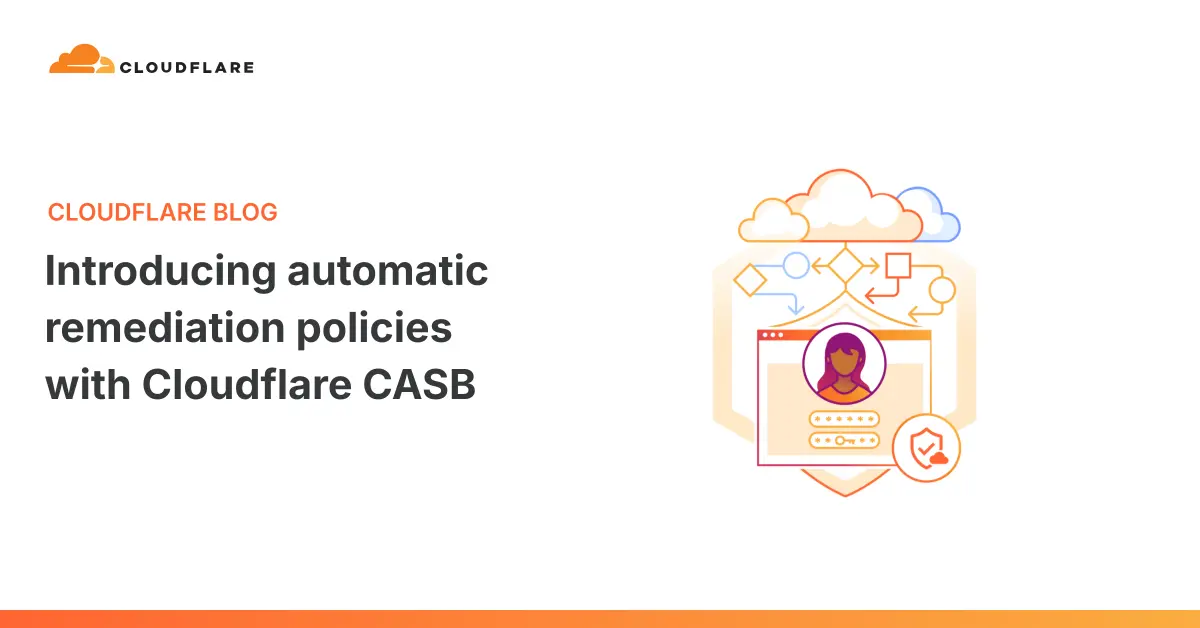
Cloudflare is significantly upgrading its Cloud Access Security Broker (CASB) platform with the rollout of automatic remediation policies. The new capabilities are designed to empower enterprise security teams by introducing event-driven logic capable of automatically revoking risky file shares and dispatching custom webhooks, eliminating the need for manual intervention in routine incident response workflows.
When Cloudflare initially launched its cloud access security broker, the core objective was to grant security organizations comprehensive visibility into the security posture of their software-as-a-service (SaaS) applications before minor misconfigurations escalated into full-scale security incidents. Utilizing a quick, clientless integration, the CASB tool continuously surfaces a variety of hidden risks across organizational users. These risks typically include overshared files, dormant administrator keys and tokens, and OAuth applications possessing excessive, unnecessary permissions.
For years, SaaS Security Posture Management (SSPM) tools, including Cloudflare CASB, have largely operated as passive alarm systems. Most SSPM solutions excel at identifying and highlighting what is broken within a digital environment, but they frequently fail to assist administrators in actually fixing the underlying problems. This dynamic leaves security teams burdened with an ever-expanding to-do list. A single misconfigured file-sharing policy across a major enterprise tenant, such as a Google Workspace environment, can effortlessly generate thousands of individual security findings in a matter of seconds. Even the most disciplined and well-resourced security teams invariably face a frustrating window of time between initial detection and ultimate remediation, which often spans hours or days. In the fast-paced modern threat landscape, that delay provides more than enough time for sensitive corporate data to be unauthorizedly downloaded, forwarded, or indexed.
With the introduction of automatic remediation policies, CASB customers can finally bypass this manual bottleneck. Administrators can now pre-configure specific, automated actions that should be invoked immediately the moment a new security finding is identified by the system.
Shifting from Reactive to Proactive SaaS Security
Earlier this year, Cloudflare introduced manual remediation actions, giving security teams the ability to resolve detected misconfigurations directly from the central Cloudflare dashboard. While this step successfully eliminated the tedious requirement for administrators to log into multiple disparate SaaS administration portals just to address security and content findings flagged by Cloudflare CASB, it still possessed a notable limitation. Every single remediation action required a human being to manually review, confirm, and initiate it, even if security personnel had encountered that exact same finding type hundreds of times before.
CASB policies now change this paradigm by functioning as a native automation engine built directly into the Cloudflare One ecosystem. The engine takes decisive action the exact microsecond a finding is detected. Security teams can define their overarching response logic once, whether that involves immediately revoking access to a compromised file share, dispatching a webhook to an internal security operations center (SOC), or forwarding the event directly to a security orchestration, automation, and response (SOAR) platform. The automation engine handles subsequent matches automatically by flawlessly executing the customer-configured action without requiring further human oversight.
Consider a common scenario faced by enterprise IT departments: many organizations implement strict security controls that prohibit corporate files from being shared publicly. However, businesses frequently must apply necessary policy exceptions for users and groups within their marketing or communications departments, who routinely need to collaborate seamlessly with external parties, vendors, and agencies. Traditional SSPM solutions allow customers to be alerted whenever files are shared publicly in a manner that violates baseline policy. Yet, under many legacy solutions, this permitted behavior simply lands in a massive operational queue alongside hundreds of other potential violations, forcing overworked administrators to manually evaluate and take action on every single individual instance.
CASB policies are architected specifically to solve this exact operational friction. Rather than waiting idly for a human security analyst to notice and manually act upon a finding, automation fires the very moment detection occurs. The unauthorized public share is revoked within minutes, keeping the organization’s finding backlog exceptionally clean and manageable.
How CASB Policies Work Under the Hood
At their foundational core, CASB policies are sophisticated automated workflows designed to instruct Cloudflare’s continuous scanning service on precisely what action to take the moment a new security finding is registered. From there, the user-configured policy commands the CASB engine to either trigger a direct remediation action, dispatch a targeted webhook, or execute both simultaneously. This architectural flexibility grants organizations the freedom to rely entirely upon native CASB remediation capabilities or integrate seamlessly with their own internal automation services and communication channels, all without needing to build a custom event processing system or juggle disparate management platforms.

The underlying architecture powering CASB policies is built entirely on Cloudflare’s robust developer platform—the exact same infrastructure and toolset available to every developer on the network. When a security finding is detected by the scanning engine, the system enqueues an orchestration message directly to a Cloudflare Queue. A dedicated Worker consumer subsequently checks whether a defined policy configuration matches the incoming finding. If a valid match is confirmed, the Worker creates the corresponding job and hands it over to the core remediations pipeline, which runs natively on Cloudflare Workflows to ensure durable, fault-tolerant execution. This design guarantees that jobs survive process restarts and that necessary retries are handled automatically by the system.
Furthermore, Cloudflare Workflows handle third-party API rate limits with high reliability. If an external SaaS vendor returns a rate limit error during an automated remediation attempt, the Workflow pauses intelligently for the appropriate backoff window before retrying the operation, ensuring that jobs are never carelessly dropped or lost. Cloudflare’s internal performance targets aim to drive the duration from initial detection to completed remediation down to five minutes or less.
Maintaining Comprehensive Visibility and Compliance
Transparency and auditability are critical components of enterprise security architecture. To that end, each policy action executed by the CASB engine produces two distinct categories of logs, which are readily visible under the Insights section within the Cloudflare One dashboard.
The first category consists of Admin Activity logs. These detailed logs capture any modifications made to a policy definition, recording crucial accountability data such as who created a policy, who edited it, who disabled it, and the exact timestamp of the action. In the event that a policy is temporarily turned off and a security risk inadvertently slips through the cracks, this comprehensive audit trail surfaces a clear, chronological timeline of the event.
The second category comprises Cloud and SaaS Security policies logs. This new class of logs captures the runtime outcome of policy invocations. It includes granular details such as which specific finding triggered the policy, which asset or file was acted upon, whether the execution succeeded or failed, and the precise error message if the operation encountered an obstacle—such as a 401 Unauthorized status code or an API rate limit response from the third-party SaaS vendor.
For organizations navigating strict regulatory and compliance use cases, the execution log serves as definitive proof of remediation. It neatly ties a specific finding, such as an overshared financial spreadsheet, directly to a specific automated administrative action and an immutable event timestamp.
Getting Started and Looking Ahead
Enterprise customers can find the new CASB Policies interface located within the Cloud & SaaS findings section of the Cloudflare dashboard. To begin utilizing automatic remediation, administrators simply need to connect or update their Microsoft 365 or Google Workspace integrations to support Read-Write permissions, allowing them to draft and activate their first automated remediation policies.
In the coming weeks, Cloudflare plans to expand the platform further by adding robust support for Custom Findings within CASB. Because different organizations maintain unique regulatory environments and specialized needs when it comes to threat detection, this upcoming feature will provide customers with the ability to augment or custom-define their own finding logic to perfectly fit their operational requirements.
Organizations new to the Cloudflare One ecosystem can sign up for free introductory seats to explore CASB capabilities, or consult directly with Cloudflare’s enterprise deployment teams regarding large-scale implementations. Complete setup instructions and technical documentation remain available through Cloudflare’s developer documentation portal.


Leave a Reply