
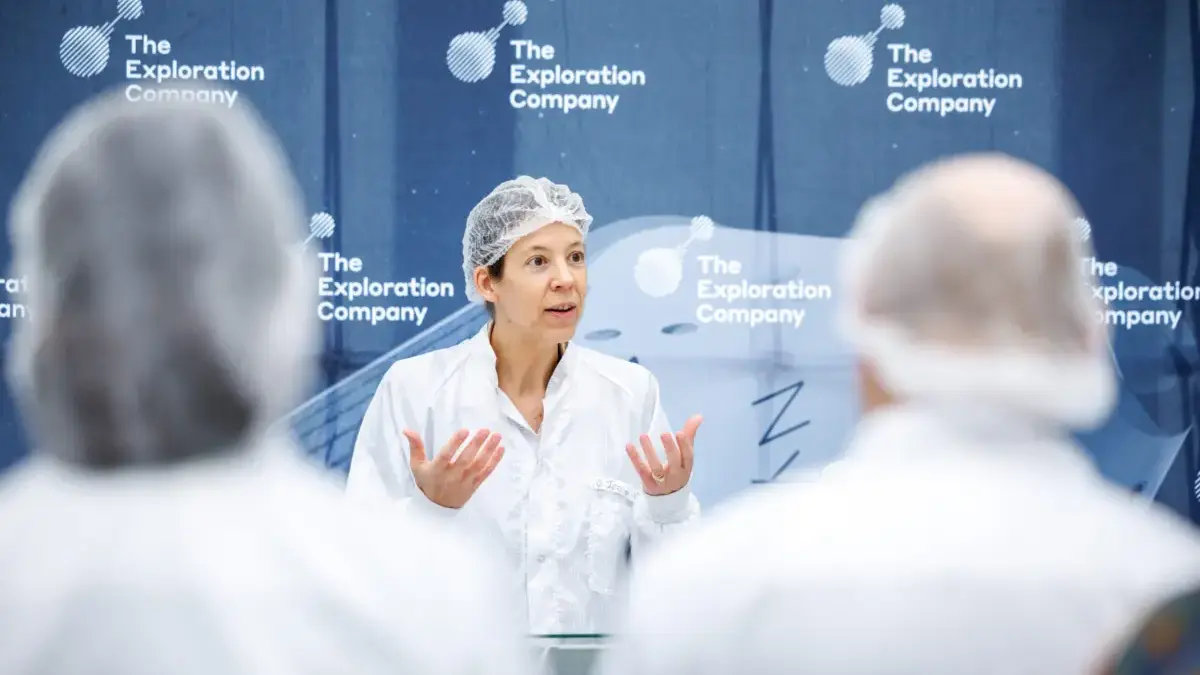
The queue to send objects into orbit is growing rapidly, but global space infrastructure is failing to keep pace with soaring demand. As the realization steadily takes hold across governments and industries that Elon Musk’s SpaceX cannot remain the sole answer to humanity’s access to space, alternative aerospace companies are raising their hands—and securing unprecedented amounts of venture capital.
Leading this charge is The Exploration Company (TEC), a multi-national aerospace startup operating out of Germany, France, Luxembourg, Spain, and Italy. The company has officially announced a massive $450 million Series C funding round, which it describes as the largest-ever Series C financing secured by a European space company. Yet, the race for orbital dominance is fiercely global. U.S.-based rival Stoke Space is concurrently raising a staggering $1 billion Series E round to rival SpaceX in the critical domain of rocket reusability.
Rivalry aside, these colossal funding rounds demonstrate that investors on both sides of the Atlantic are increasingly willing to back ambitious enterprises seeking to build reusable spacecraft. This is a technology category originally pioneered by SpaceX, but one that a growing number of public and private players now believe should not remain under a single company’s exclusive control as space gains immense strategic and economic importance.
These sovereignty-related concerns create powerful extra tailwinds for an enterprise headquartered in the European Union. Led by Chief Executive Hélène Huby, a French national who spent two decades working within established aerospace giants Airbus and ArianeGroup, TEC intends to channel its newly acquired capital into laying the groundwork for a reusable European heavy-lift launcher. This vehicle aims to offer an affordable, sovereign alternative to SpaceX’s dominant fleet.
SpaceX itself may soon find it has little choice but to loosen its nascent monopoly on low-Earth-orbit launches as it prioritizes its own massive payload requirements. Industry reports indicate that SpaceX’s Falcon rockets are already increasingly reserved for launching the company’s own Starlink satellite constellation. This strategic shift comes amid mounting uncertainty regarding what will happen when these workhorse Falcon rockets are eventually retired in favor of the much larger, next-generation Starship system.
This corporate evolution creates a deficit of launch capacity—demand that TEC acknowledges it will not be able to fully meet for years, even if the startup strictly adheres to its own self-admittedly ambitious development timeline. According to venture capital firm Atomico, TEC has already booked 10 distinct missions for its flagship spacecraft, accumulating more than $2 billion in total contracts and preliminary commitments.
A portion of these commercial and institutional commitments stem from prominent partners, including the European Space Agency (ESA) as well as NASA. Meanwhile, TEC’s landmark Series C financing was a decidedly transatlantic affair. Atomico and the EQT-managed Scaleup Europe Fund co-led the financing round alongside U.S.-based Bessemer Venture Partners, whose partner Alex Ferrara is set to join The Exploration Company’s board of directors.
This latest round further consolidates TEC’s status as an enterprise primarily funded by private venture capital, operating with a pragmatic financial strategy tailored to market realities. During a press conference, Huby noted that while she would personally love to see Europe incorporate human space flight prominently into its long-term roadmap, convincing venture capitalists to spend $4 billion developing a crewed capsule and then wait a decade for returns is simply unfeasible in the current financial climate.
Consequently, TEC’s operational timeline is significantly more pragmatic, though extraordinarily tight. Its most immediate technical focus centers on Nyx, a reusable orbital capsule akin to SpaceX’s Dragon spacecraft, capable of initially carrying cargo before eventually transporting human crews. The company aims to successfully pilot Nyx to dock with the International Space Station—which is slated for retirement—and return safely back to Earth by November 2028.
According to Huby, the fresh capital from the Series C round will also stretch to fund Storm, an advanced rocket engine development program designed to pave the way for subsequent heavy-lift vehicle developments. "Where we need more money is to build a launch pad, and to build the rocket itself," Huby explained to journalists during the briefing.
TEC will not be the first European commercial space company to reach orbit. German startup Isar Aerospace recently crossed that historic milestone with a successful launch from Norway. Huby enthusiastically praised the technical feat as "great news for the whole ecosystem," but noted that TEC ultimately intends to construct a significantly larger rocket than Isar’s expandable Spectrum vehicle.
However, Isar also harbors plans for a much larger launch vehicle within its own corporate roadmap, as Ars Technica recently reported. This ambition is presumably driven by the exact market pressures Huby highlighted: the exponential growth of the orbital economy. "In the next five to 10 years, half of our broadband communication could come from space, data centers could be in space; […] and if this is the case, we need massive rockets and cadence," she emphasized.
Achieving that required launch cadence will heavily rely on full rocket reusability. TEC plans to achieve this by adopting the same advanced technology utilized by SpaceX and Stoke Space: full-flow staged combustion. "It’s the most difficult, but also the most efficient engine cycle in the world. It is the first time ever in Europe that a company develops such a rocket engine," Huby stated.
TEC’s rapid technological advances have not gone unnoticed at the highest political levels in Europe. French President Emmanuel Macron and European Commission President Ursula von der Leyen both publicly praised the startup’s historic Series C achievement. Furthermore, the funding disclosure was strategically timed on the eve of the International Space Summit in Paris, where Huby hinted additional major sector announcements would follow.



Leave a Reply