
There has never truly been a video game release quite like Grand Theft Auto VI. Long before its launch, Rockstar Games’ upcoming blockbuster has entirely warped the release schedule of the modern gaming industry, creating a massive vacuum that nearly every major publisher and developer has desperately scrambled to avoid. The prevailing sentiment across the commercial gaming landscape is simple: everybody is afraid of going up against Grand Theft Auto VI.
Everybody, that is, except for Nintendo.
The Kyoto-based gaming giant recently made its characteristic refusal to bend to industry trends abundantly clear during a dedicated, 30-minute broadcast entirely focused on its flagship The Legend of Zelda franchise, which is currently celebrating its monumental 40th anniversary. The showcase offered fans a flurry of exciting announcements, including the official title for the upcoming live-action cinematic adaptation, an extensive global series of orchestral concerts to celebrate the series’ history, and a striking, glittery special edition of the upcoming Switch 2 hardware.
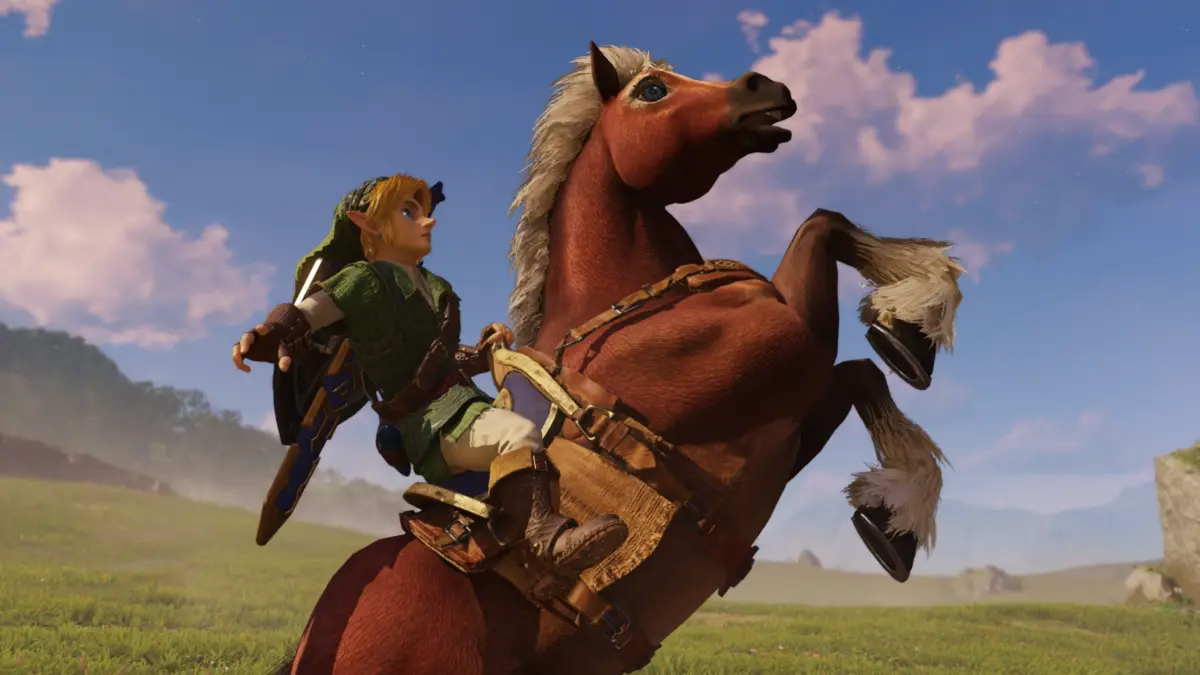
However, the vast majority of the presentation’s runtime was dedicated to a major upcoming release for the new console: a full remake of the iconic Nintendo 64 classic, The Legend of Zelda: Ocarina of Time. The broadcast treated viewers to an all-new trailer and a lengthy gameplay deep-dive demonstrating how Nintendo is modernizing the beloved title. The reimagined classic will feature significantly more realistic graphics and modernized mechanical features, most notably the inclusion of a fully controllable free camera. But perhaps the most culturally seismic detail to emerge from the showcase was not the technical upgrades or the anniversary fanfare—it was the launch date. Nintendo announced that the Ocarina of Time remake will officially hit the Switch 2 on November 5th.
For context, Grand Theft Auto VI is currently scheduled to launch on November 19th. That singular date has caused a profound and unprecedented shift across the global video game release calendar. Virtually every major third-party publisher has spent the past year preemptively adjusting their strategies, either drastically delaying their tentpole projects or rushing their release windows forward to escape the gravitational pull of Rockstar’s upcoming masterpiece.
The traditional autumn release window has been turned entirely on its head. September has barely begun, yet the market has already been flooded with a dense cluster of high-profile launches, including titles like Star Wars Zero Company, The Blood of Dawnwalker, and Onimusha: Way of the Sword. Meanwhile, other heavyweight releases such as Marvel’s Wolverine, Control Resonant, and a heavily anticipated, fully remastered edition of The Witcher 3: Wild Hunt have been jammed into the remaining weeks of the month just to clear the runway for late autumn.
This environment bears a striking resemblance to the market chaos witnessed last year during the surprise indie launch of Hollow Knight: Silksong, which similarly forced smaller independent developers to scatter and adjust their schedules to avoid being entirely overshadowed. Yet Grand Theft Auto VI exists on an entirely different scale of commercial dominance. With only a few exceptions—including a pair of exceptionally brave independent titles—the broader publishing industry has collectively decided that surviving a chaotic September scrum is far preferable to standing in the direct path of GTA VI later in the year. In fact, when looking across the entire industry pipeline, Nintendo’s Ocarina of Time remake stands as the solitary major non-port release currently slated for the month of November outside of Rockstar’s juggernaut.

Upon closer inspection, it is hardly surprising that Nintendo remains unfazed by the prospect of competing against Grand Theft Auto VI. In practical terms, the two games are not even competing directly on the same hardware battleground; Ocarina of Time will launch as an exclusive for the Nintendo Switch 2, whereas Grand Theft Auto VI is targeting traditional home consoles like the PlayStation 5 and Xbox Series X/S.
Yet the friction goes much deeper than hardware compatibility. Zelda and GTA will inevitably find themselves competing fiercely for cultural mindshare—a vital commodity that both Nintendo and Rockstar have spent decades mastering. Intriguingly, both corporate entities have achieved this supreme market position by employing a remarkably similar philosophy: largely ignoring what the rest of the interactive entertainment industry is doing.
For Rockstar Games, the staggering, historic financial success of Grand Theft Auto V provided the studio with an unprecedented level of creative autonomy, financial security, and time. The decade-plus gap between mainline Grand Theft Auto releases has cultivated a level of public anticipation and cultural hype arguably unseen in any other medium of modern entertainment. This unique position has allowed the franchise to exist almost entirely within its own isolated universe, where Rockstar can flout traditional marketing conventions and execute unprecedented strategies—such as dropping a comprehensive, feature-length gameplay overview directly onto Netflix.
Nintendo operates from a very similar playbook, consistently following its own internal creative compass rather than chasing fleeting industry trends. While this philosophy has occasionally resulted in high-profile missteps—most notably the commercial struggles of the Wii U—over the past decade, Nintendo has successfully distanced itself from direct competitors like Sony and Microsoft by pioneering an entirely distinct path with its hybrid hardware ecosystem. Instead of following prevailing industry trends, Nintendo now frequently initiates them. The explosive rise of modern handheld gaming PCs, ranging from the Valve Steam Deck to specialized accessories like the PlayStation Portal, can be traced directly back to the precedent set by the original Switch. Industry analysts even speculate that future hardware, such as a potential portable PlayStation 6, may owe its conceptual existence to Nintendo’s market disruption.
A stark illustration of Nintendo’s stubborn detachment from traditional industry pacing occurred back in November 2020. During the exact same week that Sony and Microsoft launched the PlayStation 5 and Xbox Series X to usher in a new era of high-fidelity, high-performance console gaming, Nintendo charted its own completely independent course by releasing the Game & Watch: Super Mario Bros., a retro-styled handheld device that played classic 8-bit software and doubled as a digital clock. It would be difficult to imagine a product further removed from the cutting edge of next-generation hardware discourse.
The modern incarnation of Nintendo is an enterprise that frequently plays things safe, largely avoiding aggressive financial risks in favor of reliable, mass-market family entertainment. At the same time, however, the company operates with an extraordinary degree of corporate self-assurance—a trait currently lacking across much of the contemporary game industry, where executives tremble at the mere mention of Rockstar’s calendar dominance. While the next Grand Theft Auto possesses the unprecedented ability to warp the global video game release calendar to its whim, Nintendo and its legendary Zelda franchise maintain enough cultural capital and independent pull to simply look the other way and chart their own course.

Leave a Reply